A CCJ You Never Saw Is Already Damaging Your Credit
You applied for a mortgage, a tenancy, or a business credit line — and got refused. The reason: a County Court Judgment registered against your name. A claim was filed, court papers were sent somewhere (maybe your old address, maybe a doorstep you never checked), and when nobody responded, the court entered a default judgment. Now it sits on the Register of Judgments, visible to every lender and landlord for six years.
You did not ignore the claim. You never received it. But the court does not know that — and neither does your credit file.
The CCJ Set-Aside Application System
This guide is a complete application system for setting aside a default County Court Judgment under CPR Part 13 — the rules that let you reopen a case when you had no real chance to respond. It turns a scattered, stressful process into a clear sequence: work out which legal ground applies, fill in Form N244 correctly, build a witness statement the judge can follow, gather the right evidence, file everything with CNBC, and prepare for the hearing.
It is not legal advice and it does not predict what a judge will decide. It covers the procedure — every form, every fee, every deadline — so you can present your application properly without paying a solicitor £500 to £1,200 to do it for you.
What's Inside
- Set-Aside Decision Flowchart — a one-page printable that walks CPR 13.2 (mandatory, defective service) versus CPR 13.3 (discretionary, real prospect of defence plus promptness), the 30-day N443 cancellation route, and the £0 / £126 / £321 fee split so you pick the right route before you start Form N244.
- Form N244 field-by-field walkthrough — what to write in each section, which boxes to tick, and how to phrase your order request so CNBC accepts and processes it without sending it back.
- Witness Statement Structure Worksheet — a fill-in sheet for the six-part chronological narrative the judge expects. When did you move? When was the claim issued? When did you first learn about the judgment? You write the facts, then type them into numbered paragraphs with a Statement of Truth.
- Document and Evidence Inventory Checklist — which documents to collect (postal redirections, tenancy agreements, utility bills, bank statements, address change records) and how to number them as exhibits with cover sheets that the witness statement references.
- Chronological Event and Service Log — a dated landscape log from claim issue through deemed service, judgment, discovery, and filing, so your promptness narrative is written from a record rather than from memory.
- CNBC Filing and Receipt Tracker — what you sent, when, by which method, and the confirmation reference, including Help with Fees and service of the application on the claimant.
- Court fee and Help with Fees guide — the difference between the £321 unconsented application fee and the £126 consented fee, when each applies, and a step-by-step walkthrough of Form EX160 for low-income applicants who qualify for full or partial fee remission.
- Stay of execution request — if bailiffs or enforcement officers have already made contact, the guide shows how to include an urgent stay request in your N244 application to pause enforcement while the set-aside is decided.
- Hearing Preparation Checklist — bundle contents, the 3-clear-day service rule (CPR 23.7), venue or CVP details, and one-line answers to the four questions the District Judge will ask.
- Post-order steps — once the judgment is set aside, you need to file a Defence on Form N9B within the court's deadline. The guide covers the transition from applicant to defendant, getting the CCJ entry removed from the Register, and notifying credit reference agencies.
Who It's For
This guide is for anyone in England or Wales who has discovered a default County Court Judgment entered against them in an ordinary money dispute — a contractor claim, a landlord-tenant deposit or arrears dispute, a private sale disagreement, or a small business invoice. The four most common situations:
- Mortgage or tenancy refusal — you found out about the CCJ when a credit check failed, and you need to clear it to move forward.
- Forwarded post from an old address — court papers arrived at a property you left months or years ago, and judgment was entered before anything reached you.
- Bailiff or enforcement contact — you received a letter or visit from County Court bailiffs or High Court enforcement officers about a judgment you did not know existed.
- Business credit limit cut — your company's credit was reduced or a bank account was frozen because of a CCJ against your business or you personally as a sole trader.
Not for consumer credit debt. If the judgment was brought by a lender, debt buyer, or collection agency (Lowell, Cabot, PRA Group, Intrum), free regulated debt advice from StepChange or National Debtline is the right first step — this guide covers trade and private disputes, not consumer debt collection.
Why Not Just Use Free Resources?
GOV.UK publishes Form N244 and the fee schedule. Citizens Advice explains what a CCJ is. AdviceNow describes interim applications. These are all helpful — but none of them tell you how to actually build your application.
The court form does not explain what to write in the "grounds of application" box. GOV.UK does not offer a witness statement structure. Court staff at CNBC are legally prohibited from reviewing your draft or telling you whether your evidence is organised properly. Free legal advice clinics have long waiting lists — and the "promptness" test under CPR 13.3 runs while you wait.
This guide fills the gap between free court forms and a solicitor. It puts every form, every fee, every deadline, and every document requirement into a single sequence you can work through at your own pace.
Satisfaction Guarantee
The guide comes with a full refund, no time limit. If it does not help your situation, email [email protected] for a complete refund — no forms, no questions.
The refund covers the guide purchase price only. Official HMCTS court fees (£321 or £126) are paid directly to the court and are entirely separate.
Get Started
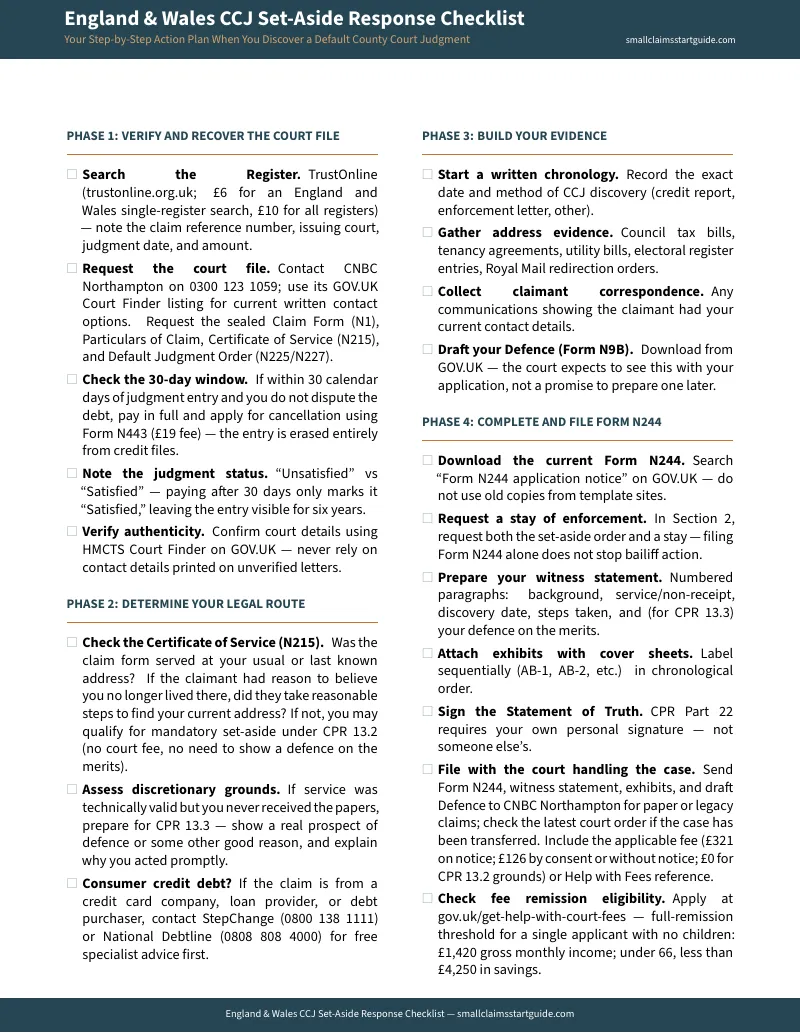
Download the free England & Wales CCJ Set-Aside Response Checklist to see the full application sequence at a glance — 25 items across two pages covering every deadline, form, and document. When you are ready for the complete walkthrough, the full guide plus six fillable worksheets give you the field-by-field instructions, witness statement structure, evidence inventory, and hearing preparation you need to file a proper application.