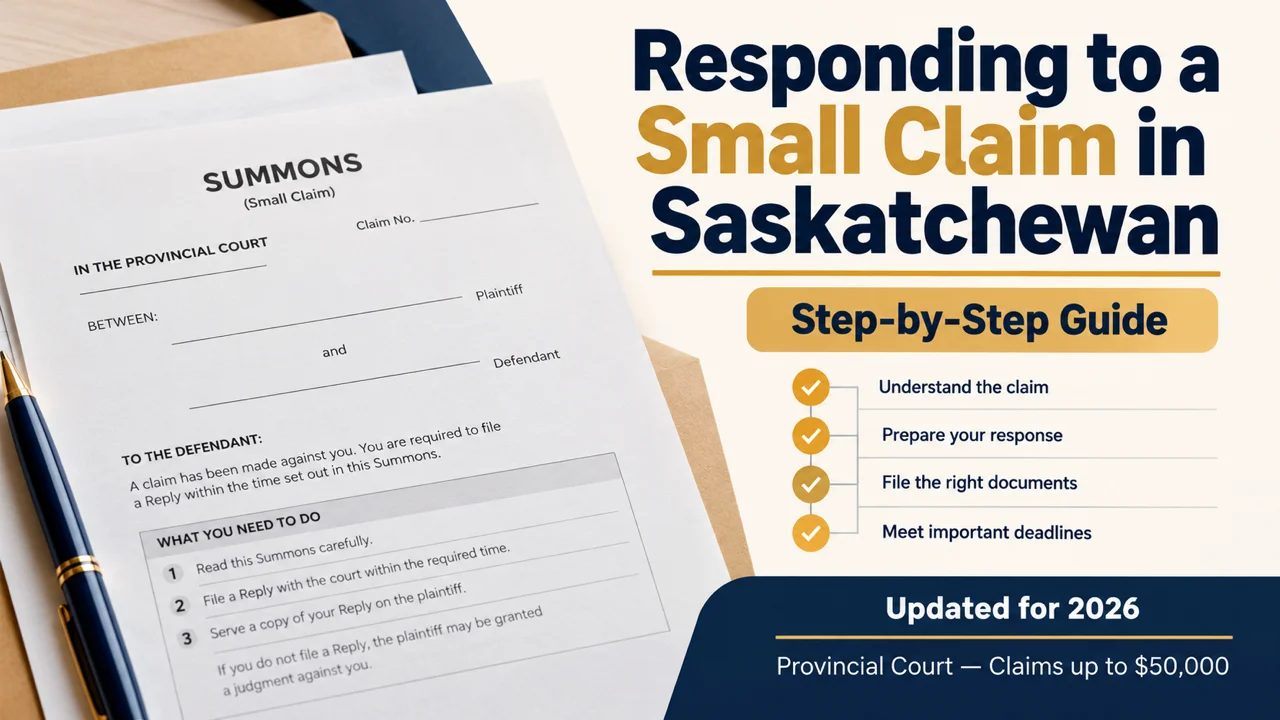
You have been served with a small claims summons. The clock is already running.
Someone has filed a claim against you in the Provincial Court of Saskatchewan. The papers look official and intimidating. You are not sure what the Form A Summons means, what the appearance date requires, or what happens if you do nothing. What you do know is that you have a deadline — and the consequences of missing it are severe.
You could call the court registry, but clerks are legally prohibited from giving legal advice, helping you draft your Reply, or telling you whether to dispute, admit, or counterclaim. You could hire a lawyer at C$250 to C$450 an hour — for a claim that might be worth C$5,000. Or you could search government websites, Reddit threads, and law firm blogs, hoping to assemble the procedure yourself before the 10-day window closes.
The Saskatchewan Defence Response System: every step from summons to hearing, in one place
The Responding to a Small Claim in Saskatchewan guide is a chronological response system that takes you from "what do these court papers mean?" to "what do I say to the judge?" — in the exact order you need to follow. Not a collection of government fact sheets. Not a summary of legislation. A complete procedural workflow with every form reference, fee, deadline, and preparation tool in its proper place.
The difference between this guide and free court websites is structure. The Law Courts of Saskatchewan, PLEA, and law firm blogs all publish pieces of the information you need — scattered across separate sites, in legislative order rather than chronological order, and without the practical tools a first-time defendant actually needs. The guide reorganizes those same authoritative rules into a workflow you can follow without a law degree.
What you get
- Court papers decoder — a breakdown of every document in your packet: the Form A Summons, the Statement of Claim particulars, and the blank Form B Reply. You will know what each section means, what the appearance date actually requires, and how to verify the lawsuit is real by contacting the correct court registry.
- 10-day deadline calculator — the exact method for counting clear calendar days back from your appearance date, with worked examples showing how weekends, holidays, and mail delivery windows affect your cutoff. The single most consequential date in your case, calculated step by step.
- Response option decision trees — a structured walkthrough of your four options: dispute the claim entirely, admit the claim and propose a payment plan, settle before the hearing, or file a counterclaim against the plaintiff. Each option explains the procedural steps, the required forms, and the fees involved (C$50 for Form B; an additional C$50 for a counterclaim).
- Form B Reply walkthrough — how to complete the Reply by Defendant paragraph by paragraph, what to include in your defence, and what the court expects in each section. The guide covers the filing fee, acceptable payment methods, and the difference between filing and serving.
- Service tracking log — the rules for serving your Reply on the plaintiff by personal delivery or registered mail, how the Affidavit of Service works, and a printable tracking log for recording service dates and Canada Post signature receipts. Filing your Reply at the registry is only half the job — the plaintiff must receive a copy within the same 10-day window.
- Evidence binder organizer — how to turn disorganized text messages, invoices, photos, and receipts into a numbered exhibit binder indexed to the issues in your defence. Judges decide based on what you can show them, and clear organization is the single biggest advantage a self-represented defendant can bring to a hearing.
- Hearing preparation guide — what to expect at the Case Management Conference and the trial, how to present your evidence to the judge, court decorum rules, what happens if the plaintiff does not show up, and how a settlement conference works.
- Post-judgment options — what a judgment means, the 30-day appeal window to the Court of King's Bench, the C$100 appeal filing fee, transcript costs, and the process for requesting an instalment payment order if you are ordered to pay.
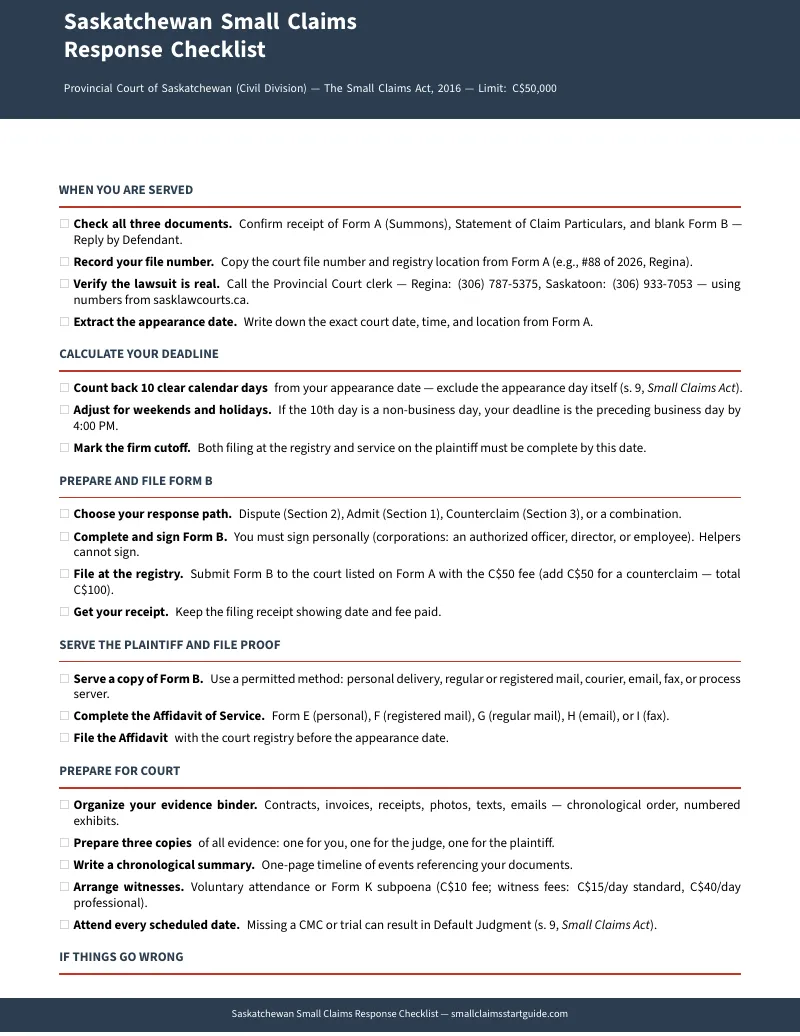
Plus: the Saskatchewan Small Claims Response Checklist
Every deadline, document, and decision point on one page, in the order you need them — from reading the summons through the hearing and beyond. Print it, pin it above your desk, and check items off as you go. The checklist comes free with the guide or as a standalone download. The paid kit also includes the Deadline Calculation Worksheet, the Response Option Decision Tree, the Reply Filing and Service Tracker, the Evidence Index Template, the Hearing Preparation Checklist, the Settlement Calculation Worksheet, and the Post-Judgment Action Map.
Who this is for
- A homeowner served by a contractor or tradesperson over a disputed renovation bill
- A former landlord or tenant served over property damage or unpaid rent — where the matter has been filed in Provincial Court rather than the Office of Residential Tenancies
- A small business owner or sole trader served by a customer or supplier over a commercial dispute
- A private vehicle seller or buyer served over a sale that went wrong
- Anyone in Saskatchewan who has been served with a small claims summons and needs to respond before the deadline
Who this is not for
If you want to file a small claim against someone, see the Saskatchewan Small Claims Filing Guide.
If your dispute is a residential tenancy matter — security deposits, unpaid rent, lease disputes between a landlord and tenant — the Office of Residential Tenancies (ORT) has exclusive jurisdiction. If someone has filed a residential tenancy matter in Small Claims Court, the guide explains how to raise the jurisdictional issue at your first appearance.
If you have been sued by a lender, debt buyer, or collection agency over a consumer debt, free legal aid is the right first stop. The guide lists Pro Bono Law Saskatchewan, CLASSIC, and other free resources, but it does not cover debt-collection defence strategies.
Why not just use the free court website?
The court website is authoritative. It is also spread across multiple government domains, organized in legislative order rather than response order, and missing every practical tool a first-time defendant actually needs: the deadline calculation worksheet, the response option decision tree, the reply filing and service tracker, the evidence index template, the hearing preparation checklist, the settlement calculation worksheet, and the post-judgment action map.
PLEA explains concepts clearly but deliberately avoids step-by-step response workflows. Registry clerks answer basic administrative questions but cannot give legal advice, help you write your Reply, or organize your evidence. Pro Bono Law Saskatchewan offers free advice clinics, but wait times are three to eight weeks — longer than most Form B deadlines allow.
The court website tells you what the rules are. The guide shows you how to follow them, in the order you will follow them, with the paperwork tools built in.
What this guide will not do
This is an independently published navigation guide — not a law firm, not affiliated with any court, and not a substitute for legal advice. It does not predict whether your defence will succeed, draft legal arguments, or file anything on your behalf. It provides step-by-step procedural instructions so you can respond to a small claim on your own.
For legal advice on the merits of your case, the guide lists free resources: PLEA's plain-language legal information, Pro Bono Law Saskatchewan's free advice clinics, CLASSIC's community legal services in Saskatoon, and the Law Society of Saskatchewan's lawyer directory.
Current as of October 2026
The guide reflects the C$50,000 monetary limit (effective April 1, 2024), the C$50 Form B filing fee, the C$50 counterclaim fee, the requirement to file and serve at least 10 days before the scheduled appearance, and the forms prescribed by The Small Claims Regulations, 2017, under The Small Claims Act, 2016. Every statutory reference is dated so you can verify it yourself.
Full refund, no time limit
If the guide is not what you expected, email [email protected] for a full refund. No window, no questions.
Get the Saskatchewan Small Claims Response Guide →
The checklist is free. Download it now and see what the full guide builds on — or get the complete guide and start responding today.
Frequently Asked Questions
What if the rules change after I buy?
We update the guide when the rules change. Email us any time, even years later, and we'll send you the current edition free.