You know the money is yours. You just don't know how to get the Nunavut Court of Justice to give it back.
The contractor took your deposit and left the territory. The invoice has been sitting unpaid for months. The buyer agreed to pay and then stopped answering. You've asked, reminded, waited — and now you're on the Nunavut Courts website trying to make sense of a summary table, a list of form names, and links to PDF files that do not explain how to fill them in.
The Nunavut Court of Justice, Small Claims Court handles claims up to $20,000 — and the filing fee is $75. But between the Notice of Claim (Form 1), the service requirements through the Sheriff Department, the 30-day reply deadline, mandatory settlement mediation, and the reality that most Nunavummiut live in fly-in communities hours from the only courthouse, there are enough procedural steps that a single mistake can stall your claim, waste a non-refundable filing fee, or produce an unenforceable judgment because you filed in the wrong forum or named the wrong party.
The Nunavut Filing Roadmap — every step from demand letter to collecting the judgment
This is not a summary of the Small Claims Rules or a high-level overview of how courts work. Making a Small Claim in Nunavut is a complete procedural workbook that follows the Nunavut Court of Justice's small claims process from the moment you decide to act through to enforcing a judgment. Every step is in the order you will actually do it, with the form numbers, the dollar amounts, the deadlines, and the practical details that nunavutcourts.ca's summary table and blank forms cannot provide in sequence.
What's Inside
- Pre-filing triage checklist — confirms your dispute belongs in the Small Claims Court before you pay anything, and catches the most expensive misfiling in Nunavut: residential tenancy deposit disputes, which go to the Rental Officer under the Residential Tenancies Act, not the court. File in the wrong forum and you lose the $75 filing fee with nothing to show for it
- Limitation period check — Nunavut still applies the Northwest Territories' six-year limitation period for most claims through the duplicated Limitation of Actions Act. The guide maps each limitation period to its claim type so you know whether your window is still open before you spend a dollar
- Demand letter framework — the structured pre-filing demand that signals serious court intent, with the elements that turn a letter the other side ignores into one that produces a cheque or a settlement. Many disputes resolve at this stage without ever reaching the registry
- Legal Registries Division entity search — you cannot enforce a judgment against a trade name. The guide walks through searching Nunavut's Legal Registries Division to find the exact registered legal name of a business defendant — sole proprietor, partnership, or incorporated company — so you name the right entity on Form 1 the first time
- Form 1 completion walkthrough — the Notice of Claim form on nunavutcourts.ca does not explain how to distinguish a corporation from an operating trade name, how to frame your cause of action, or how to calculate the total you are entitled to claim. The guide walks through every field
- Service of process through the Sheriff Department — you must legally serve the defendant and prove it. The guide covers personal service through the Sheriff's office in Iqaluit, alternative service methods for remote communities (including local RCMP detachments and registered mail), and service on out-of-territory defendants who left after the dispute
- Service tracking log — logs every service attempt with the date, method, and outcome, tracks the 30-day reply deadline, and tells you exactly when you can apply for default judgment if the defendant never responds
- Mandatory settlement conference preparation — every defended claim goes to a settlement conference before trial. The guide provides a structured preparation worksheet: itemised damages, supporting documents, a realistic settlement range, and what to expect when you sit down with the judge and the other side
- Evidence organisation and trial preparation — numbered evidence index, witness preparation, disclosure deadlines, and what to bring to the courtroom so the judge can follow your case without asking you to go back and find documents
- Post-judgment enforcement roadmap — winning a judgment does not mean the money arrives. The court does not collect funds on your behalf. The guide covers Payment Hearings, garnishment, Writs of Seizure and Sale, and the practical steps when the debtor does not pay voluntarily
Who This Is For
- Homeowners in Nunavut who paid a contractor a deposit — for renovations, plumbing, mechanical work, freight deliveries — and got nothing in return
- Sole traders, freelancers, and small business owners chasing an unpaid invoice up to $20,000
- Buyers who paid for goods or services that were never delivered or arrived defective
- Vehicle or snowmobile buyers involved in a dispute over undisclosed defects or an unpaid balance
- Landlords (commercial, not residential) owed rent, or tenants owed a commercial deposit
- Neighbours with a property damage claim — fuel spills, equipment damage, vehicle collisions
- Anyone in Nunavut owed money and ready to stop waiting for it to show up on its own
Not for residential tenancy disputes. If your claim involves a security deposit, rent arrears, or a residential lease, the Nunavut Rental Officer has exclusive jurisdiction under the Residential Tenancies Act. The maximum security deposit in Nunavut is one month's rent. The guide includes a triage checklist that catches this before you waste a filing fee in the wrong forum.
Why Not Just Use the Court Website?
nunavutcourts.ca is the official source — and the forms are free. But the information you need is scattered across a summary overview table, individual guide pages that reference Form 1 and Form 2 without line-by-line instructions, and links to PDF form files that sometimes come back blank or unformatted. None of it walks you through the filing process in sequence, form by form, with the practical details that matter when you are a self-represented claimant trying to get your claim accepted at the registry.
nunavutcourts.ca tells you to serve the defendant. It does not explain what to do when the defendant is a contractor who left the territory after taking your deposit, how to serve someone in a fly-in community through the RCMP when the Sheriff Department does not travel there, or how to apply for default judgment when the defendant never files a Reply (Form 2) within 30 days. Court registry staff (toll-free 1-866-286-0546) can confirm fees and accept filings, but they are legally prohibited from helping you draft your claim, organise your evidence, or advise on your next step.
Maliiganik Tukisiiniakvik (Qikiqtaaluk), Kivalliq Legal Services, and the Kitikmeot Law Centre provide legal aid across the territory — but their mandates focus on criminal and family matters. The Legal Services Board's toll-free Law Line (1-866-606-9400) can point you toward initial guidance, but it cannot draft your court documents, track your deadlines, or walk you through the entire filing sequence. The guide fills the gap between the free information and a prepared claimant.
What This Guide Does Not Do
This is a procedural guide, not legal advice. It will not tell you whether your claim will succeed, how the judge will weigh your evidence, or whether the amount you are claiming is reasonable. It explains how the Nunavut Court of Justice's small claims process works so you can navigate it yourself. Small Claims Start Guide is an independent publisher — not a court, not a legal aid provider, and not a law firm.
A Filing Error Costs More Than the Guide
Filing fees at the Nunavut Court of Justice are non-refundable once your claim is processed. Name the wrong legal entity on Form 1 and the court rejects your filing — you fix the error, re-file, and pay the $75 again. Miss the deadline to serve the defendant and your filed claim sits idle. File a residential tenancy deposit dispute in the Small Claims Court instead of with the Rental Officer and you lose the filing fee in the wrong forum entirely. In a territory where the nearest courthouse might be a charter flight away, every procedural misstep costs time and money you will not get back.
For less than the cost of a single court filing fee, you get the complete procedural sequence — demand letter through enforcement — with every deadline, form number, and practical step in one place.
Get the Full Nunavut Filing Guide →
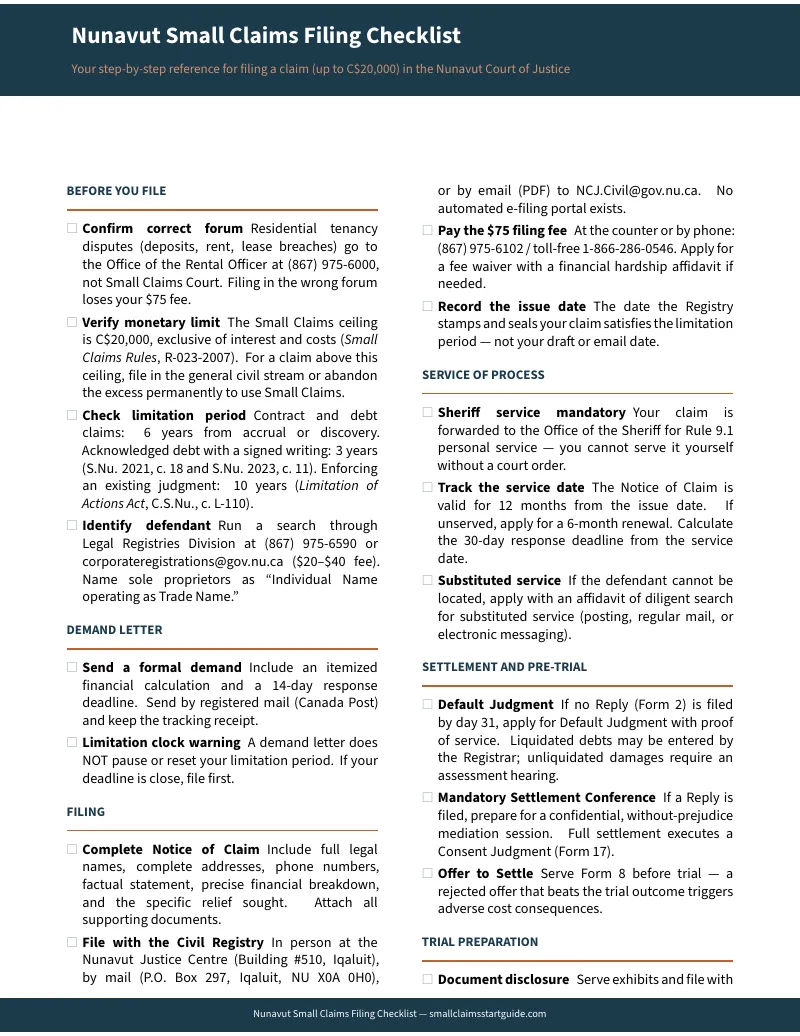
The full guide spans 14 chapters and 48 pages, plus a printable filing checklist and six standalone planning worksheets: a demand letter worksheet, a service tracking log, an evidence index, a deadline calendar, a post-judgment enforcement checklist, and a costs calculator. Covering the demand letter, entity identification through the Legal Registries Division, Form 1 completion, filing with the Civil Registry, service through the Sheriff Department and alternatives for remote communities, mandatory settlement conference preparation, trial evidence and witnesses, and post-judgment enforcement through Payment Hearings, garnishment, and Writs of Seizure and Sale.
The free checklist confirms the basics — the $20,000 limit, the form numbers, the filing fees, and the key deadlines. If you want the complete step-by-step system for every stage of the process, the full guide picks up where the checklist stops.
Frequently Asked Questions
What if the rules change after I buy?
We update the guide when the rules change. Email us any time, even years later, and we'll send you the current edition free.