
Someone owes you money. The CRT portal is open. Now what?
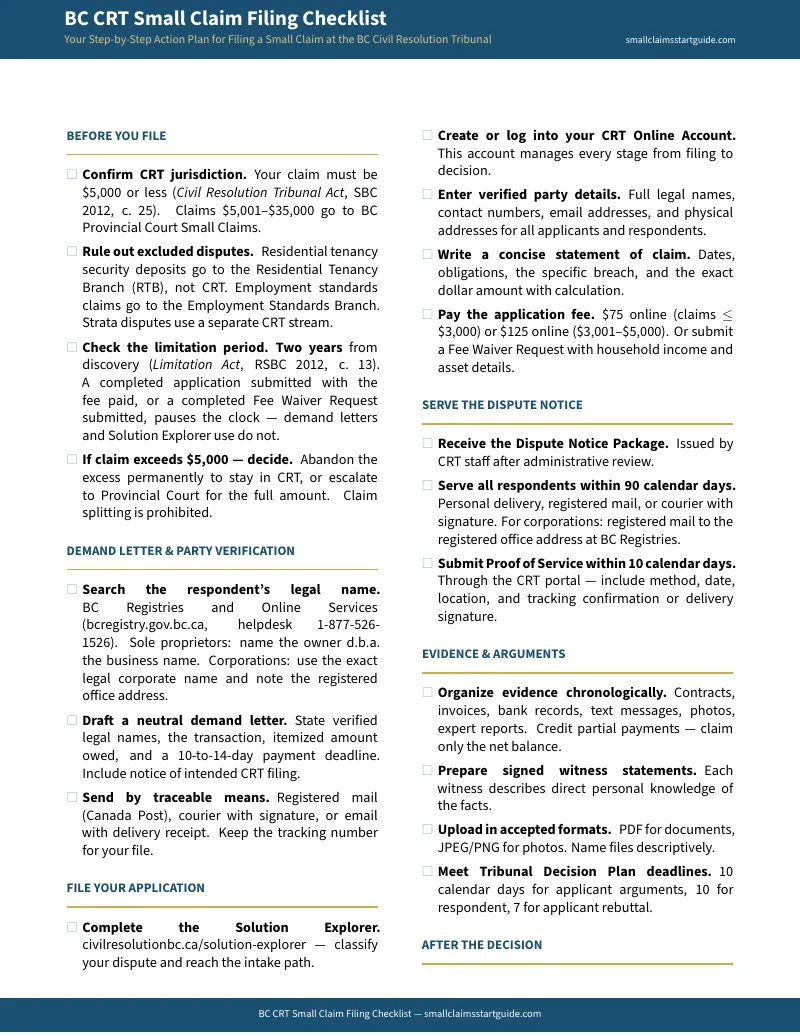
You know the Civil Resolution Tribunal exists. You know your claim is under $5,000. You may have even opened the Solution Explorer and clicked through a few screens. But somewhere between "name the respondent" and "serve the Dispute Notice within 90 days," the process stopped feeling manageable and started feeling like a trap — one wrong move away from a dismissed claim, a wasted filing fee, and months lost.
The CRT website tells you what the rules are. It does not tell you how to execute them in order, offline, with a plan you can follow from your kitchen table before you log into the portal.
The CRT Filing Roadmap: every step, every deadline, one document
The BC CRT Small Claim Step-by-Step Guide is a complete procedural roadmap that takes you from "I think I have a claim" through demand letter, application, service, evidence, and tribunal decision — in the order things actually happen, with the deadlines and fees at every stage.
It is not legal advice. It is not a filing service. It is the organized, printable workflow the CRT portal does not give you — so you walk into each stage knowing exactly what to do, what it costs, and when the clock runs out.
What is inside the guide
- Forum Decision Checklist — five yes/no checks that confirm whether your dispute belongs at the CRT, the Residential Tenancy Branch, the Employment Standards Branch, or the Provincial Court before you pay a non-refundable filing fee
- Limitation Period Checker — the two-year clock, what pauses it, and the 15-year ultimate backstop so you know whether you are still in time
- Demand Letter Calculation Sheet — a fill-in breakdown for principal, credits, interest, and expenses, plus a sending log, because the CRT expects you to have tried to resolve it first
- Respondent Verification Protocol — step-by-step BC Registry Services lookup for sole proprietorships, corporations, and partnerships so you name the correct legal entity (suing a trade name instead of the registered business is the fastest way to get a claim thrown out)
- Application Walkthrough — the Solution Explorer, issue classification, and online application screen by screen, with the complete fee schedule ($75–$125 online, higher by paper) and fee waiver eligibility
- Service Tracking Log — a print-and-write log for registered mail, personal delivery, and courier attempts, with the 90-day service window and the mandatory 10-day Proof of Service deadline
- Evidence Index Worksheet — a printable exhibit organizer with chronological file naming, so your receipts, texts, contracts, and photos reach the adjudicator in a format that makes your timeline clear
- Deadline Calendar — every statutory countdown in one place: 90 days to serve, 10 days for proof, 14 or 30 days for the respondent to reply, Tribunal Decision Plan dates, and the adjudication fee trigger
- Post-Decision Roadmap — what happens after the tribunal rules, including the repeal of the Notice of Objection (effective July 2022), Judicial Review in the BC Supreme Court, and the path to enforcement
Who this guide is for
- A homeowner whose contractor took a deposit and walked off the job
- A sole trader or freelancer chasing an unpaid invoice
- A buyer refused a refund for something that was broken, misrepresented, or never delivered
- A roommate whose security deposit was not returned — and the RTB says it is not their problem
- A neighbour with a fence, tree, or drainage damage bill
- Anyone in British Columbia owed money under $5,000 who wants to handle the CRT process themselves
What free resources miss
The CRT portal, People's Law School, and smallclaimsbc.ca all provide accurate statutory information. None of them provides a single, printable, end-to-end workflow you can follow offline.
The portal's Solution Explorer walks you through issue classification — but it does not help you verify the respondent's legal name, track your service deadlines, or organize your evidence before you upload it. People's Law School publishes clear-language overviews — but not fillable worksheets or a deadline calendar. The Justice Education Society focuses heavily on Provincial Court procedures for claims over $5,000.
This guide fills the gap between knowing the rules and executing them: the demand letter before you file, the entity lookup before you name a respondent, the service tracking before you miss the 10-day proof deadline, and the evidence indexing before you upload a disorganized photo dump.
The numbers
CRT filing fees run $75 to $125 depending on claim size, plus a $50 adjudication fee if the dispute goes to a decision. Filing in the wrong forum, serving the wrong person, or missing a deadline means you lose those fees and start over. Paralegal services in BC charge $300 to $1,200 or more. A guide that costs a fraction of one filing fee is the least expensive insurance against a procedural mistake.
Updated for 2026
- The $5,000 CRT small claims limit and the $5,001–$35,000 Provincial Court range
- The March 2025 BPCPA consumer protection expansion
- Current fee schedules: $75/$125 online application, $50 adjudication fee, $25 default order, $30 validated order copy
- The July 2022 repeal of the Notice of Objection — older guides and forum posts still reference it, but it no longer exists for small claims
Satisfaction guarantee
Full refund, no time limit. If the guide does not help you, email [email protected] and you will get your money back.
Get started
Download the free two-page checklist to see the key steps and deadlines. When you are ready for the full roadmap — demand-letter calculation sheet, service tracking log, evidence index, and every deadline on the calendar — get the complete guide.