You Know You're Owed the Money. The Court Process Is What's Stopping You.
Someone owes you money — a contractor who took your deposit and disappeared, a customer who will not pay the invoice, a tenant who trashed the place and ghosted. You have tried asking. You have tried demanding. Now you are staring at the Magistrates Court website, scrolling through Fact Sheet 3, Fact Sheet 8, Form 4, Form 6, the eCourts Portal login page, and a fee schedule that does not explain whether you qualify for the reduced rate.
You are not confused about what happened. You are confused about how to make the court do something about it.
The Minor Case Filing System
This guide takes the entire WA minor case procedure — from the letter of demand to the hearing — and puts it in the order you actually need it. Every step references the specific form, the specific fee, the specific deadline, and the specific portal workflow, so you never have to jump between five separate PDFs trying to piece together what comes next.
Registry staff are legally prohibited from reviewing your draft claim, telling you which form to use, or helping you calculate what you are owed. The court publishes the rules. This guide tells you how to follow them.
What's Inside
- Jurisdiction and forum check — a screening framework that confirms your claim fits the minor case stream (up to $10,000), verifies the six-year limitation period, and diverts building disputes, residential park tenancies, and strata matters to their correct forums before you waste a filing fee.
- Letter of demand blueprint — what to include, how to itemise the amount, the 7-to-14-day deadline convention, and why sending it by registered post matters for recovering your costs later.
- Defendant identification worksheets — step-by-step instructions for verifying whether you are suing the right legal entity, using ASIC company extracts and ABN Lookup. Naming the trading name instead of the person or company behind it is the most common reason claims get struck out.
- Form 4 and Form 6 walkthrough — field-by-field instructions for drafting your statement of claim, calculating pre-judgment interest, and itemising allowable costs. Covers both the general minor case claim (Form 4) and the consumer/trader pathway (Form 6) where the court serves the defendant for you.
- eCourts Portal filing guide — account registration, document naming conventions, upload requirements, and payment steps. Explains how to avoid the upload errors and format rejections that send claims back to the queue.
- Service execution pack — personal service rules, court bailiff service (with travelling fee calculations), substituted service applications, and the Form 11 Affidavit of Service template. Tracks the 14-day response window for WA service and the 21-day window for interstate service.
- Default judgment pathway — what happens when the defendant does not respond within the deadline, how to apply for default judgment, and the documents you need to file.
- Evidence bundle and hearing preparation — how to organise and index your documents, what the Magistrate expects at a pre-trial conference, courtroom conduct rules, and how to present your case when cross-examining the other side.
- Printable worksheets and deadline calendar — a filing-readiness checklist, party identification worksheet, cost and interest calculator, service tracking log, and evidence index sheet. Print them, fill them in, and keep them with your court file.
Who This Guide Is For
- Homeowners chasing a contractor who took a deposit and never finished the job
- Sole traders and small business owners with unpaid invoices under $10,000
- Tenants owed a bond refund or landlords owed rent
- Buyers refused a refund on defective goods or a failed service
- Neighbours with a property damage bill the other side will not pay
- Anyone in Western Australia who has sent a demand, received nothing, and is ready to file
Why the Free Checklist Is Not Enough
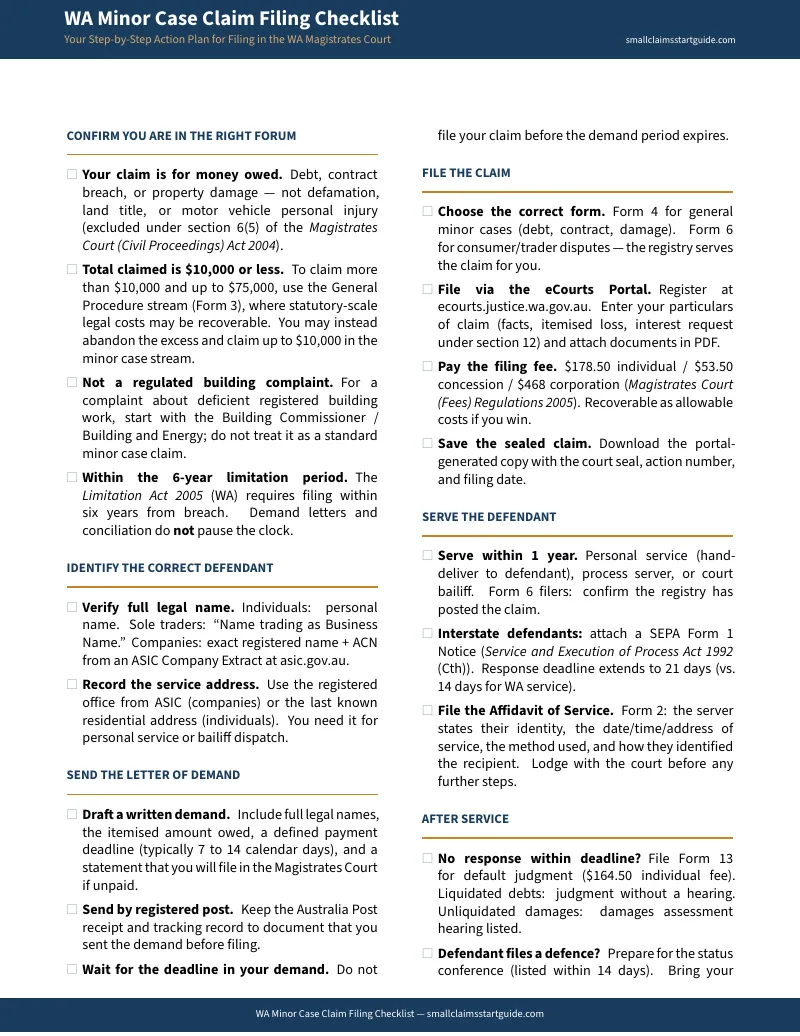
The free checklist gives you the sequence — the steps in order, the forms by name, the key deadlines. That is enough to get oriented.
But it does not tell you how to draft a concise statement of claim that a Magistrate can follow. It does not walk you through calculating pre-judgment interest on an unpaid invoice. It does not explain how to verify a company's registered office address through ASIC so your service is legally valid. It does not give you the document-naming conventions the eCourts Portal expects, or the courtroom conduct rules for a private minor case hearing.
The Magistrates Court publishes every form and fact sheet for free. Legal Aid WA publishes infosheets. But none of them connect the dots into a single filing workflow — and none of them give you the worksheets, calculators, and templates that turn scattered rules into something you can actually execute at a desk.
This guide is the instructions the court cannot give you.
Satisfaction Guarantee
If the guide does not deliver what you expected, email [email protected] for a full refund — no time limit, no questions, no hoops.
Start Filing
Every week you wait is another week the debtor has to restructure, relocate, or simply assume you are not serious. The court system is designed for people to use without a lawyer — the minor case stream limits costs, restricts legal representation, and runs a private hearing before a single Magistrate. The procedure exists. The forms are free. The only thing missing is the step-by-step sequence that turns your demand into a court-stamped claim.
Download the free checklist to see the filing steps at a glance, or get the full guide for to start today.