
You know you can take them to court. You just don't know where to start.
The contractor walked off with your deposit. The car you bought had damage the seller never mentioned. The invoice you sent three months ago is still sitting unpaid. You have looked up the Magistrates Court website and found a list of forms, a fee schedule on a different page, service rules on a third, and a CourtSA portal that asks you to pick between claim types you have never heard of.
Meanwhile, the limitation clock is ticking. File the wrong form and your A$186 filing fee is gone. Name a business's trading name instead of its registered company and any judgment you win is unenforceable. Skip the mandatory 21-day pre-action notice and the Registrar can reject your claim outright — and you lose the right to recover filing costs from the other side.
The SA Court Filing Roadmap puts every step — from your first demand letter through to the hearing room — into a single document you can print, annotate, and carry into the Adelaide Magistrates Court.
What makes this different from the free government pages
The Courts Administration Authority and the Law Handbook publish the rules for free. They are accurate. They are also scattered across dozens of pages, written in legislative language, and impossible to print as a single working document.
This guide reorganises all of it into one chronological filing sequence with printable tools you will not find on any government site:
- Forum Decision Checklist — a screening matrix that tells you whether your dispute belongs in the Minor Civil Division (up to A$12,000), the General Claims Division (A$12,001 to A$100,000), or SACAT (residential tenancy matters). File in the right place the first time.
- Entity Verification Worksheet — a fill-in record of your ASIC and Consumer and Business Services search results so the claim names the correct legal entity, not just the signage on the shopfront. A claim against an unregistered business name produces a judgment nobody can enforce.
- Statutory Deadline Calendar — a printable timeline tracking the 21-day pre-action waiting period, the 28-day defence window, the 14-day document exchange, and every other statutory deadline from demand through trial.
Everything inside, chapter by chapter
- Jurisdiction and forum selection — the statutory tests every minor civil claim must pass, plus a side-by-side comparison of the Minor Civil Division, General Claims Division, and SACAT so you know which forum hears your dispute
- Court fees — the full 2026 fee schedule (effective 1 July 2026), including the A$186 filing fee, the A$26.00 Form P1 notice fee, and the tiered setting down fees (A$260 for claims up to A$4,000, A$783 for claims A$4,001 to A$12,000)
- Interest and limitation periods — how to calculate pre-judgment interest, the 6-year limitation period for contract and tort claims, and what stops or restarts the clock
- The pre-action demand — how to write and send a Letter of Demand or lodge Form P1 on CourtSA, with the exact 21-day waiting period and postal tracking requirements that protect your right to recover filing fees
- Entity verification — searching ASIC and the Consumer and Business Services register to identify the correct respondent before you file, so your judgment is enforceable from the start
- Filing the claim — completing Form 1 and the Statement of Claim (Form 1S) on CourtSA field by field, choosing the correct claim type, drafting material facts under 100 words, and paying the filing fee
- Service — lawful methods for serving the sealed claim with the Form 31 multilingual notice, Australia Post tracking compliance, email service conditions, and completing Form 42 (Affidavit of Proof of Service)
- Defence and discovery — what happens when the respondent files Form 51S within 28 days, the 14-day document exchange under Form 73A, and preparing for the directions hearing
- Default judgment — applying via Form 76B when no defence is filed, the difference between liquidated and unliquidated claims, and the assessment hearing that unliquidated damages require
- The hearing — what to bring, how to address the magistrate, organising your tabbed evidence binder, the no-lawyer rule under Section 38, and what happens after the decision
Who this guide is for
- A homeowner whose contractor took a deposit and disappeared before finishing the work
- A sole trader with an unpaid invoice or trade account under A$12,000
- A consumer refused a refund for defective goods or a cancelled service
- A private car buyer who discovered undisclosed collision damage after the sale
- A neighbour with a property damage bill — tree roots, boundary walls, shared fences
Not for tenancy disputes: if your claim involves a residential rental bond, maintenance obligations, or any dispute under the Residential Tenancies Act 1995 (SA), you must file with SACAT. This guide covers the Magistrates Court only.
Why not piece it together yourself
You can. The Law Handbook explains the rules. The CourtSA portal hosts the forms. The CAA website lists the fees. You will need to visit all three, cross-reference them manually, figure out which form numbers changed when the Uniform Civil Rules 2020 replaced the old Magistrates Court (Civil) Rules, and keep your own notes on deadlines and service requirements.
A single procedural error — naming a trading name instead of the registered entity, using standard post instead of tracked delivery, missing the 21-day pre-action window — can cost you the A$186 filing fee, produce an unenforceable judgment, or get your claim rejected before it reaches a hearing.
This guide puts every step in order, flags the common mistakes that trip up self-represented claimants, and includes the printable checklists and deadline calendar that no government site provides.
What you get
- The full 13-chapter guide — a comprehensive, printable PDF covering every stage from jurisdiction check through to the hearing
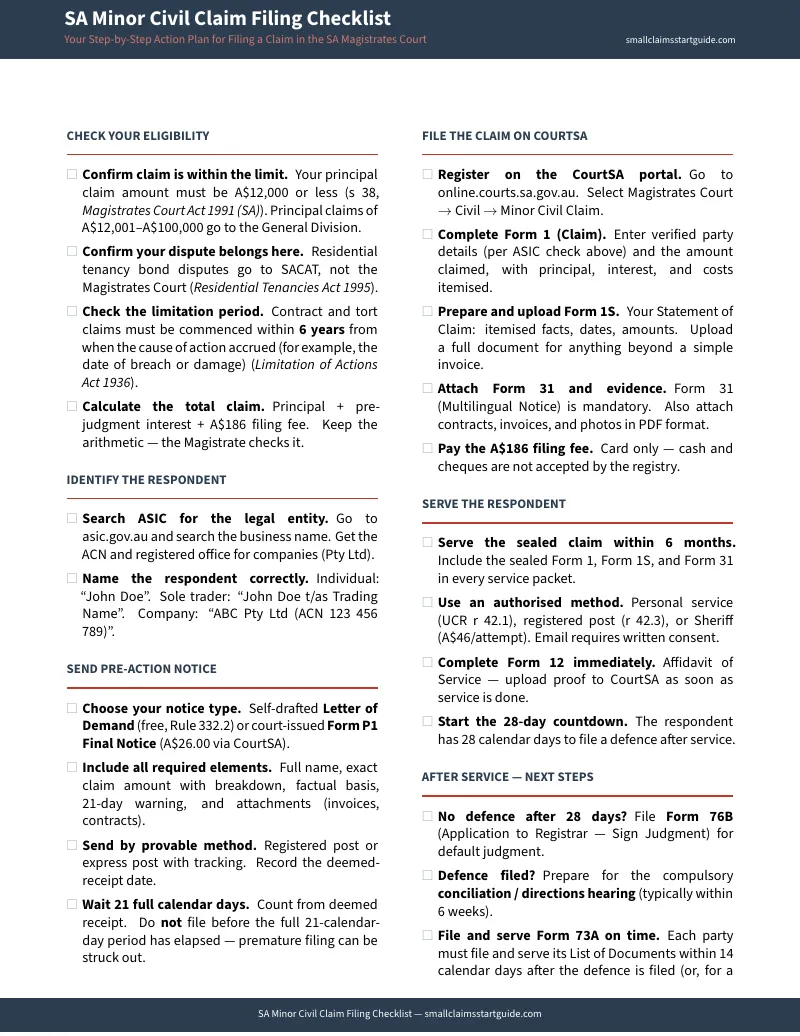
- The 25-item filing checklist — every form, fee, and deadline you need to track, on a single printable page
- 8 standalone printable worksheets — Forum Decision Flowchart, Entity Verification Worksheet, Pre-Action Demand Checklist, CourtSA Filing Checklist, Service Tracker, Evidence Bundle Organiser, Statutory Deadline Calendar, and Agency Communication Log
10 files download instantly. No subscription, no recurring charge. Full refund, no time limit — email [email protected] if the guide is not what you expected.
Try the checklist first — free
Download the SA Minor Civil Claim Filing Checklist free. It covers the limit, the key forms, the 2026 fees, and the major deadlines on a single page. If the full guide is what you need, you can get it afterwards.