You Won the Case. Now the Court Expects You to Collect.
The Magistrates Court handed down your judgment. You waited 28 days. The debtor still has not paid — and the court is not going to chase the money for you. That part is yours.
So now you are staring at a screen full of forms on CourtSA — Investigation Notices, Investigation Summonses, Examination Summonses, garnishee applications, warrants of sale — and trying to work out which one comes first, what each one costs, and whether the debtor even has anything worth seizing.
Free resources explain the rules in pieces. The Law Handbook gives you the statute. CourtSA tells you which button to click. The registry tells you they cannot give you advice. None of them put the steps in order or help you decide which enforcement tool fits your debtor's situation.
The SA Enforcement Roadmap — Every Step From Default to Satisfaction
This guide is a complete procedural roadmap for collecting a minor civil judgment in South Australia. It takes you from the moment the 28-day window closes through every enforcement tool the Magistrates Court offers, in the order you actually use them — and it tells you when to stop if the debtor has nothing.
Where official sources give you isolated form descriptions, this guide gives you the decision logic: which tool to reach for based on what you know about the debtor's wages, bank accounts and property, and when to move from one tool to the next.
What's Inside
- The enforcement timeline — when the 28-day window ends, how stays of execution work, and the 6-year filing deadline under Rule 201.5 (with the 15-year backstop under the Limitation of Actions Act)
- Pre-enforcement asset audit — a structured check of the debtor's employment, bank accounts, vehicles, real property and business interests, so you know whether spending on Sheriff fees is likely to produce anything before you file
- Investigation Notices and Summonses — Form 140 and Form 143 explained step by step, including what questions to ask at the hearing and how to use the Financial Questionnaire (Form 145) to pin down exactly what the debtor owns
- Garnishee orders — wages, bank accounts and trade debts — how each type works, the 2023 reform changes, and why bank garnishees are often the faster path in South Australia
- Warrants of sale — personal property and land, with the exempt-property rules that determine what the Sheriff can and cannot seize (the $2,500 vehicle threshold, essential household items, tools of trade)
- Charging orders (Form 150) — securing your judgment against the debtor's real property when you cannot force an immediate sale
- Examination Summonses (Form 146) — the escalation tool when the debtor defaults on court-ordered instalments (the two-missed-payment trigger)
- Warrants of apprehension — bringing a debtor who ignores court orders back before the court
- Four printable worksheets — an enforcement decision matrix, payment tracking ledger, pre-enforcement audit checklist and Sheriff fee risk calculator you fill in by hand as you work through enforcement
- Recording satisfaction of judgment — the closing procedure when the debt is paid in full, so both sides have a clean record
Who This Guide Is For
- You won a money judgment or order in the SA Magistrates Court (Minor Civil Claims Division, up to $12,000) and the other side has not paid voluntarily
- You are self-represented — no solicitor — and want to handle enforcement yourself
- You are a sole trader or small business owner with an unpaid commercial judgment and need a cost-effective way to collect
- You had an instalment order in place and the debtor stopped paying
Why Not Just Use the Free Resources?
The Courts Administration Authority website, CourtSA and the Law Handbook are accurate — and they are all you need if you already understand how the enforcement system fits together. The problem is that none of them do this:
- Put the steps in order. The CAA website describes each enforcement tool on a separate page. The Law Handbook organises them by statute. Neither tells you which one to try first for a debtor who has a job but rents.
- Help you avoid wasted fees. Filing for a Warrant of Sale when the debtor owns nothing but exempt property burns your money and your time. Free resources list what is exempt, but they do not give you a pre-enforcement audit to check before you file.
- Track what you are owed. Court fees, Sheriff fees and post-judgment interest all get added to the debt, but no free resource gives you a running ledger to keep the total straight — or flags when two missed instalments trigger an Examination Summons.
The guide costs a fraction of one billable hour with a solicitor. A single initial consultation in South Australia runs A$350 to A$750. The guide gives you the procedural roadmap to handle the enforcement process yourself.
Satisfaction Guarantee
Full refund, no time limit. If the guide does not help you, email [email protected] and we will refund you — no questions, no deadline.
Get the Enforcement Roadmap
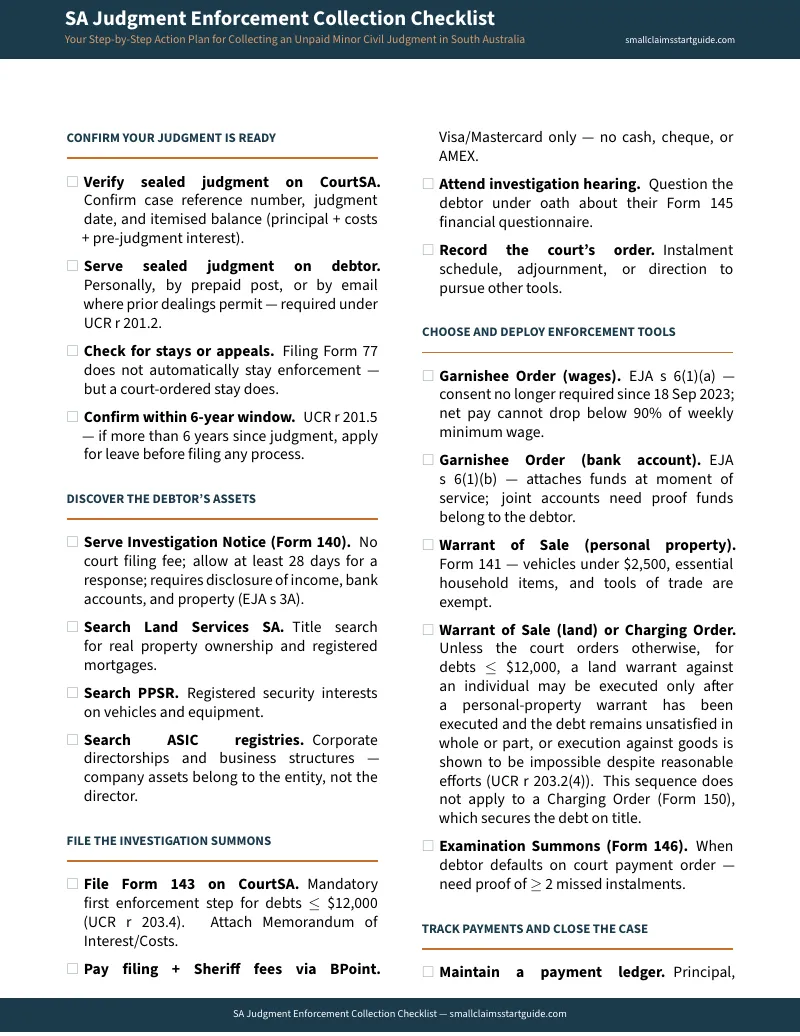
The free checklist gives you the readiness check and a summary of your options. The full guide gives you the complete procedure — every form, every fee, every step from default to satisfaction of judgment.
Download the free checklist to see whether your judgment is ready for enforcement, or get the full guide to start collecting today.