You know you're owed money. You just don't know which form to file, whether your dispute even belongs at QCAT, or what happens after you lodge.
The contractor took your deposit and disappeared. The retailer refused the refund. The tenant left without paying. You've sent messages, left voicemails, maybe written a demand letter — and nothing.
You know QCAT exists. You've been on the website. And you've spent an evening clicking between the minor debt page, the consumer and trader page, the forms page, the fees page, and the QCase portal — trying to work out whether you need Form 1 or Form 3, whether you need a QBCC outcome letter first, what "personal service" means, and how to turn a folder of receipts into something an adjudicator can follow.
The information is all there. It's just scattered across dozens of government pages with no clear order and no way to print a single document that walks you from "I'm owed money" to "I'm sitting in the hearing with my evidence organised."
The QCAT Filing Route System
This guide turns QCAT's fragmented online information into a single, printable execution plan. Every step is in order, every form is named, every fee is current as of 1 July 2026, and every deadline is mapped — from checking whether your dispute fits QCAT's minor civil dispute jurisdiction through to the hearing itself and what happens after the decision.
It is not legal advice. It does not predict whether you will win. It does not replace the free help available from LawRight, Legal Aid Queensland, or community legal centres. What it does is put every procedural step in one place so you are not guessing what comes next.
What's Inside
- Filing Route Verification Matrix — before you pay the filing fee, verify that your dispute belongs in QCAT and not the Magistrates Court, the QBCC (for domestic building), or the RTA (for bond disputes). This catches the prerequisite gaps that get applications rejected at intake and waste up to $405.60 in non-refundable fees.
- Form Selection Decision Tree — walk through the logic that separates a minor debt (Form 3 or QCase) from a consumer and trader dispute (Form 1). Filing the wrong form causes registry delays and potential strike-outs — and QCAT registry staff are legally prohibited from choosing the form for you.
- Letter of Demand Template — fill in party details, the facts, the monetary breakdown, and a 14-day payment deadline, then send it as your formal pre-action notice before filing.
- Entity Verification Checklist — ASIC business name search and ABN Lookup steps so you name the correct legal entity on your application, not the trading name on the invoice.
- QCase Portal Walkthrough — step-by-step guidance through Digital ID verification, account registration, lodging a minor debt application, uploading attachments (with the 30-page email limit for paper filers), and paying the fee online.
- Service Tracker and Form 9 Execution Checklist — a printable log for documenting how and when you served the application on the respondent, with separate instructions for personal service on individuals and corporate service under the Corporations Act. Makes the Form 9 Affidavit of Service a fill-in exercise instead of a last-minute scramble.
- Procedural Deadline Calendar — tracks the 28-day response window after service, the first eligible date for a default decision (Form 6), evidence exchange deadlines, and the hearing date. QCAT does not send deadline reminders to parties — the calendar keeps every window visible.
- Evidence Bundle Index Template — a paginated cover sheet for organising contracts, invoices, emails, photos, and text messages into a physical bundle. Follow your Tribunal Directions for format and exchange; bring printed copies unless they allow another format. Electronic devices may be used in a hearing room only when permitted by practice direction or the presiding member.
- Interest Calculation Worksheet — work the statutory interest rate into a pleaded daily figure before you file, with a worked example showing the calculation from invoice date to lodgement.
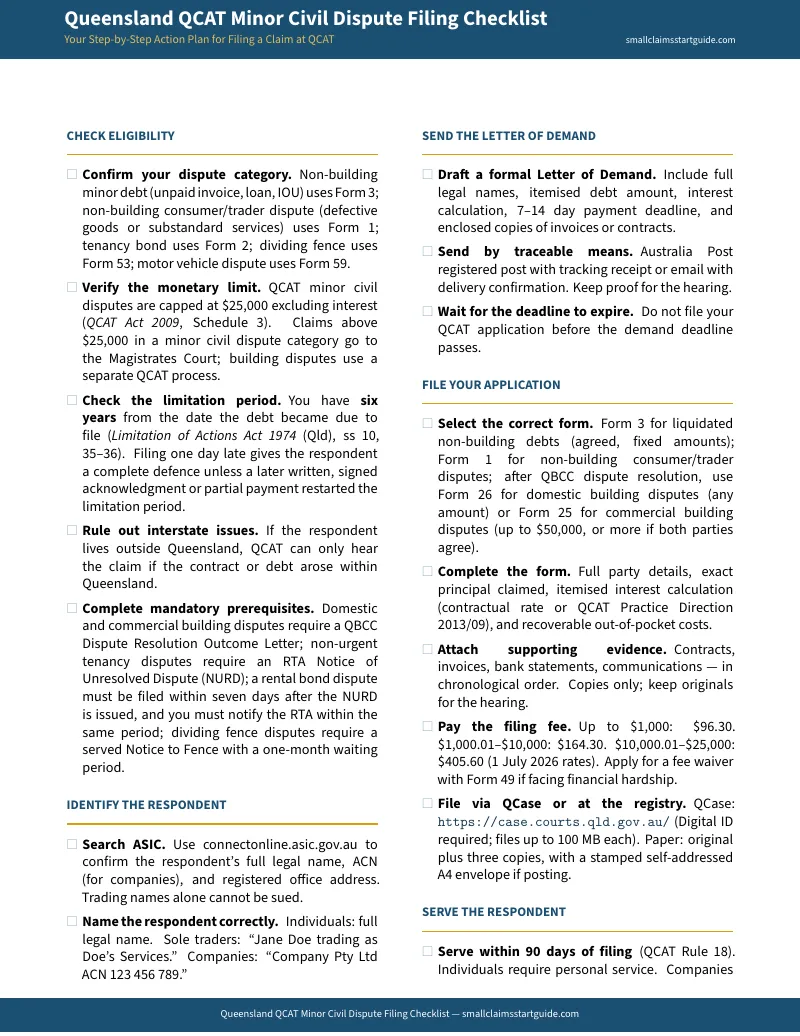
- Two-Page Filing Checklist — a quick-reference printable covering the monetary limit, all current fees, key deadlines, and the service steps. Pin it to the fridge.
Who This Is For
- Sole traders and freelancers with an unpaid invoice — the core minor debt claim (Form 3)
- Homeowners chasing a contractor who took a deposit and did not finish the work — if it involves domestic building, the guide walks you through the mandatory QBCC early dispute resolution step before you file
- Tenants owed a bond or landlords disputing bond deductions — the guide covers the RTA dispute resolution prerequisite and the Notice of Unresolved Dispute you need before QCAT will hear it
- Consumers refused a refund for defective goods or services under Australian Consumer Law
- Anyone in Queensland who has sent a demand and is ready to file — but needs the steps in order
Why Not Just Use the Free Information?
You should use the free information. The official QCAT website, LawRight, Legal Aid Queensland, and community legal centres all publish accurate procedural guidance — and the guide links directly to every one of them.
The gap is not accuracy. It is organisation. QCAT's own site spreads the application process across separate pages for minor debts, consumer disputes, building disputes, tenancy disputes, fees, forms, the QCase portal, and service rules. Each page covers its own scope. None of them puts your steps in order from demand letter to hearing. None gives you a printable form-selection decision tree. None provides a service tracking log or a deadline calendar you can fill in as dates arrive.
Registry staff cannot fill that gap either. Under the QCAT Act, they are prohibited from advising which form to file, how to word your claim, or how to organise your evidence. LawRight's free appointments are excellent but carry a two-week waiting period and do not provide ongoing case management.
The guide does not contain secret information. It consolidates what is already free into a format you can execute without 30 browser tabs open.
What This Guide Does Not Do
- It does not give legal advice or tell you whether your claim will succeed
- It does not speak for QCAT, the Queensland Government, or any court or tribunal
- It does not replace a lawyer for complex disputes or claims over $25,000
- It does not cover responding to a claim you have been served with (see the companion QCAT Response Guide) or enforcing an unpaid order (see the QCAT Order Enforcement Guide)
Full Refund, No Time Limit
If the guide is not what you expected, email [email protected] for a full refund. No time limit, no questions.
Start With the Free Checklist
Not sure yet? Download the free Queensland QCAT Minor Civil Dispute Filing Checklist — a 2-page printable covering the monetary limit, current fees, the QCase portal steps, and links to free legal help. If you need the full step-by-step system with worksheets, the calendar, and the evidence index, the complete guide is here when you are ready.