You know you can take the trader to NCAT. You just don't know how.
The contractor took your deposit and vanished. The dealer sold you a car with hidden defects. The retailer refused your refund. You have every right to file a consumer claim at the NSW Civil and Administrative Tribunal — but when you go looking for the steps, they are scattered across fifteen different government pages, six PDF forms, and a registry portal that demands 100 points of ID before it lets you in.
Meanwhile, the three-year limitation clock is running. File in the wrong forum and you lose your application fee. Name the wrong entity and any order you win is unenforceable. Miss a service deadline and your hearing gets adjourned.
The NCAT Consumer Claim Procedure Companion puts the entire process — from the first jurisdiction check through to enforcement — into a single document you can print, annotate, and carry into the hearing room.
What makes this different from the free government pages
NCAT's website is authoritative. It is also fragmented. The fee schedule is on one page. The application form is on another. The evidence directions are buried in a third. Service rules link to a fourth. The registry portal lives on a separate domain entirely.
This guide reorganises all of it into a single chronological workflow with printable worksheets you will not find on any government page:
- Forum Selection Worksheet — a screening matrix that verifies whether your dispute belongs in NCAT's Consumer Claims List, the Motor Vehicles List, the Tenancy List, the Home Building List, or the NSW Local Court. File in the right place the first time.
- Respondent Entity Search Sheet — a fill-in record of your ASIC register and ABN Lookup results so the application names the correct legal entity (a company's ACN or the individual sole trader), not just the trading name on the invoice. An application against an unregistered business name produces an order nobody can enforce.
- Statutory Deadline Calendar and Evidence Index Cover Sheet — printable worksheets for tracking your limitation date, demand-letter deadline, filing date, service deadline, evidence exchange date, and hearing date, plus a paginated index for the bundle the Tribunal actually expects.
Everything inside, chapter by chapter
- Jurisdiction and forum selection — the three statutory tests every consumer claim must pass, plus a side-by-side comparison of NCAT versus the Local Court so you know exactly where your dispute belongs
- Filing fees and concession rates — the current fee schedule (effective 1 July 2026), corporate rates, concession eligibility, fee waiver applications, and worked examples showing your actual out-of-pocket cost
- Time limits — the three-year and ten-year limitation periods, how to count your accrual date, and the narrower windows for Consumer Guarantee Directions and conveyancing disputes
- Letter of demand — what the letter must contain, how to send it by traceable means, and what to do when the trader ignores it or rejects your claim
- Entity verification — identifying the correct respondent through ASIC and ABN Lookup before you file, so your application is enforceable from the start
- Filing the application — completing the form field by field (paper PDF or NCAT Online), choosing the right statutory remedy under the Australian Consumer Law, and paying the correct fee tier
- Service — how to serve the application and evidence on the respondent, acceptable methods, and the Service Log and Proof Tracker you can fill in and present to the Tribunal
- Conciliation preparation — what happens at the mandatory conciliation session, how to set your three settlement numbers on the Conciliation Settlement Boundaries Worksheet, and how to handle pressure from an experienced trader representative
- Evidence and hearing day — building an indexed evidence bundle, preparing your oral submissions, what to wear and bring, and what to expect from the Tribunal Member
- Appeals — internal review, Appeal Panel jurisdiction, and the time limits for each pathway
- Enforcement — registering an NCAT monetary order in the Local Court, examination notices, garnishee orders, and writs of execution
- Printable worksheets — Forum Selection Worksheet, Respondent Entity Search Sheet, Letter of Demand Drafting Checklist, Evidence Index Cover Sheet, Service Log and Proof Tracker, Statutory Deadline Calendar, Conciliation Settlement Boundaries Worksheet, and Hearing Day Preparation Checklist
Who this is for
You are a consumer in New South Wales who paid a trader for goods or services and did not get what you were promised. Your claim is worth enough to fight for — but not enough to justify a solicitor's fee. You want to handle this yourself, correctly, the first time.
- A homeowner whose contractor took a deposit and abandoned the job
- A car buyer whose licensed dealer sold a vehicle with undisclosed mechanical defects
- A customer whose retailer refuses to honour a consumer guarantee
- A small business owner who paid for services that were never delivered or were defective
- Anyone in NSW who has already sent a demand letter and gotten silence in return
Why not just use free templates and Google it?
Generic demand letter templates on Etsy and Gumroad tell you to name the business on the invoice. That is often a trading name, not the legal entity — and an NCAT order against a trading name that is not a registered company is unenforceable. The guide shows you how to find the actual entity behind the name.
Automated demand letter generators produce a styled letter and then stop. They offer nothing for what comes next — the application form, the service requirements, the evidence exchange deadline, the conciliation session, the hearing.
Law firm consultations start at A$350. For a dispute under A$10,000, the consultation can cost more than the claim is worth — and under NCAT rules, you represent yourself at the hearing anyway.
This guide covers the full procedure from demand letter to enforcement, in one document, for a fraction of the cost of a single legal consultation.
Your purchase is protected
Full refund, no time limit. If the guide is not what you expected, email [email protected] and you will get your money back. No form, no waiting period, no questions.
This is an independent publication. Small Claims Start Guide is not affiliated with NCAT, the NSW Department of Customer Service, Legal Aid NSW, or any court, tribunal, or government body. The guide explains procedure — it does not give legal advice, assess the merits of any claim, or predict outcomes.
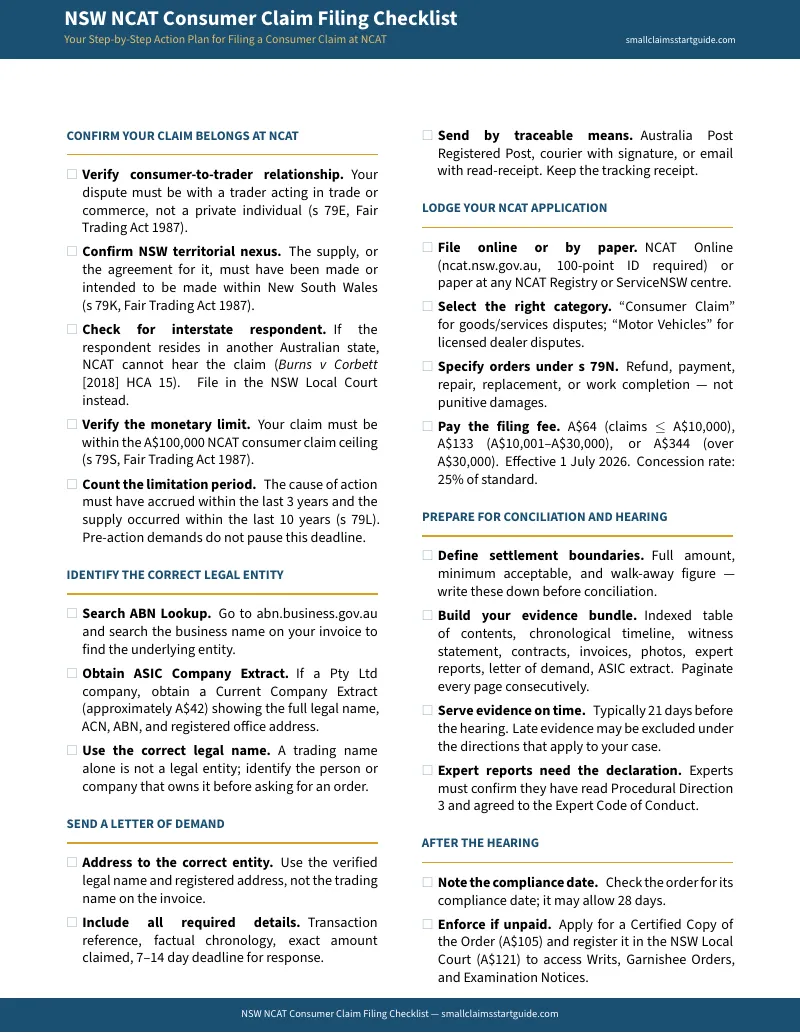
The free checklist shows you the steps. The full guide shows you how to do each one.
Download the free checklist to see whether your claim qualifies and what the filing steps look like. If you want the complete walkthrough — field-by-field form instructions, entity verification, evidence packaging, conciliation strategy, and printable worksheets — the full guide picks up where the checklist leaves off.