You just received papers from ACAT. Now what?
A Civil Dispute Application is sitting on your table. The form number, the section references, the statutory language — none of it looks like something you were ever supposed to deal with. But the 21-day deadline printed on page one is real, and if you miss it, the other side can apply for a default order without you ever being heard.
Most people in this situation either freeze — and the deadline passes — or spend hours jumping between ACAT web pages, PDF forms, and practice notes trying to work out what to do, in what order. Both paths cost more than they need to.
The ACAT Response Navigator
This guide is a single, linear walkthrough of every step between receiving ACAT civil dispute papers and the options after a decision. It is not legal advice. It does not tell you how to argue your case or predict what the tribunal will decide. What it does is take the scattered procedural rules — from the ACAT website, the ACT Civil and Administrative Tribunal Act 2008, Practice Note 3 of 2023, the fee schedule, and Approved Form AF2021-29 itself — and put them in the order you actually need them, with printable worksheets so you can track your deadlines, filings, and evidence as you go.
We call it the ACAT Response Navigator because that is what it replaces: the hours you would spend cross-referencing form instructions, checking which sections apply to your situation, and hoping you haven't missed a filing requirement that matters.
What's Inside
- Paper decoder worksheet — a structured walkthrough of your Civil Dispute Application so you can identify the case number, applicant, claim amount, tribunal registry, and which parts of Form AF2021-29 you need to complete, all in one sitting
- 21-day deadline calculator — a printable service log that works out your response deadline from the date of service, accounts for postal service rules and ACT public holidays, and flags the default order risk if the deadline passes
- Form AF2021-29 filing guide — step-by-step instructions for completing Section A (admit and propose payment), Section B (dispute the claim), and Section C (lodge a counter-application), plus both filing methods: the ACAT Online Forms portal (Chrome browser requirement, 7 MB attachment limit, 20-character filename rule, 45-day draft auto-deletion) and paper filing at the registry
- Response position framework — a plain-language breakdown of the three response routes with a decision worksheet that walks you through each option without telling you which one to pick — including when a counter-application makes sense and what fee applies
- Evidence binder template — a structured index for organising contracts, invoices, emails, text messages, photographs, and receipts into numbered bundles for the hearing, including a Scott Schedule template for building and property defect disputes
- Directions Hearing and preliminary conference guide — what to expect at the tribunal's first procedural step under Practice Note 3 of 2023, whether your matter is routed to a standard conference, an evaluation, or an immediate determination, and how to prepare for mediation
- Hearing day checklist — what to bring, how the hearing runs, what the tribunal member expects from a self-represented party, the rules for remote hearings (AVL), and the practical logistics of appearing in person
- Post-decision pathways — a clear map of what happens after the decision: compliance deadlines, the 28-day appeal window to the Appeal Tribunal under section 81, applications to set aside a default order, costs orders, interest, and when to seek free legal advice before acting
- Free legal help directory — verified contact details, eligibility notes, and service descriptions for Legal Aid ACT, Canberra Community Law, the Conflict Resolution Service, and the National Debt Helpline
Who This Is For
- A homeowner served with a building, renovation, or defect dispute claim who needs to understand the papers and respond before the 21-day deadline
- A small business owner or sole trader facing a claim over an unpaid invoice, a service dispute, or a commercial contract — including how to lodge an authority to act for a corporation
- A tenant or former landlord dealing with a post-tenancy bond claim, property damage allegation, or compensation demand that has ended up in ACAT's general civil dispute stream
- A private vehicle seller served by a buyer alleging undisclosed mechanical faults or misrepresentation
- Anyone in the ACT who has received ACAT civil dispute papers and wants a clear procedural walkthrough without hiring a solicitor
Why Not Just Use the Free Information?
You should use the free information. Every form, rule, and deadline in this guide is published on acat.act.gov.au, and the guide tells you exactly where to find each one. ACAT's website is accurate and official.
The problem is how that information is organised. ACAT's process pages cover all parties (applicants, respondents, and witnesses), all case types (civil disputes, rental disputes, guardianship, government decisions), and all stages across separate sub-pages. If you are a respondent to a civil dispute, you need pieces from at least six different pages — form instructions, filing requirements, the fee schedule, the practice note on conference streams, the evidence rules, and the post-decision options — and you need them in the right order, because choosing Section A on Form AF2021-29 before you understand Section B and Section C is a decision you may not be able to reverse.
What you are paying for is not secret information. It is the time you would spend finding, sorting, and cross-referencing that information under a statutory deadline — organised into one document, in the order a respondent actually needs it, with worksheets that turn reading into doing.
ACAT registry staff are helpful with administrative questions, but they cannot give legal advice, review what you have written on your form, or tell you which response route to choose. The guide respects that same boundary — it explains the procedure, not the strategy.
What This Guide Does Not Do
- It does not give legal advice or assess the merits of any claim
- It does not predict outcomes or promise results
- It does not cover debt-collection lawsuits by banks, lenders, debt buyers, or collection agencies — if that is your situation, the guide directs you to the National Debt Helpline (1800 007 007) and Care Financial Counselling
- It does not replace a solicitor for complex disputes — and it tells you when to get one
The Free Checklist vs. the Full Guide
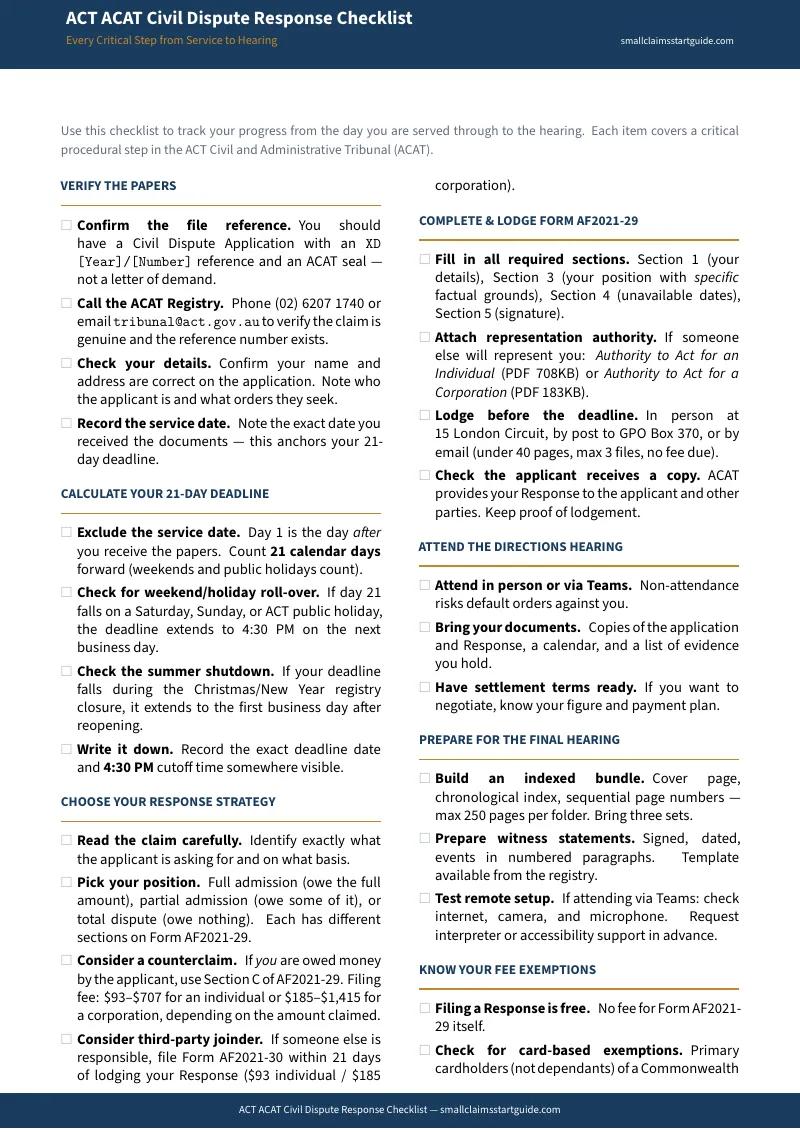
The free ACT ACAT Civil Dispute Response Checklist gives you the essentials on one page: the 21-day deadline calculation, your three response options on Form AF2021-29, the filing methods, and the phone numbers for free legal help. If that is all you need, you are set.
The full guide goes deeper: 14 chapters covering every stage of the respondent's journey, from decoding your papers through to post-decision options, plus 8 standalone printable worksheets — a deadline calculator, a paper decoder, a response decision matrix, an evidence index, a Scott Schedule for building disputes, a hearing day checklist, an agency communication log, and a free legal help directory. If your situation is straightforward and the checklist answers your questions, save your money. If you want the full procedural walkthrough in one place — especially if you are preparing for a hearing — the guide is built for that.
Satisfaction Guarantee
Full refund, no time limit. If the guide does not help, email [email protected] and we will refund your purchase — no questions, no deadline.
Get the ACAT Response Navigator →
The checklist is free. The full guide is . Both are instant PDF downloads — no subscription, no recurring charges, no account required.
Frequently Asked Questions
What if the rules change after I buy?
We update the guide when the rules change. Email us any time, even years later, and we'll send you the current edition free.