You Won at ACAT. The Other Side Won't Pay. Now What?
You sat through conciliation. You gathered evidence. You attended the hearing. The tribunal ruled in your favour and issued a money order. Then — nothing. Weeks pass. No payment. No acknowledgment. Just silence.
And then you discover something that shocks most successful ACAT applicants: the tribunal has no power to collect the money for you. There is no ACAT enforcement officer. No automatic seizure. No wage redirection. Your order is binding, but it sits on paper until you take it somewhere else and activate the enforcement tools yourself.
That somewhere else is the ACT Magistrates Court. And the process of getting from a tribunal order to actual money in your account involves a specific sequence of registrations, notices, waiting periods, forms, fees, and service rules that most self-represented creditors have never encountered before.
The Court-to-Collection Roadmap
This guide is a complete procedural navigation system for enforcing an unpaid ACAT money order through the ACT Magistrates Court. It covers the entire pathway — from registering your order under Section 71 of the ACAT Act to filing the Notice of Satisfaction once the debt is cleared — with every form number, fee amount, service rule, and deadline mapped out in sequence.
It is not a legal opinion. It is not affiliated with any court or tribunal. It is a practical, step-by-step roadmap built specifically for people in the ACT who hold an unpaid order and need to know exactly what to do next.
What the Guide Covers
- Section 71 Registration — how to file your sealed ACAT order at the Magistrates Court Civil Registry, with the supporting documents that prevent rejection at the counter
- The 7-Day Pre-Enforcement Notice — Form 2.49 must be served before any enforcement application, and the mandatory waiting period must expire. A premature filing wastes your fees and gets returned. The guide walks you through service methods that create a provable record
- Enforcement Hearing Subpoenas — Forms 2.50 and 2.51 compel the debtor to attend court and disclose their bank accounts, employer, income, and property. This is how you find out whether they have assets worth pursuing before you spend $450 on execution
- Earnings Redirection Orders — Form 2.64 directs the debtor's employer to deduct a portion of their wages and pay it directly to you. The guide covers the protected income thresholds so the court does not refuse your application
- Debt Redirection Orders — Form 2.62 redirects funds held by a third party, typically a bank, to satisfy your judgment. This is the ACT equivalent of what other jurisdictions call a garnishee order
- Seizure and Sale Orders — Form 2.55 sends the ACT Sheriff to seize and sell the debtor's personal property. The guide details the $450 execution fee, what property is exempt, and what the Sheriff can and cannot take
- Post-Judgment Interest and Cost Recovery — a balance ledger framework for tracking the principal, statutory interest, and every recoverable court fee so you claim the full amount owed
- Insolvency and Cross-Border Scenarios — what happens when the debtor goes bankrupt, enters administration, or moves interstate, and when to stop spending money on enforcement
- Closing the Case — filing Form 2.70 to discharge the judgment on court records once you have been paid in full
Who It's For
- Self-represented creditors who won an ACAT money order between $1,000 and $25,000 and have not been paid — whether the dispute was a contractor claim, rent arrears, bond shortfall, unpaid invoice, or property damage
- Small business owners and sole traders in the ACT with an outstanding tribunal order against a customer, tenant, or debtor, where hiring a lawyer would cost more than the judgment is worth
- Administrative helpers — a partner, family member, or office manager handling the paperwork on behalf of the named creditor
Why Not Free Resources?
Every form in this guide is available free from the ACT Magistrates Court website. The court's own Guide to Enforcement of Judgments outlines the enforcement options. The legislation is on the public record. This guide does not sell you forms or secret information.
What it sells is sequence, structure, and operational clarity. The official resources are scattered across multiple institutional websites. The court's form library contains hundreds of general civil forms without field-by-field completion guidance. Registry staff can confirm filing requirements but are legally prohibited from advising you on which enforcement tool to use, or how to complete the forms.
The result is that self-represented creditors spend ten or more hours piecing together the correct pathway from fragmented sources — and one mistake in service, timing, or form selection can delay recovery by months. A creditor on a Canberra forum described how improper service of their original ACAT judgment caused an eight-month delay before the court could redirect funds from the debtor's account.
This guide puts every step in order, matches each step to the exact ACT form, and flags the procedural traps that cause costly rejections and delays.
Satisfaction Guarantee
Full refund, no time limit. If the guide does not clearly explain how to move your ACAT order through the Magistrates Court enforcement process, email [email protected] and we will refund the purchase. No conditions, no deadline.
This guide cannot guarantee that you will recover the money — no product and no lawyer can promise that, because the debtor may have nothing to take. What the guide guarantees is that you will know the correct procedure, the right forms, and the exact steps to follow, so that when you walk into the registry at Knowles Place, you are filing correctly the first time.
Your Free Checklist and Full Guide
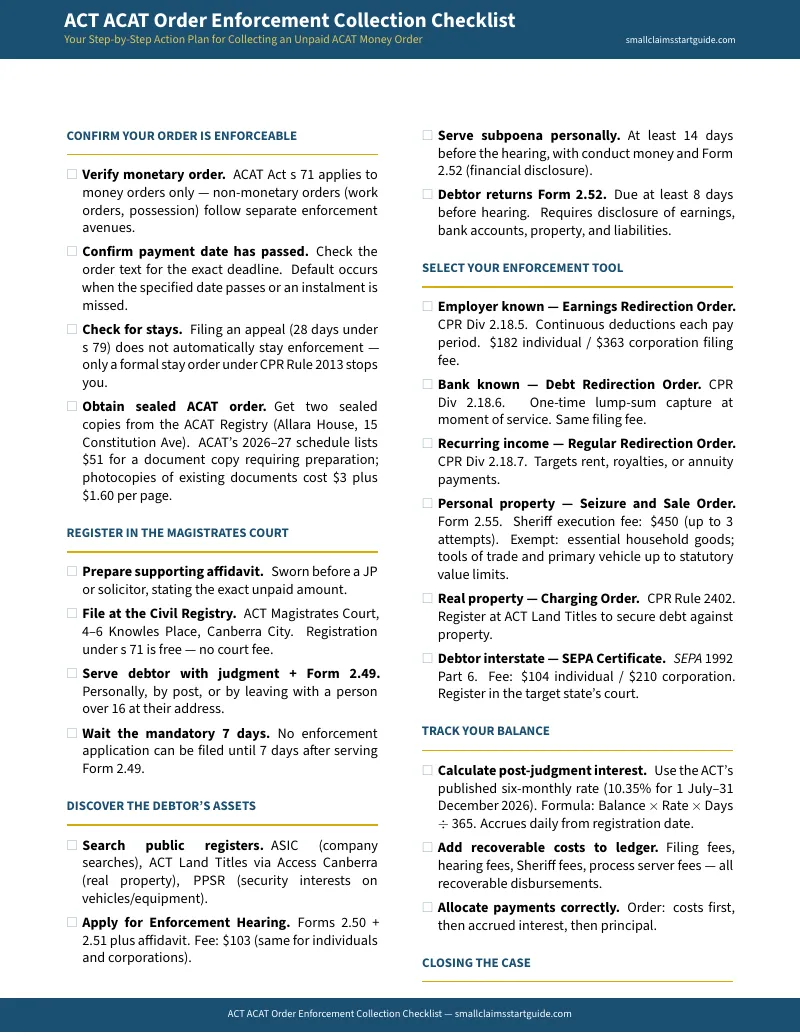
Download the free ACT ACAT Order Enforcement Collection Checklist to see the enforcement steps at a glance — the waiting period, form numbers, fees, and key deadlines on a single page. When you are ready for the complete walkthrough, the full guide gives you the field-by-field detail, decision frameworks, interest calculations, and service protocols for every enforcement tool available in the ACT.
Frequently Asked Questions
What if the rules change after I buy?
We update the guide when the rules change. Email us any time, even years later, and we'll send you the current edition free.