
You Won. The Court Isn't Going to Collect It for You.
A Wyoming Circuit Court judge signed your judgment. The case number is in the system. And now nothing happens — because the court's job ended the moment the judge ruled. Nobody is going to chase the debtor, freeze an account, or garnish a paycheck on your behalf.
The clerk's office will hand you a stack of blank forms — Writs of Continuing Garnishment, Non-Continuing Garnishment, Requests for Execution — and tell you they're legally prohibited from explaining how to fill them out, which one to file first, or where to take them once they're done. That's not the clerk being unhelpful. That's the law.
So you're left with a judgment that says you're owed money and a procedural maze that nobody in the courthouse is allowed to guide you through.
The Judgment Enforcement Toolkit
This guide is built around one idea: turn your paper judgment into collected money by following the enforcement steps in the right order, with the right forms, at the right offices.
It covers every tool Wyoming law gives a small claims judgment creditor — from the 30-day appeal window through the final Satisfaction of Judgment — and maps each one to the exact forms on wyocourts.gov, the filing offices that handle them, and the sheriff routing instructions that make them work. Each enforcement method has its own chapter, so you can go straight to the tool that fits your situation instead of reading a 300-page general manual to find the six pages that apply.
What's Inside
- Appeal Window Verification Checklist — before you spend money on writs and sheriff fees, confirm that the 30-day appeal period has expired, no stay has been ordered, and no appeal bond has been posted. One wasted writ costs $25–$50 in non-refundable sheriff fees.
- Debtor Examination Framework — if you don't know what the debtor owns or where they work, Wyoming law lets you subpoena them to court to answer under oath. The guide covers the motion steps, question structure, and what to do with the information you get back.
- Wage Garnishment Walkthrough — the complete sequence for a Writ of Continuing Garnishment: which form to file, what information the employer needs, how much of each paycheck is protected (75% of disposable earnings or 30 times federal minimum wage — whichever is greater), and how to handle a garnishee answer that shows zero collectible wages.
- Bank Account Levy Instructions — Non-Continuing Garnishment targets a bank account in a single sweep. The guide covers the separate form set, timing considerations, and what happens when the bank claims exemptions on the funds.
- Property Execution Procedure — personal property seizure via Writ of Execution, including the 60-day sheriff return deadline, what happens at a sheriff's sale, and which personal property is protected under Wyoming exemption law.
- Real Property Lien Recording — a Circuit Court judgment doesn't automatically attach to real estate. You need to get a Transcript of Judgment, file it with the District Court clerk, and record it with the County Clerk. The guide maps this multi-office process and explains when liens pay off — refinancing, sale, or judgment renewal.
- Exemption Reference Sheet — Wyoming's $100,000 homestead exemption, wage protection limits, and federal benefit protections on one page, so you can target enforceable assets and skip the ones the sheriff can't touch.
- Interest and Payment Tracking Ledger — post-judgment interest accrues at 10% per year. When you're receiving irregular partial payments, the math gets complicated. The ledger applies payments against interest first, then fees, then principal — with running balances you can present to the court.
- Satisfaction of Judgment Protocol — once you've collected everything, you're legally required to file a Satisfaction of Judgment and release any recorded liens. The guide covers drafting, notarization, and the recording steps across each office that holds a lien.
Who It's For
This guide is for anyone in Wyoming who already has a small claims judgment and needs to collect it without hiring a lawyer:
- A landlord whose former tenant owes for unpaid rent or damages beyond the security deposit
- A contractor who completed the job but never got paid
- A small business owner with an outstanding invoice that went to court
- A private seller who won a judgment for a bounced check or broken agreement
- A vehicle owner awarded damages after an accident, still waiting for the money
If you haven't filed your small claims case yet, the Wyoming Small Claims Filing Guide covers the process from demand letter through the hearing.
Why Not Just Use the Free Court Forms?
You should use the free court forms — this guide doesn't replace them. Every enforcement tool in Wyoming runs on official forms from wyocourts.gov, and the guide links to each one in the chapter where you need it.
What the court website gives you is a list of downloadable PDFs. What it doesn't give you is the order to use them in, the difference between a Continuing and Non-Continuing Garnishment (filing the wrong one wastes your sheriff fee and delays collection by weeks), or the three-office process for getting a lien on the debtor's house.
The court clerks are legally prohibited from explaining any of that. Legal Aid of Wyoming and Equal Justice Wyoming both exclude business disputes, commercial debt, and landlord claims from their free assistance programs. And hiring a private attorney to enforce a judgment capped at $6,000 costs $150–$300 an hour — which makes the math stop working before you've even started.
This guide fills the space between the blank forms and knowing what to do with them.
Satisfaction Guarantee
Full refund, no time limit. If the guide doesn't help you move forward with collecting your judgment, email [email protected] and you'll get your money back.
What You Get
Nine instant-download PDFs:
- Collecting a Small Claims Judgment in Wyoming: Step-by-Step Guide (47 pages) — the complete enforcement procedure from appeal window through satisfaction of judgment
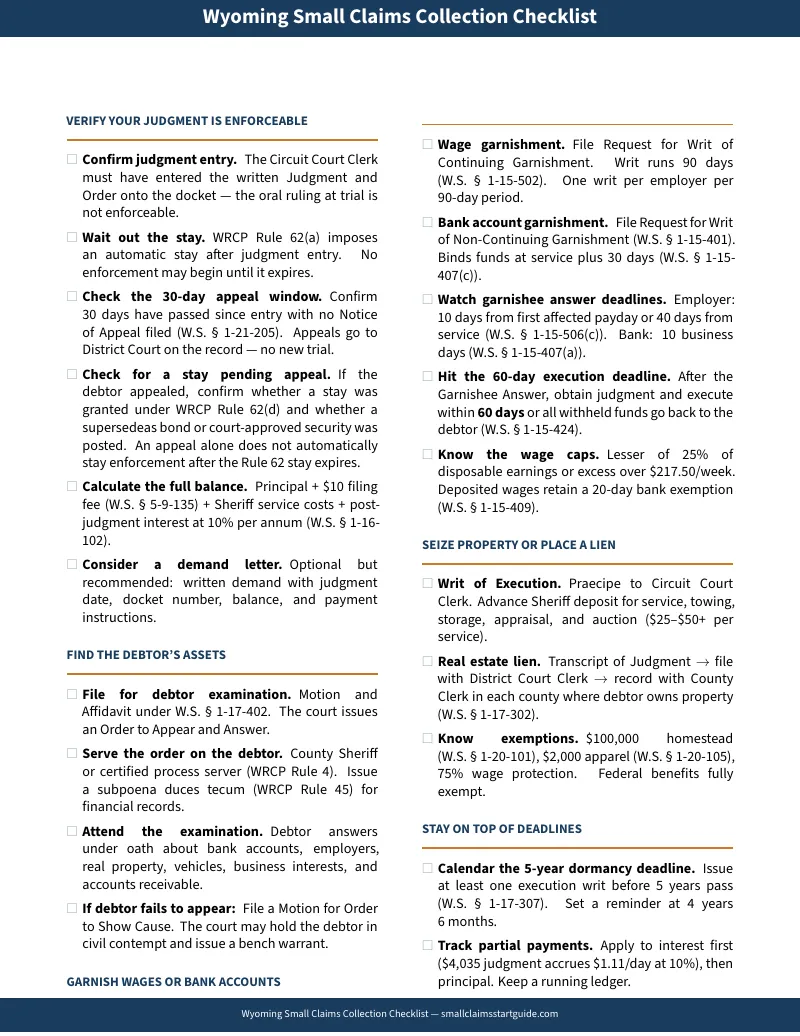
- Wyoming Small Claims Collection Checklist (2 pages) — a printable summary of every enforcement step, deadline, and form reference
- Post-Judgment Verification Checklist — confirm your judgment is final, the appeal window has closed, no stay is in effect, and calculate the total owed before you spend on writs
- Asset Discovery Worksheet — record every asset the debtor discloses during examination: employer, bank accounts, real property, vehicles, and business interests
- Collection Action Log — track every enforcement action filed, served, and returned, with fees paid and amounts recovered
- Interest and Payment Ledger — log payments and interest accrual at 10% per year, apply each payment to interest first, then costs, then principal, with running balances
- Payment Agreement Tracker — if the debtor agrees to installments, record each payment, due date, and whether it arrived on time
- Garnishment Deadline Tracker — track the 90-day continuing garnishment window, garnishee answer deadlines, and the critical 60-day execution deadline for each writ
- Satisfaction of Judgment Checklist — step-by-step process for drafting, notarizing, and filing the satisfaction when you have collected everything, including lien removal
The checklist is also available as a free standalone download — enter your email on this page to get it. If you find it useful, the full guide is the complete companion with chapter-by-chapter instructions for every enforcement tool.
Not legal advice. This is an independent educational guide. It is not affiliated with, endorsed by, or part of the Wyoming Judicial Branch or any government agency. It explains the procedure; it does not predict outcomes or substitute for a lawyer's advice in complex situations.
Frequently Asked Questions
What if the rules change after I buy?
We update the guide when the rules change. Email us any time, even years later, and we'll send you the current edition free.