You've Been Served — and Your Return Date Is Closer Than You Think
Someone just handed you court papers — a Small Claims Summons and Complaint from a Wisconsin Circuit Court. Maybe a contractor is suing over an unpaid invoice, a former tenant wants their deposit back, a customer says you sold them a defective product, or a buyer from a private car sale wants their money. Your summons has a return date printed on it, and what you need to do by that date depends on which county filed the case.
In Milwaukee County, Local Rule 3.78 requires a written answer served and filed on or before the return date — an oral answer in court is not enough. In Dane County, filing a written answer means neither side has to appear. In Waukesha County, a timely written answer under Local Rule 6.2 eliminates the in-person appearance for non-eviction cases. In many rural counties, you show up at the courthouse on the return date itself. Get the wrong track and you lose by default — the court can enter judgment against you for up to $10,000 without hearing your side.
The Wisconsin Small Claims Response Navigator
This guide puts the entire response process in one place: from decoding your summons and identifying your county's specific filing track, through completing Form SC-5200V (Answer and Counterclaim) and serving the plaintiff, to organizing your evidence for the court commissioner hearing and understanding your options after the decision.
It is built exclusively for Wisconsin Circuit Court small claims defendants — not a 50-state overview, not a plaintiff's filing guide, not a generic legal template. Every statute cited is Wisconsin's. Every form number is from the Wisconsin Judicial Council. Every county procedural track follows Chapter 799 and the local circuit court rules that govern your county.
What You Get
- Summons Audit Worksheet — copy the five critical fields from Forms SC-500 and SC-500i (county, case number, parties, return date, relief demanded) onto one sheet so every later filing matches the caption
- Response Deadline Calculator — mark your county track (Milwaukee Local Rule 3.78, Dane County Joinder, Waukesha Local Rule 6.2, La Crosse, or rural) and write the dates that control your answer, appearance, and same-day counterclaim service
- Answer Preparation Worksheet — admit, deny, or mark lack of knowledge on each allegation, draft your Box 2 statement, and capture any counterclaim before you copy the notes onto Form SC-5200V
- Answer Filing and Service Log — the same-day mailing requirement for Form SC-5250V (Notice of Counterclaim) and Form SC-5130V (Declaration of Mailing), with a row for every mailing and clerk confirmation. Miss this step and the court can dismiss your counterclaim on a technicality
- Evidence Index and Exhibit Organizer — number every exhibit and check off the three identical sets for the court, the plaintiff, and you, plus witness rows for Form GF-126A subpoenas
- Settlement Negotiation Planner — write your walk-away number and proposed terms before mediation (Waukesha Local Rule 6.4 and La Crosse intake both route contested cases there)
- Post-Decision Timeline Tracker — the trial de novo right under Wis. Stat. § 799.207 with its strict 10-day (oral decision) and 15-day (written decision) filing deadlines, plus the 45-day and 90-day appeal windows
- Default judgment and reopening — what happens if you miss the return date, how to petition to reopen a default using Form SC-511A (improper notice) or Form SC-515A (excusable neglect), and the strict requirements for each
Plus the Response Checklist
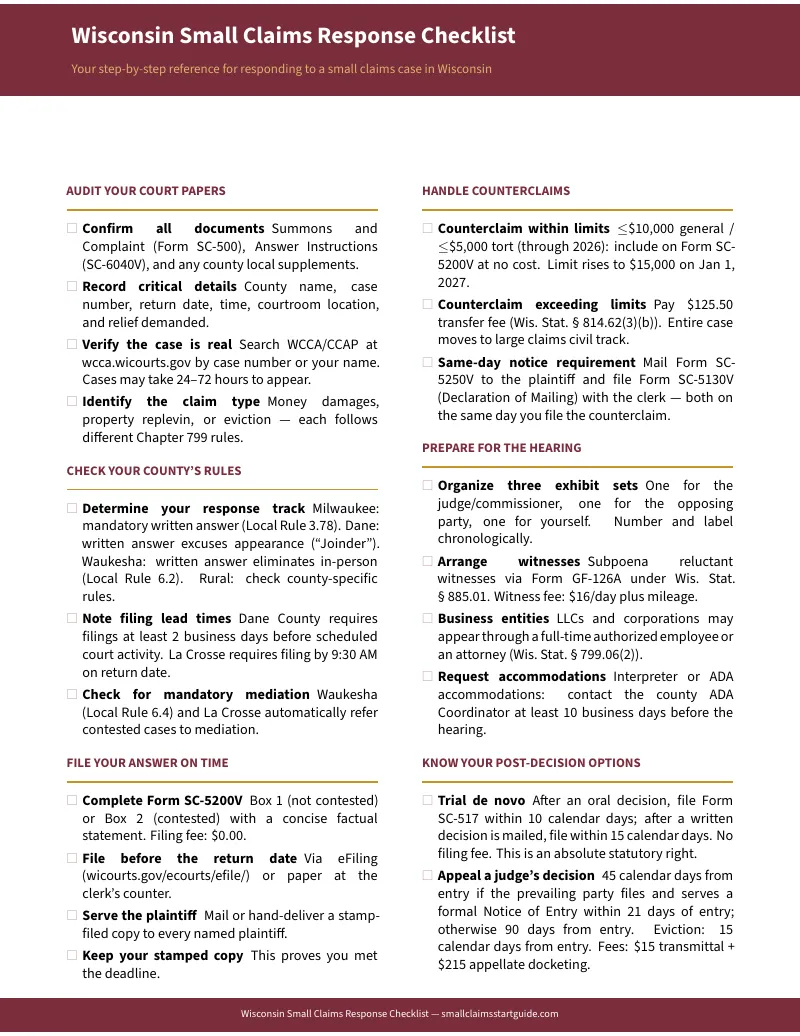
The free checklist gives you the return date, your county track, the four response options, and every critical deadline on two pages — a quick reference while you work through the full guide.
Who This Is For
- Homeowners sued by a contractor over a renovation, repair, or property damage dispute — including tree damage, boundary issues, and unreturned service deposits
- Former tenants or landlords in a security deposit, property damage, or lease-break rent dispute under ATCP 134 and Wis. Stat. § 704.29 (not evictions — those have separate expedited timelines)
- Small business owners and independent contractors sued by a customer or vendor over a commercial invoice, supply agreement, or service dispute
- Private vehicle buyers or sellers in a dispute over undisclosed defects, earnest money, or a breach of a private sale agreement
This guide is not for eviction cases seeking physical possession, consumer debt-collection lawsuits from lenders, debt buyers, or collection agencies, or consumer credit disputes. Those require different procedures and different legal protections. The guide directs those readers to Legal Action of Wisconsin and the State Bar Lawyer Referral Service for free help.
Why Not Just Use the Free Court Website?
The Wisconsin Court System publishes every form — SC-5200V, SC-5250V, SC-5130V, SC-6040V — and a two-page instruction sheet. But the instruction sheet says "check local court rules" without explaining that Milwaukee requires a written answer while most rural counties want you in person. Lincoln County hosts a comprehensive guide, but it was last revised in 2021 and omits eFiling. The Dane County clerk's website explains the Joinder system, but not how to serve a counterclaim.
Court clerks can answer procedural questions about where to file and when the office is open, but Wisconsin law prohibits them from advising you on how to fill in the form, whether your defense makes sense, or how to frame your answer. The national alternatives — Nolo's 480-page, 50-state overview for $25 or generic Etsy answer templates — either bury Wisconsin's Chapter 799 procedure in hundreds of irrelevant pages or sell you a debt-defense template that doesn't reference a single Wisconsin Judicial Council form.
This guide does one thing: it takes the response process for Wisconsin Circuit Court small claims and puts it in order, with the county tracks identified, the form numbers cited, and the filing steps explained for someone staring at a summons on a weeknight.
2026 Rules — 2027 Changes Flagged
The guide reflects current 2026 Wisconsin procedure, including the $10,000 general small claims cap. Under 2025 Wisconsin Act 105 (enacted March 2026), the cap rises to $15,000 for cases filed on or after January 1, 2027. The guide flags every section affected by the change so you know exactly which rules apply to your case.
Full Refund, No Time Limit
If the guide doesn't help, email [email protected] for a full refund. No time limit, no questions.
Important: Small Claims Start Guide is an independent commercial publisher. This guide is not affiliated with, endorsed by, or speaking for any court, government agency, or legal aid organization. It provides procedural navigation only — not legal advice, representation, or outcome predictions.
Download the free checklist to see the response steps at a glance, or get the complete guide with the full walkthrough, form completion instructions, county-specific filing tracks, and post-decision options.
Frequently Asked Questions
What if the rules change after I buy?
We update the guide when the rules change. Email us any time, even years later, and we'll send you the current edition free.