You found the court's website. Now you need to know what to do first.
Your contractor took your deposit and stopped returning calls. Your landlord kept your security deposit for damage that was already there when you moved in. A client owes you for work you finished three months ago. You searched "how to file small claims in Wisconsin" and landed on wicourts.gov — a sprawl of forms, instruction sheets, and county-specific pages organised by topic, not by the order you actually need to do things.
You do not need more information. You need a sequence: which form to fill out, which fee to pay, how to get the papers served on the other side without missing the deadline, and what to bring to a hearing that runs ten to fifteen minutes. One wrong name on the complaint, one missed service window, and a court commissioner dismisses the case before you say a word about what happened.
The Wisconsin Filing Workflow
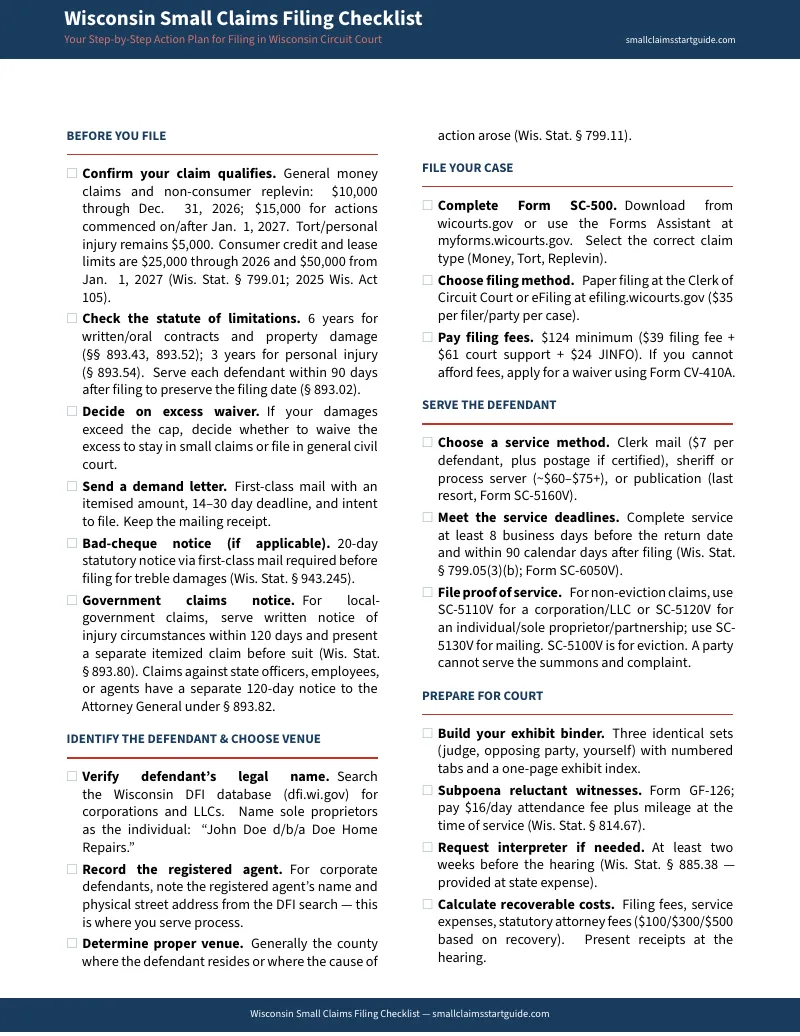
The Wisconsin Small Claims Filing Guide takes the entire process — from checking whether your claim fits the statutory cap through to preparing your evidence for the hearing — and puts it in one printable sequence with a 21-item checklist, the Filing & Service Deadline Calculator, and fillable worksheets. Every step references the exact Wisconsin form number, the fee, and the statutory deadline under Chapter 799.
This is not a 400-page legal textbook covering all fifty states. It is not a $40-a-month document-preparation subscription. It is a procedural workflow built for one state and one job: filing your Wisconsin small claims case correctly the first time.
What's Inside
Checking the Limit and the Clock
Wisconsin caps general money claims at $10,000 (rising to $15,000 on January 1, 2027) and tort claims at $5,000. But the dollar cap is only half the question — contract and property damage claims carry a six-year statute of limitations, while personal injury claims have three years. The guide walks through every cap and shows you how to calculate your deadline from the date the breach or damage occurred.
The Demand Letter — Because Commissioners Ask About It
Wisconsin does not require a demand letter for most claims, but circuit court commissioners expect to see that you tried to resolve the dispute before filing. The guide covers what the letter needs to say, when certified mail matters, and the two situations — dishonoured cheques and government claims — where a pre-suit demand is legally required.
Naming the Right Defendant — Entity Verification Through DFI
Filing against "Mike's Plumbing" when the registered entity is Michael J. Rodriguez LLC can make your judgment unenforceable even if you win. The guide walks through how to search the Wisconsin Department of Financial Institutions database to verify the exact legal name and registered agent for sole proprietorships, LLCs, and corporations — and how to format each one correctly on Form SC-500.
Filing Form SC-500 — Field by Field
Form SC-500 (Summons and Complaint) starts your case. The guide covers every field: plaintiff and defendant identification, claim-type selection (money, tort, replevin, or eviction), the factual statement, and the amount claimed. It explains the Forms Assistant at myforms.wicourts.gov for filers who prefer an interview format, and covers both paper filing at the clerk's counter and eFiling through efiling.wicourts.gov.
Fees — What You Will Actually Pay
The base filing fee is just one piece. Between the $39 base fee, $61 court support surcharge, and $24 justice information fee, the filing total is $124 for a paper filing — plus $7+ clerk mail or more if you eFile or need a sheriff. The Court Fee Worksheet breaks down every component so you know the total before you walk up to the counter, and the guide covers Form CV-410A if you qualify for a full fee waiver.
Serving the Defendant — Methods, Deadlines, and the 8-Business-Day Rule
You cannot hand the papers to the defendant yourself. Clerk mail, sheriff service, or a private process server — each has different rules, different costs, and one strict deadline: service must be completed at least eight business days before the return date, and all service must be done within 90 calendar days of filing. The guide lays out every method with the cost and timing for each, and the Filing & Service Deadline Calculator plus the Service Tracking Log keep those dates on paper so you do not discover a missed window at the courthouse.
Evidence Binder Assembly — Three Copies, Chronological Order
Small claims hearings are short. You will not have time to hunt through a folder for the right receipt. The Evidence & Exhibit Inventory shows you how to organise contracts, invoices, text messages, photographs, and repair estimates into three matching evidence sets — one for the court commissioner or judge, one for the defendant, and one for you — with tab numbers and a cover index.
The Hearing — What Actually Happens
What the courtroom looks like, how the intake proceeding works (especially in Milwaukee County), the difference between a return date and a trial date, how to present your evidence when the commissioner asks, and what happens if the other side does not show up.
County-by-County Variations
Milwaukee, Dane, and Waukesha counties each handle small claims differently — intake commissioner protocols, mediation programs, written-answer rules, and fee structures. The guide maps these variations so you know what to expect in your specific courthouse, including rural counties where the general civil docket handles small claims directly.
Printable Checklists and Fillable Worksheets
A 21-item two-page master checklist plus eight fillable tools — the Filing & Service Deadline Calculator, Evidence & Exhibit Inventory, Entity Verification Checklist, Court Fee Worksheet, Hearing Preparation Checklist, demand-letter template, service tracking log, and case eligibility worksheet. Print them, fill them in by hand, and know exactly where you are in the process.
Who This Is For
- Tenants owed a security deposit. Your landlord had 21 days under ATCP 134 and Wis. Stat. § 704.28 to return your deposit or send an itemised statement. If they did neither, you may be entitled to double damages. The guide covers the statutory timeline and how to calculate your claim.
- Homeowners with a contractor dispute. The contractor took your deposit and disappeared, or the work is defective. The guide covers entity verification through DFI, naming the correct defendant, and organising contract documents and photo evidence.
- Small landlords owed rent or damage costs. Your former tenant left owing rent or caused damage beyond normal wear. The guide covers locating a former tenant for service and documenting damage for the hearing.
- Sole traders and freelancers with unpaid invoices. A client stopped paying. The guide covers suing a business entity, verifying DBA registrations, and presenting an invoice trail.
- Buyers refused a refund. You paid for something that never arrived or did not match the description. The guide covers identifying the seller's registered agent and establishing venue.
- Anyone owed money in Wisconsin who wants to handle it themselves. If your claim is within the statutory cap and you would rather spend an evening with a step-by-step guide than weeks piecing together scattered court-system pages, this is for you.
Why Not Just Use the Free Court Resources?
You should use them — and the guide tells you exactly when and where. The Wisconsin Court System publishes every form, instruction sheet, and procedural overview at wicourts.gov, and some counties run free self-help clinics (the Dane County Law Library's Small Claims Clinic on Wednesdays, the Milwaukee Justice Center's walk-in help).
What the court's website does not do is put the information in the order you need it. The self-help pages are organised by topic — one page for forms, another for service, another for fees — not by step. The clinics can answer procedural questions, but court staff are legally prohibited from giving legal advice, organising your evidence, or telling you whether your case is strong.
The guide does the organisational work: every form, every fee, every deadline, in the order you encounter them, with checklists you can print and work through. It sits between the free information (which you still need) and a recurring-fee document preparation service (which submits forms but does not prepare you for the courtroom).
What This Is Not
This guide explains the procedure. It does not give legal advice, predict outcomes, or tell you how to argue your case. It is not published by, affiliated with, or endorsed by the Wisconsin Court System, any Circuit Court, or any government agency. If you need legal advice, contact a lawyer. If you need free help, the guide lists Legal Action of Wisconsin, the Dane County Clinic, and the Milwaukee Justice Center — with eligibility details and contact information.
Satisfaction Guarantee
Full refund, no time limit. If the guide is not what you expected, email [email protected] and we will refund you — no questions, no deadline.
Get Started
Download the free Wisconsin Small Claims Filing Checklist — a two-page, 21-item summary of the limit, forms, fees, service steps, and deadlines. If you want the full 49-page guide with step-by-step form instructions, the Entity Verification Checklist, Evidence & Exhibit Inventory, and the Filing & Service Deadline Calculator, get the complete Wisconsin Small Claims Filing Guide for .
Frequently Asked Questions
What if the rules change after I buy?
We update the guide when the rules change. Email us any time, even years later, and we'll send you the current edition free.