You know you're owed the money. You just don't know how to make the court give it back.
The contractor took your deposit and vanished. The landlord kept your security deposit with a list of "damages" that were there when you moved in. The client signed the invoice and stopped returning calls. You know the money is yours — but the idea of walking into a courthouse, filling out legal forms and standing in front of a judge makes the whole thing feel bigger than the amount you're owed.
Washington's small claims court was designed for exactly this situation: no lawyers, no legal jargon, a judge who hears both sides and decides. But the court doesn't walk you through it. The clerk can't give you advice. The state website gives you the form and the statute — and leaves the rest to you.
The Washington Small Claims Filing System
This guide turns the scattered rules, county-specific quirks and strict deadlines into a single sequence you follow from your kitchen table to the courtroom. It is not legal advice and it cannot predict whether you will win. What it does is make sure your case is heard — filed correctly, served properly, evidence organised — so the judge decides on the facts, not on a technicality you didn't know about.
Built for Washington's unique system: the $10,000 natural-person limit (or $5,000 if you're filing as a business entity), the mandatory Form MISC 05.0100 (January 2025 revision), the rule that you cannot hand the papers to the defendant yourself, and the county-by-county differences in fees, portals and mediation requirements across all 39 District Courts.
What's Inside
- 14-chapter step-by-step guide (49 pages) — from checking whether your claim fits the limit and the statute of limitations, through the demand letter, filing, service of process, hearing preparation and what happens after the judge rules
- Form MISC 05.0100 walkthrough — line-by-line instructions for Washington's mandatory small claims form, including the January 2025 SCRA declaration update that catches many filers off guard
- County fee and portal reference — exact filing fees ($35–$50 depending on your county's DRC surcharge), e-filing portals (King County eCourt, Pierce County's 72-hour confirmation rule), and paper-filing instructions for rural courts
- Demand Letter Template — fill-in fields for both parties, claim type, dollar breakdown and a certified-mail delivery record, plus ruled lines to draft the letter
- Service of Process Tracking Log — the four legal ways to serve in Washington (sheriff, process server, substitute service, certified mail), a printable instruction sheet for your server, and a Certificate of Service (MISC 05.0200) log
- Defendant Entity Identification Worksheet — step-by-step Secretary of State CCFS, Department of Revenue and L&I searches to find the correct legal entity name and registered agent, so your claim isn't dismissed for naming the wrong party
- Hearing Day Evidence Organizer — how to build a triple-copy binder (judge, defendant, you), label exhibits, list witnesses and structure a clear 30-minute presentation
- Deadline Calendar — every critical window on two printable pages: the 10-day minimum service deadline, the 30-day appeal period for claims over $1,000, and county-specific mediation timelines
- GR 34 fee waiver instructions — who qualifies, what documentation you need and how to file the Motion and Declaration alongside your claim
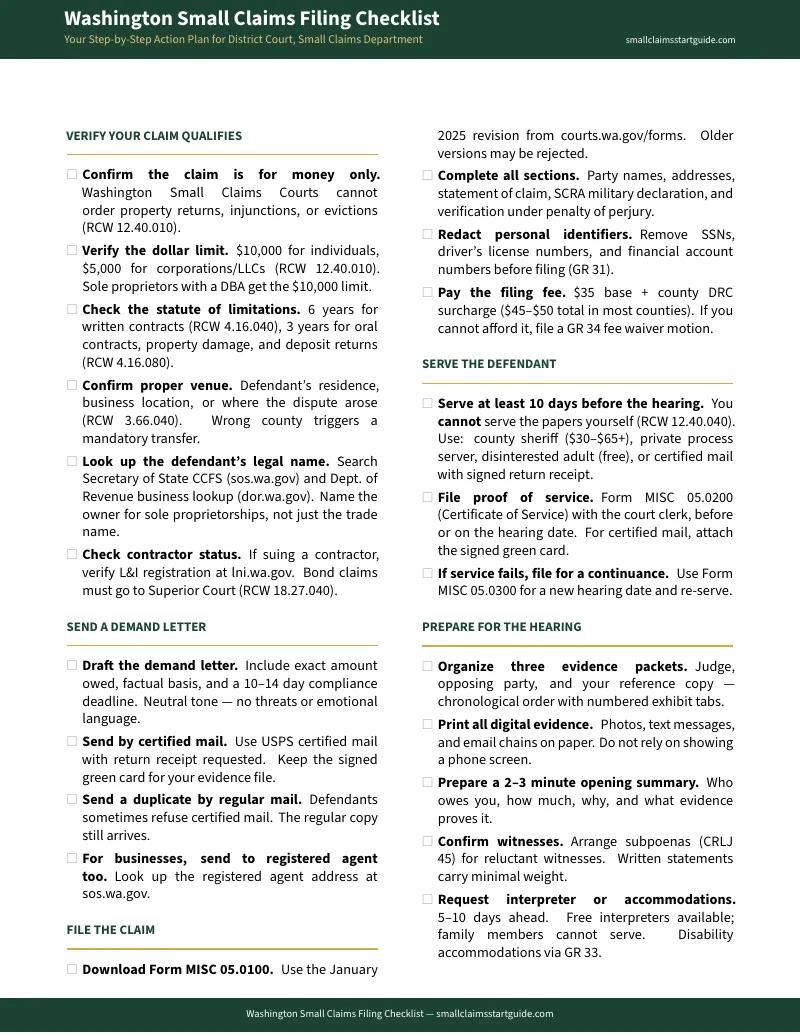
- Two-page filing checklist — 25 steps covering every form, fee and deadline you can tick off as you go (included free)
Who This Guide Is For
- A tenant whose landlord kept the security deposit past the 30-day statutory window
- A homeowner whose contractor took the deposit and left the job unfinished
- A sole trader or freelancer with an unpaid invoice that's been ignored for months
- A buyer who paid for goods or services that were never delivered or were defective
- A neighbour dealing with property damage — a fence, a tree, water runoff — and an unresponsive party
- A family member helping someone navigate the process who needs clear, printable materials
If you've been served with a claim and need to respond, the Washington Small Claims Response Guide covers that process instead.
Why Not Just Use the Free Court Resources?
You should. Every official form, statute and court contact is publicly available at no cost — and the guide links directly to those free sources. What the court website does not provide is a walkthrough that connects the pieces: which form goes first, what fee your specific county charges, how to serve the defendant when you can't do it yourself, how to organise evidence so the judge can follow your case in a 30-minute window, and what to do when the person you're suing is a business that uses a different legal name than the one on the storefront.
The guide doesn't replace the court's resources. It puts them in order, fills the gaps between them with execution worksheets, and gives you a structure that runs from the demand letter through to judgment day.
Satisfaction Guarantee
Full refund, no time limit. If the guide isn't what you expected, email [email protected] and you'll receive a complete refund — no form to fill out, no waiting period.
Get Started
Download the free checklist to see the full filing sequence on two printable pages. When you're ready for the complete guide — with every form instruction, county reference, service tracker, evidence organiser and deadline calendar — upgrade to the full Filing a Small Claims Case in Washington guide for .
Frequently Asked Questions
What if the rules change after I buy?
We update the guide when the rules change. Email us any time, even years later, and we'll send you the current edition free.