You Won. The Court Agreed You're Owed Money. So Where Is It?
You did everything right. You filed the claim, showed up to court, made your case, and the judge entered a judgment in your favour. The debtor owes you money — officially, on the record.
But the court doesn't collect it for you. The clerk can't advise you on what to do next. And the debtor is in no rush to write a cheque.
Now you're staring at a stack of enforcement forms — DC-451, DC-455, DC-456, DC-407 — with no idea which ones you need, what order to file them in, or how much each step costs. One wrong form wastes a sheriff fee. One missed attachment gets your filing rejected by mail.
Meanwhile, the debtor's paycheques keep clearing, and you're no closer to collecting what you're owed.
The Virginia Judgment Collection System
This guide turns your paper judgment into an organised enforcement plan. Instead of guessing which form to file or which tool might work, you follow a step-by-step sequence built around Virginia's actual statutory process — the same tools and procedures that attorneys use, laid out so you can execute them yourself.
The difference between this and Googling each step: every enforcement tool is explained in context. You'll know when to use interrogatories versus garnishment versus a levy, what each one costs, which forms pair together, and what the debtor can legally protect from collection. No more filing a garnishment summons only to discover the debtor's wages are fully exempt.
What's Inside the Guide
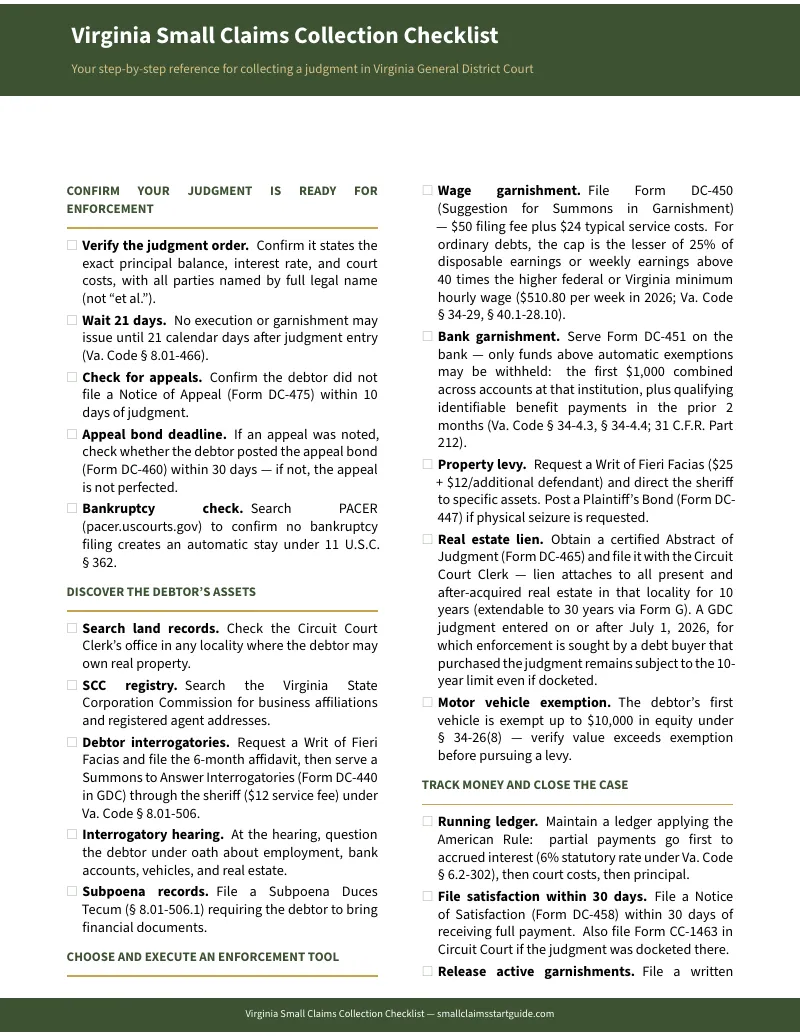
- The 10-day appeal stay protocol — exactly when enforcement can legally begin, how to confirm the judgment is final, and what to do if the debtor files an appeal to Circuit Court
- Debtor asset discovery — how to use Virginia's Summons to Answer Interrogatories (Va. Code § 8.01-506) to compel the debtor to reveal bank accounts, employers and property under oath, so you know what's collectible before you spend a dollar on enforcement
- Wage garnishment walkthrough — completing Form DC-451 with mandatory attachment DC-454, serving through the sheriff, the 2026 exemption floor ($510.80/week), handling the employer's answer on Form DC-456, and what happens when the debtor claims exempt wages
- Bank account garnishment — the same form sequence directed at a financial institution, frozen-funds procedures, and the timeline from summons to disbursement
- Property levy via Writ of Fieri Facias — requesting the writ, sheriff execution fees by jurisdiction, what personal property can be seized, and Virginia's homestead and personal property exemptions that limit what the sheriff will take
- Circuit Court real estate liens — docketing your General District Court judgment to encumber the debtor's real property; for judgments entered on or after July 1, 2021 the lien is enforceable for 10 years and can be extended up to 30 years under Va. Code § 8.01-251
- The full exemption map — every category of income and property Virginia protects from enforcement, written from the creditor's perspective so you can evaluate collectibility before each filing
- Post-Judgment Interest and Payment Ledger — applying the 6% statutory rate under Va. Code § 6.2-302, adding recoverable court costs and sheriff fees, and maintaining a running ledger of the total enforceable balance
- Satisfaction and closure — filing Form DC-458 to mark the judgment satisfied when the debtor pays, releasing any liens, and the statutory consequences under Va. Code § 8.01-454 if you fail to file
- Five fillable printables — Enforcement Readiness Checklist, Debtor Asset Discovery Worksheet, Post-Judgment Interest and Payment Ledger, Garnishment Filing Tracker, and Satisfaction Closing Checklist
Who This Is For
- Individuals who won in Virginia General District Court — including the Small Claims Division (claims up to $5,000) — and haven't been paid
- Freelancers and sole proprietors with an unpaid-invoice judgment who can't afford to lose billable hours researching court procedure
- Small businesses and landlords who need a repeatable, clerk-ready filing workflow for multiple judgments
- Anyone representing themselves — Virginia's Small Claims Division requires pro se representation, and this guide is written for people navigating enforcement without a lawyer
Why Not Just Use the Free Court Forms?
Virginia publishes every enforcement form for free — and this guide links directly to each one. What the court website doesn't give you is the sequence, the context, or the judgment calls.
The forms are scattered across multiple portals. There's no index that tells you Form DC-451 requires attachment DC-454 or your filing gets rejected. There's no explanation of when a bank garnishment makes more sense than a wage garnishment. There's no fee schedule that covers all jurisdictions, no interest calculator, and no guidance on what to do when the debtor claims an exemption.
You could piece all of this together from court websites, Reddit threads, and attorney blog posts — or you could have it organised in one place, in the right order, with every form reference and fee already verified.
A single rejected filing costs more in sheriff fees and wasted time than this entire guide. A collection agency takes 25–50% of everything they recover. An attorney bills $250–$450 per hour. This guide costs less than one sheriff service fee and lets you keep 100% of your judgment.
100% Satisfaction Guarantee
Full refund, no time limit. If the guide doesn't help you understand and execute Virginia's judgment collection process, email [email protected] and we'll refund every penny. No forms, no questions.
Start Collecting What You're Owed
Every day that passes without enforcement is another day the debtor's paycheques clear without a garnishment, another day their bank account stays untouched. Virginia's post-judgment interest accrues at 6% per year — but interest doesn't collect itself.
Download the free checklist to see what enforcement tools are available to you. When you're ready for the step-by-step instructions, the full guide is waiting — for less than the cost of a single sheriff service fee.
Get the full guide and start turning your paper judgment into real money — or grab the free Virginia Small Claims Collection Checklist to see what's ahead. The price is shown in your local currency — .
Frequently Asked Questions
What if the rules change after I buy?
We update the guide when the rules change. Email us any time, even years later, and we'll send you the current edition free.