You know the court exists. You don't know which precinct to file in.
Your contractor took your deposit and vanished. Your landlord is ignoring every text about the security deposit. A client owes you three months of invoices and has gone silent. You searched "how to file small claims in Texas" and found out Texas does not even call it small claims court — it is a Justice of the Peace Court, split into precincts and places, and every county has its own fee schedule and e-filing portal. The court's website gives you the rules by topic. It does not give you the rules in the order you need to follow them.
You do not need a legal textbook. You need to know which precinct to file in, what the petition form requires, how much it costs, how to get the citation to the other side, and what to bring to a hearing that runs fifteen to twenty minutes. One wrong name on the petition, one missed service deadline, and the judge dismisses your case before you open your mouth.
The Texas Filing Workflow
The Texas Small Claims Filing Guide takes the entire Justice Court process — from checking whether your claim fits the $20,000 limit through to enforcing the judgment after you win — and puts it in a single printable sequence. Every step names the statute or rule, the form, the fee, and the deadline. No guesswork, no tab-juggling, no wondering what comes next.
This is not a 400-page legal reference and it is not a $50–$200 filing service that submits your paperwork but leaves you on your own at the hearing. It is a procedural workflow that walks you through what to do, in what order, by when.
What's Inside
Understanding the Court System
Texas merged the old small claims court into the Justice Court system in 2013. The guide starts by explaining the four procedural tracks (Small Claims, Debt Claims, Repair and Remedy, Evictions), confirming your case belongs on the Small Claims track under TRCP Rules 500–507, and showing you how to verify the $20,000 jurisdictional ceiling — what counts toward the cap and what does not.
Statutes of Limitations — The Deadlines You Cannot Extend
Every type of claim has a mandatory filing deadline — two years for property damage and personal injury, four years for breach of contract. Sending a demand letter does not pause the clock. The guide walks through every deadline by claim type, shows you how to calculate yours from the date the dispute happened, and explains the diligence trap on service that catches people who file at the last minute.
The Demand Letter
Texas does not legally require a demand letter, but judges routinely ask whether you sent one — especially in contractor and security deposit disputes. The guide covers what the letter needs to say, how to send it by certified mail so you have a delivery receipt for court, and how long to wait before filing.
Filing the Petition — Paper or eFileTexas
The petition is the form that starts your case. The guide covers every required field: the dollar amount, the facts, the defendant's exact legal name, the military-status affirmation, and venue selection. The section that saves the most time is entity verification — using the Texas Secretary of State's SOSDirect portal and county DBA records to find the defendant's legal name before you file. A wrong name makes your judgment unenforceable even if you win.
Court Fees and the Fee Waiver
Base filing fees typically run $46–$54 across Texas counties. The guide covers the fee schedule, how to pay at the counter or through eFileTexas, and the full process for requesting a fee waiver using the Statement of Inability to Afford Payment of Court Costs — because tech filing services that charge $39–$200 per case rarely mention that free filing exists.
Serving the Defendant
You cannot hand the papers to the defendant yourself. A court-issued citation must be delivered by a Constable, a private process server, or (with court permission) by certified mail. Constable service fees run $65–$90 in the major metros and $50–$75 in rural counties. The guide lays out every method with the cost, the timing, and what to do if the first attempt fails — because a missed service deadline means your hearing gets postponed or dismissed.
Evidence Binder — Three Copies, Chronological Order
Texas Justice Court judges require physical hard copies of all evidence. You cannot display anything from your phone during the hearing. The guide shows you how to assemble three matching evidence binders — one for the judge, one for the defendant, and one for yourself — with contracts, invoices, text messages, photographs, and repair estimates in chronological order, tabbed and ready to reference when the judge asks a question.
The Hearing
What the courtroom looks like, how the Justice of the Peace runs the proceeding, how much time you typically get, how to present evidence without rambling, and what happens if the other side does not show up.
After the Decision
Winning does not mean the defendant writes you a cheque. After the 21-day appeal window closes, you may need to enforce the judgment yourself. The guide covers Abstracts of Judgment for real-property liens, Writs of Execution for wage garnishments and bank levies, and post-judgment discovery to find assets the defendant has not disclosed.
Printable Worksheets and Standalone Tools
Seven standalone PDFs you print and use throughout the case: a filing preparation worksheet, a demand letter template with mailing record, a citation service tracking log, a service of process planner comparing methods and costs, an evidence binder organizer, a deadline calendar worksheet, and a post-judgment enforcement decision tree. Each one corresponds to a phase of the filing process — fill them in as you go.
Who This Is For
- Tenants owed a security deposit. Your landlord had 30 days to return your deposit or send an itemised statement. If they retained it in bad faith, you may be entitled to up to three times the amount wrongfully withheld plus $100 in statutory damages. The guide covers the Property Code timeline and how to calculate your claim.
- Homeowners with a contractor dispute. The contractor took your money and disappeared, or the work is defective. The guide covers entity verification, naming the correct business on the petition, and presenting repair estimates as evidence.
- Small landlords owed rent or damage costs. Your former tenant left owing rent or caused damage beyond normal wear. The guide covers locating a former tenant for service and documenting damage with photographs and invoices.
- Sole traders and freelancers with unpaid invoices. A client owes you for completed work. The guide covers filing under a DBA, suing a business entity, and presenting an invoice trail.
- Buyers refused a refund. You paid for something that never arrived or did not match the description. The guide covers identifying a business's registered agent and establishing venue.
- Anyone owed money in Texas who wants to handle it themselves. If your claim is $20,000 or less and you would rather spend an evening with a step-by-step guide than an afternoon navigating county websites and calling the clerk, this is for you.
Why Not Just Use the Free Court Resources?
You should use them — and the guide tells you exactly when and where. TexasLawHelp.org publishes forms and self-help articles. The Texas Justice Court Training Center offers self-represented litigant packets. County clerk staff can answer basic procedural questions, though they are legally prohibited from telling you how to draft your claim or what to say at the hearing.
What none of those resources do is put the information in the order you need it. The self-help pages are organised by topic — one page for fees, another for service, another for the hearing — not by step. The packets provide blank forms without instructions on how to complete them. Tech filing platforms automate the paperwork for $39–$200 per case, but they do not prepare you for the courtroom, and they rarely mention that fee waivers exist.
The guide does the organisational work: every form, every fee, every deadline, in the order you encounter them, with a checklist you can print and work through. It sits between the free information (which you still need) and a filing service (which submits your paperwork but does not prepare you for the hearing).
What This Is Not
This guide explains the procedure. It does not give legal advice, predict outcomes, or tell you how to argue your case. It is not published by, affiliated with, or endorsed by any Texas court, the Office of Court Administration, or any government agency. If you need legal advice, contact a lawyer. If you need free help, the guide lists the resources available through TexasLawHelp.org and the Texas Justice Court Training Center.
Satisfaction Guarantee
Full refund, no time limit. If the guide is not what you expected, email [email protected] and we will refund you — no questions, no deadline.
Get Started
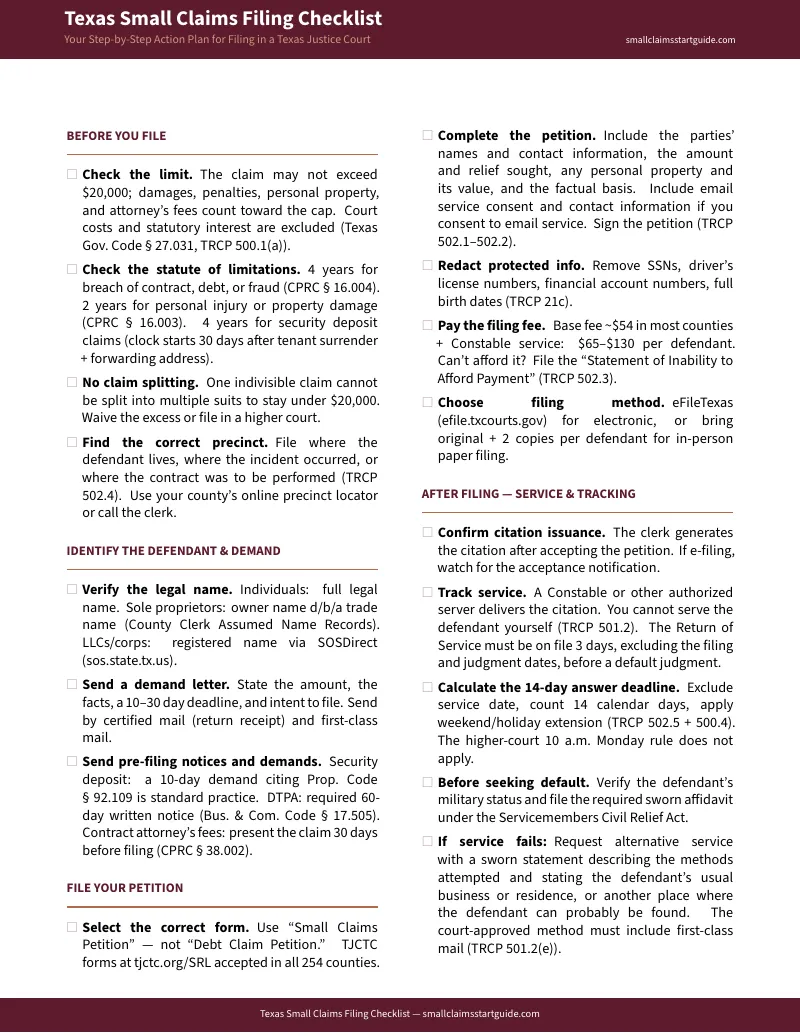
Download the free Texas Small Claims Filing Checklist — a one-page summary of the limit, forms, fees, service steps, and deadlines. If you want the full guide with step-by-step instructions, evidence binder templates, and the deadline calendar, get the complete Texas Small Claims Filing Guide for .