
You won. Now you have to collect it yourself.
The judge signed your judgment. The case is over. But no one at the courthouse is going to put that money in your account.
Tennessee General Sessions Courts enter judgments. They do not enforce them. The Clerk cannot tell you what to do next — deputy clerks are legally prohibited from giving legal advice, even about which form to file. The Sheriff will serve writs you prepare, but will not track down the debtor's assets or recommend an enforcement strategy. Every legal aid organization in the state is funded to defend debtors, not help creditors collect. And the attorneys who handle post-judgment work want retainers that swallow half of what you are owed when the judgment is under $10,000.
So you are on your own. And the process involves the General Sessions Clerk, the county Sheriff, the Register of Deeds, three different types of garnishment writ, a set of debtor protections that can dissolve your enforcement if you do not account for them, and a mandatory 10-day waiting period that invalidates everything you file if you start too early.
The Tennessee Enforcement Sequence
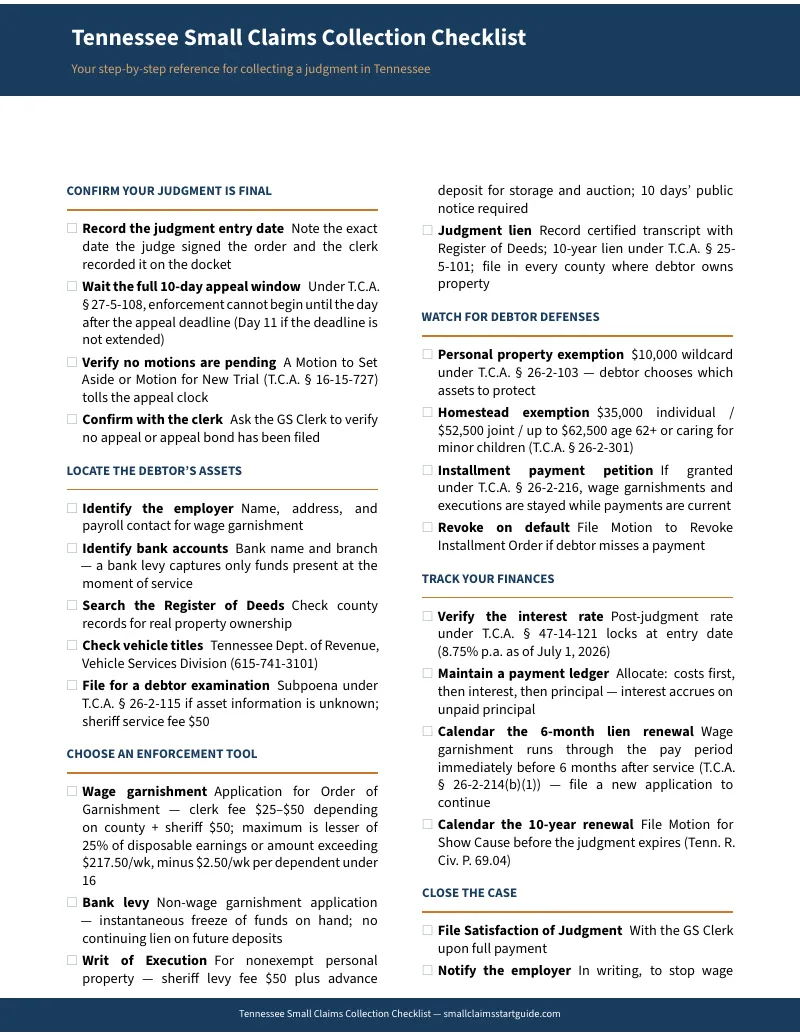
This guide replaces the confusion with a single enforcement sequence — every tool, every form, every fee, in the order that protects your money and your time.
Instead of guessing whether to start with wage garnishment or a bank levy, you follow the same progression that experienced collections attorneys use: confirm the judgment is final, discover what the debtor actually owns, then choose the enforcement tool that matches the assets you found.
That sequence matters because the wrong starting point wastes real money. A wage garnishment served on an employer before you confirm the debtor still works there costs filing fees and sheriff service fees you will not get back. A bank garnishment served on the wrong branch wastes the same. A property levy requires advance deposits before the Sheriff will act. The guide starts with the zero-cost debtor examination and builds from there.
What You Get
- 10-day finality verification — Tennessee judgments are not enforceable until 10 calendar days pass without an appeal under T.C.A. § 27-5-108, and a pending motion to set aside tolls the clock further; the guide walks you through confirming finality with the Clerk before you spend a single fee on enforcement
- Debtor examinations under T.C.A. § 26-2-115 — how to compel the debtor to appear and disclose bank accounts, employment, vehicles, and real property under oath, what to do when they ignore the order, and how to use the disclosure to choose your first enforcement tool
- Wage garnishment, step by step — from filing the application through the General Sessions Clerk to serving the employer through the Sheriff, with the federal 25% disposable-earnings cap, Tennessee's dependent-child deductions, the 6-month continuing lien that keeps payments coming, and renewal instructions when the lien period expires
- Bank garnishment walkthrough — how to freeze and collect funds held at the debtor's financial institution, the garnishee answer timeline, and how to handle a zero-balance response without losing the fees you already paid
- Property execution and Sheriff levies — requesting a Writ of Execution, the Sheriff's levy process, the advance deposit requirement, the public sale procedure, and the realistic recovery you can expect after costs
- Real estate liens that outlast the debtor's excuses — recording a certified judgment transcript with the county Register of Deeds to establish a lien that attaches to every parcel the debtor owns in that county, the 10-year lifespan, renewal, and how the lien gets paid when the debtor eventually sells or refinances
- Tennessee exemptions mapped — every major asset the debtor can legally shield, including the $10,000 personal property exemption under T.C.A. § 26-2-103, the homestead exemption ($35,000 individual / $52,500 joint), and the wage protections, so you know what is actually reachable before spending money to seize it
- Post-judgment interest calculation — how to apply the statutory interest rate under T.C.A. § 47-14-121 (locked for the life of the judgment), allocate partial payments correctly to costs, interest, and principal, and maintain a payment ledger that holds up if the debtor disputes the balance
- Installment orders and default — what happens when the debtor files a slow-pay petition under T.C.A. § 26-2-216, how an installment order stays active garnishments, and how to reinstate enforcement immediately when the debtor misses a payment
- County-specific clerk guidance — navigating the administrative differences across Tennessee's 95 counties, from Davidson County's eFiling portal to Shelby County's online garnishment answer system to paper-only rural courthouses
Who This Is For
You have a final judgment from a Tennessee General Sessions Court and the other side has not paid. Maybe they are ignoring you entirely. Maybe they paid part of it and stopped. Maybe you have no idea what they own or where their money is.
You do not need a lawyer for this. Every enforcement tool in this guide uses standard forms available from the General Sessions Clerk, the Sheriff, or the Register of Deeds. The guide shows you which form, which office, and which fee — in order.
Why Not Just Use the Free Court Forms?
The forms are free. What is not free is the knowledge of which form to file, at which office, in what order, with what deposit.
Tennessee county court websites range from Shelby County's downloadable PDFs to Perry County's complete absence of online self-help. Even the counties that offer forms provide no sequencing, no explanation of the Sheriff's advance deposit requirements, no debtor examination walkthrough, and no guidance on the exemptions that could make your entire enforcement effort pointless.
And the Clerk's office cannot help you sort it out. Blount County's civil division states it plainly: deputy clerks cannot give legal advice, and filers are advised to consult an attorney.
The result is predictable: creditors file garnishments before running asset discovery, serve writs before the 10-day finality window closes, attempt to seize homestead-protected property, or let a garnishment lien lapse by missing the 6-month renewal. Each mistake costs filing and service fees that are not refundable — and some errors hand the debtor grounds to vacate the entire enforcement action.
The guide puts every step in the right order so the forms actually work.
Satisfaction Guarantee
Full refund, no time limit. If the guide does not help you move forward with collecting your judgment, email [email protected] and we will refund your purchase — no questions, no deadline.
Start Collecting What You Are Owed
The free checklist gives you the enforcement overview — the waiting period, the main tools, the key exemptions. It is a solid starting point.
The full guide gives you the execution: every form identified, every fee listed, every office mapped, every step sequenced — plus 6 printable worksheets (asset discovery tracker, wage garnishment calculator, payment ledger, enforcement timeline planner, county clerk intake checklist, and satisfaction of judgment checklist). Yours to keep permanently — .
Frequently Asked Questions
What if the rules change after I buy?
We update the guide when the rules change. Email us any time, even years later, and we'll send you the current edition free.