You're owed money. The court can get it back — if you file correctly.
You did the work, you held up your end, and now someone won't pay. Maybe a contractor walked off with your deposit. Maybe your landlord ghosted you after move-out. Maybe a client is ignoring your invoices. Whatever happened, the money is yours and you want it back.
Tennessee's General Sessions Court is built for exactly this — claims up to $25,000, no lawyer required. But the court won't hold your hand through the process. You have to file the right form (it's called a Civil Warrant, not a complaint), pay the right fees (they vary by county — anywhere from $140 to $270), serve the other side properly, and show up prepared. Get any of those steps wrong and your case can be dismissed before you ever see a judge.
The County Filing Navigator
This is not a generic overview of how courts work. The Filing a Small Claims Case in Tennessee guide is a county-level procedural navigator — it walks you through the exact sequence of steps for your General Sessions Court, flags the county-specific rules that trip people up, and gives you printable worksheets so you arrive at the clerk's counter with everything in order.
Think of it as the instruction manual the courthouse should give you but doesn't.
What's Inside
- 8-step filing sequence — from checking the jurisdictional limit and statute of limitations all the way through to what happens after the judge rules. Every step in order, nothing skipped.
- Civil Warrant walkthrough — line-by-line instructions for completing Tennessee's filing form, including how to write the cause of action and correctly name business defendants (DBA, LLC, or individual).
- County fee tables — verified filing fees, sheriff service costs and accepted payment methods for Davidson, Shelby, Knox, Hamilton, Blount and other counties, so you know the total cost before you go.
- Three ways to serve — county sheriff, private process server, or certified mail, with the cost, timeline and when each one makes sense for your situation.
- Evidence preparation worksheets — a structured system for organising contracts, invoices, photos, texts and receipts into three exhibit packets (judge, defendant, your copy) so your presentation looks professional.
- Demand letter template and guidance — how to write a formal demand that meets judicial expectations and sometimes resolves the dispute before you ever file.
- Deadline calendar — key dates mapped out: the statute of limitations for your claim type, the service deadline, the 10-day appeal window, and every other timeline that matters.
- Fee-relief instructions — how to complete the Uniform Civil Affidavit of Indigency if the filing fees are a hardship, with an explanation of what the court considers.
- 6 printable worksheets — demand letter template, defendant identification worksheet, filing cost calculator, service-of-process tracker, evidence organization checklist and deadline calendar. Print them, fill them in by hand, and bring them to the clerk's counter and the courtroom.
Who This Is For
- Homeowners with a contractor who took a deposit and disappeared or left the job unfinished
- Tenants owed a security deposit with no itemised deductions after 30 days
- Small landlords chasing unpaid rent or property damage beyond the deposit
- Sole traders, freelancers and small business owners with unpaid invoices
- Private sale buyers who never received a clean title or got a defective vehicle
- Anyone in a property or boundary dispute under $25,000
Why Not Just Use Free Resources?
Tennessee's court website gives you blank forms. Legal aid sites summarise the rules. Blog posts give you eight steps with no detail. None of them tell you that Blount County doesn't accept personal cheques, or that Shelby County won't send you a hearing notice and expects you to check the docket yourself, or that suing a business operating under a trade name means searching the Secretary of State database first.
Free resources tell you that you need to file a Civil Warrant. This guide tells you how — line by line, county by county, with the worksheets to keep everything organised.
What This Is Not
This is an independent educational guide. It is not legal advice, it is not published by any court, and it cannot predict how a case will turn out. It explains the procedure — the forms, the fees, the steps, the deadlines — so you can handle your own claim with confidence. If you need advice on the merits of your case, consult a licensed attorney.
Full refund, no time limit.
If the guide doesn't help, email [email protected] for a full refund. No window, no questions.
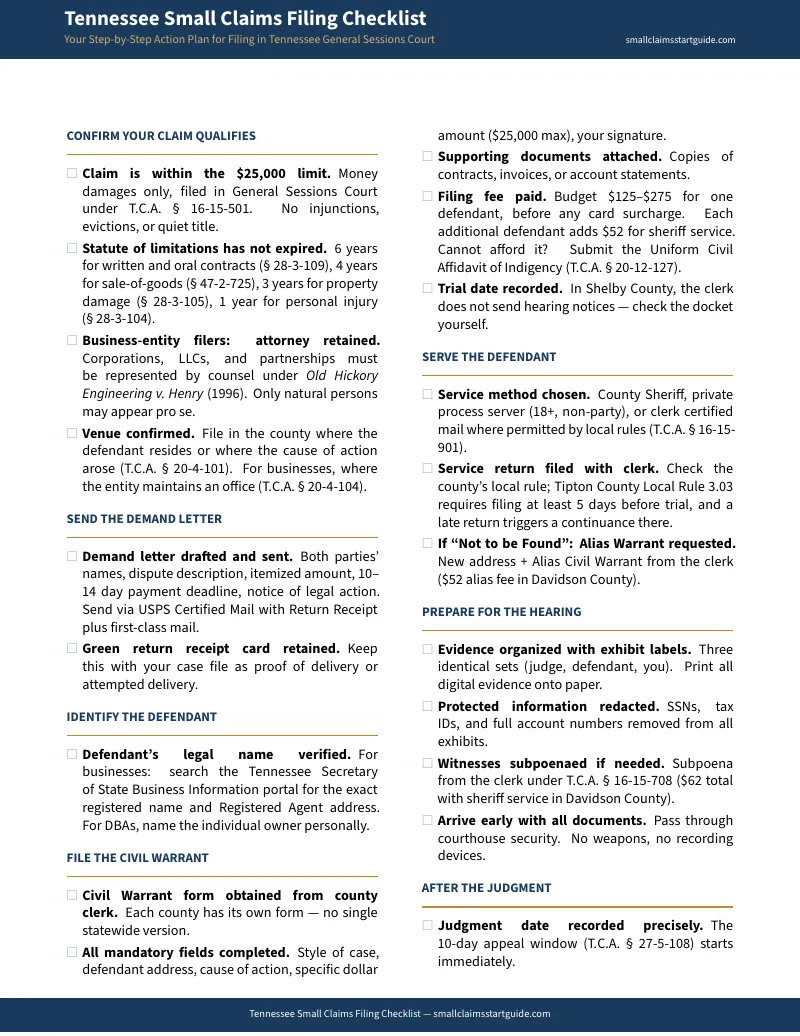
The free checklist gives you the overview. The full guide gives you the system. Download the checklist to see if this fits your situation — or get the complete guide and start preparing your case today.
Frequently Asked Questions
What if the rules change after I buy?
We update the guide when the rules change. Email us any time, even years later, and we'll send you the current edition free.