You've been served. South Dakota gives you days, not weeks.
A small claims summons just landed — maybe by certified mail, maybe hand-delivered by the county sheriff. The papers look official. The numbers don't make sense. And somewhere in the fine print is a date that, if you miss it, means the court rules against you without ever hearing your side.
That's a default judgment. It can become a lien on your property, a garnishment on your bank account, or a mark on your credit report. And in South Dakota small claims court, there is no appeal. The magistrate's decision is final. You get one hearing, one chance to present your side — and if you never show up or never respond, you don't even get that.
The South Dakota Small Claims Response System is a step-by-step procedural framework that takes you from "I just got served" to "I'm walking into the hearing with my response filed, my evidence organized, and my deadline met." It's not a collection of tips. It's the complete defendant response sequence — reading the papers, calculating your deadline, choosing your response option, filing the right form, preparing for the hearing — with every form, fee, and statutory window in the order you need them.
What's inside
- Summons decoder — your service packet contains three plaintiff-side forms and a court-issued summons. The guide maps each document so you know what demands a response, what's informational, and how to verify the case is real through the clerk's office.
- Court-day deadline calculator — South Dakota counts response deadlines in court days under SDCL § 15-39-54, not calendar days. Weekends, state holidays, and the day of service don't count. One mistake in the count and you're defaulted. The guide includes a worked example showing the exact calculation.
- Form UJS-278 field-by-field walkthrough — the official Denial and Counter Claim form is your response vehicle. Every field is explained: how to deny specific allegations, how to admit what you agree with, how to attach a counterclaim, and the single-sided black-ink printing rule the court enforces without exception.
- Response option map — deny the claim, admit it, negotiate a settlement with a written stipulation and Form UJS-255 dismissal, or file a counterclaim up to the $12,000 jurisdictional limit. The guide explains each path, what it costs, and when each one makes sense procedurally.
- Transfer petition guide — if you want an appeal right or a jury trial, you must petition to transfer the case to the regular civil docket within 5 court days of being served. The guide covers the $35 transfer fee, the $250 appeal bond, and the exact timeline — because once that 5-day window closes, it's closed permanently.
- Evidence preparation framework — contracts, receipts, bank statements, text messages, and photos organized for the magistrate. Includes the three-copy rule (one for the judge, one for the plaintiff, one for you), guidance on what gets excluded as hearsay, and how to handle witness testimony.
- Hearing day walkthrough — what happens when you arrive, how testimony works in small claims procedure, how the magistrate typically runs the hearing, and the rules about subpoenas if you need a witness who won't come voluntarily.
- Post-decision chapter — paying a judgment, requesting a payment schedule, filing Form UJS-019 (Satisfaction of Judgment) to clear court records, and understanding that the decision is final under SDCL 15-39-57.
- Six standalone printable tools — a court-day deadline calculator, a Form UJS-278 preparation worksheet, a response filing checklist, an evidence organizer, a hearing preparation checklist, and a post-decision action tracker. Print them, fill them in, and bring them to the courthouse.
Who this is for
You've been served with a small claims summons in South Dakota and the amount is $12,000 or less:
- A homeowner sued by a contractor over an unpaid invoice or disputed work
- A tenant sued by a former landlord for property damage beyond the security deposit
- A landlord sued by a former tenant over a security deposit withholding
- A small business owner, freelancer, or sole trader sued by a customer
- A private seller or buyer in a vehicle sale or property damage dispute
- A neighbour in a fence line, pet damage, or livestock damage claim
Why not just use the free court resources?
You should. The South Dakota Unified Judicial System publishes every form for free, and their Guide and File tool helps you fill them in online. The UJS Self-Represented Litigant Helpline (1-855-784-0004) answers questions about completing forms.
What none of those resources do is put the defendant's steps in order. The UJS website lists forms on one page, fees on another, and deadline rules in a statute most people don't know how to read. The helpline can explain a field on a form, but court staff are legally prohibited from advising you on your options, recommending whether to deny or counterclaim, or calculating your deadline for you.
And Guide and File — the tool most defendants assume submits their response electronically — does not file anything. It generates a printable PDF. You still have to print it single-sided in black ink, sign it, and physically deliver it to the Clerk of Courts.
The guide is the execution layer those resources are missing: the step-by-step sequence, the deadline calculator, the form walkthrough, and the evidence framework that connect scattered court information into a defendant response workflow you can follow from start to finish.
What this guide is not
This is an independent procedural guide. It is not published by, endorsed by, or affiliated with the South Dakota Unified Judicial System, any circuit court, or the State Bar of South Dakota. It does not give legal advice, predict outcomes, or tell you whether you will win. The magistrate decides every case on its merits.
If the plaintiff is a credit card company, debt buyer, or collection agency, the lawsuit involves federal protections under the Fair Debt Collection Practices Act that are outside this guide's scope. Contact free legal aid immediately — the guide provides the numbers.
If you need legal representation, East River Legal Services covers 33 eastern counties and Dakota Plains Legal Services covers 33 western counties and nine tribal reservations — both serve low-income residents through sdlawhelp.org.
Full refund, no time limit
If the guide is not what you expected, email [email protected] for a full refund. No deadline, no conditions.
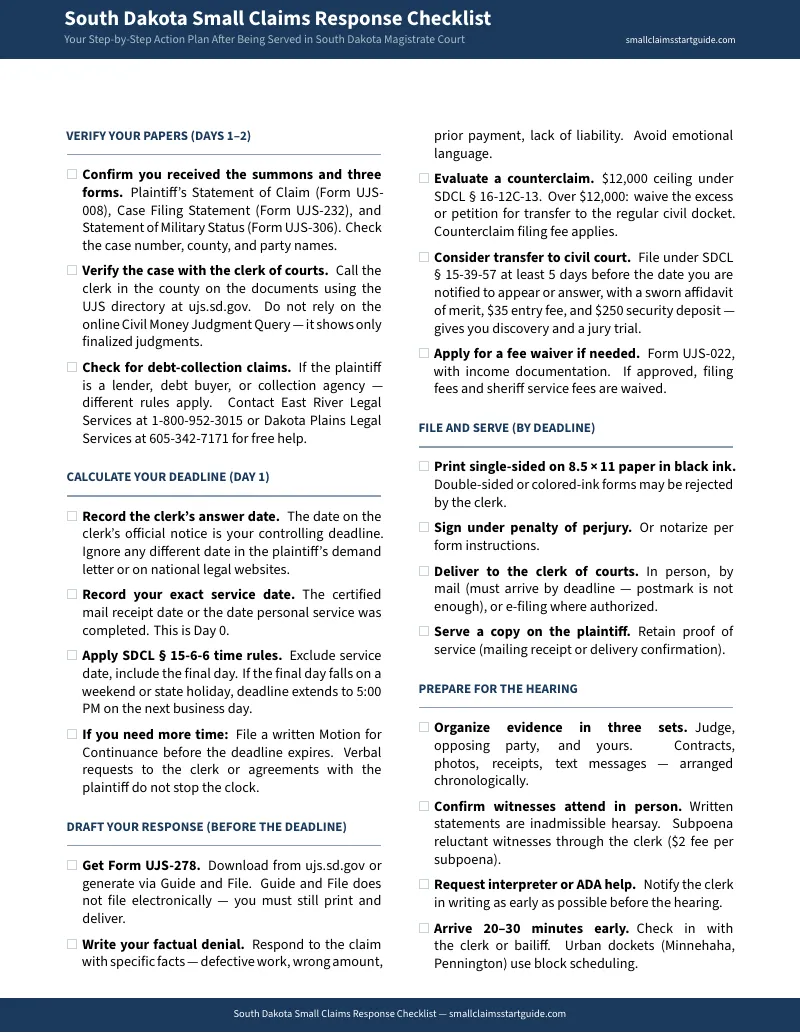
Download the free checklist to see the response deadline, options, forms, and hearing preparation steps at a glance. When you're ready for the complete system — the deadline calculator, the Form UJS-278 walkthrough, the evidence framework, and the hearing prep — get the full guide.
Frequently Asked Questions
What if the rules change after I buy?
We update the guide when the rules change. Email us any time, even years later, and we'll send you the current edition free.