You Won. Now What?
The judge ruled in your favor. You walked out of Magistrate Court with a judgment for every dollar you were owed. But nobody handed you a check, and nobody from the court is going to call the other side and ask them to pay.
In South Dakota, collecting a small claims judgment is entirely your job. The court adjudicates — it does not enforce. And between the sheriff's non-refundable execution fees, the uninstructed blank forms on the UJS website, and clerks who are legally prohibited from telling you which paperwork to file first, most people either give up or waste hundreds of dollars on enforcement actions that come back empty.
The Judgment Enforcement Roadmap
This is a complete, step-by-step system for turning a South Dakota small claims judgment into actual money in your hands. It does not assume you have a legal background. It does not assume you have done this before. Every chapter walks you through one enforcement tool — with the exact South Dakota statute, the specific UJS form number, the office where you file it, and the fee you will pay before you walk through the door.
Most free resources tell you that you can garnish wages or levy a bank account. This guide tells you how — form by form, step by step, with the exemptions and fee schedules that determine whether the enforcement action is worth filing in the first place.
What's Inside
- The 30-day enforcement timeline — know exactly when the appeal window closes and enforcement can legally begin, so you do not file early and have your paperwork rejected
- Asset discovery before you spend a dollar — a framework for identifying the debtor's employment, bank accounts, and real property before you pay non-refundable sheriff fees on a writ that may come back empty
- Wage garnishment walkthrough — the complete Garnishee Summons and Affidavit process under SDCL Chapter 21-18, including how to calculate the 20% disposable earnings cap so you garnish the legal maximum without the court tossing your paperwork
- Bank account garnishment — how to serve the garnishment on the financial institution, what happens when the account holds exempt federal benefits, and how the disclosure process works
- Writs of execution through the county sheriff — the exact fee structure (Minnehaha County charges $105, Pennington County requires a $105 deposit) and the 60-day expiration window, so you know the cost and timing before you commit
- Real estate liens — your judgment automatically created a lien when it was docketed. Learn how long it lasts (10 years, renewable for 10 more), how to record it in additional counties, and when it pays off at a property sale
- Debtor examinations — the supplementary proceedings process under SDCL Chapter 15-20, including the Second Judicial Circuit's rule that exams must happen before a judge or court referee, not a non-judicial officer
- Post-judgment interest calculation — a straightforward formula for applying the 10% annual rate under SDCL § 54-3-5.1 to track exactly what the debtor owes you at any point
- Filing satisfaction and releasing liens — how to complete Form UJS-019 when the judgment is paid, discharge real estate liens, and close the case properly so you are not on the wrong end of a show-cause order
- 6 printable worksheets — an enforcement decision flowchart, post-judgment balance tracker, wage garnishment calculator, debtor asset screening checklist, agency communication log, and enforcement timeline tracker
Who This Guide Is For
- Individuals who won a small claims judgment over an unpaid loan, security deposit, property damage, or contract dispute — and have not been paid
- Landlords collecting on lease disputes or property damage awards
- Sole proprietors and small business owners recovering unpaid invoices, service contracts, or bounced checks
- Family members or assistants handling court paperwork on behalf of someone else
You do not need a lawyer to use these enforcement tools. Every step tells you the form, the office, and the fee.
Why Not Just Use the Free Court Forms?
The forms on the UJS website are free. But they are blank PDFs — no instructions, no completion guide, no fee schedule, and no explanation of which form to file in which order. The court's own handbook says that advanced collection procedures are "legally complex, and the assistance of an attorney may be required." Legal aid organizations in South Dakota do not help judgment creditors collect private debts.
An attorney will cost you a retainer or take a third of whatever you collect. One failed writ of execution costs you $105 in non-refundable sheriff fees — and you get nothing back if the debtor has no assets to seize. This guide costs a fraction of a single enforcement filing and shows you how to check for assets before you spend that money.
Full Refund, No Time Limit
If the guide does not help you, email [email protected] for a full refund. No time limit, no questions.
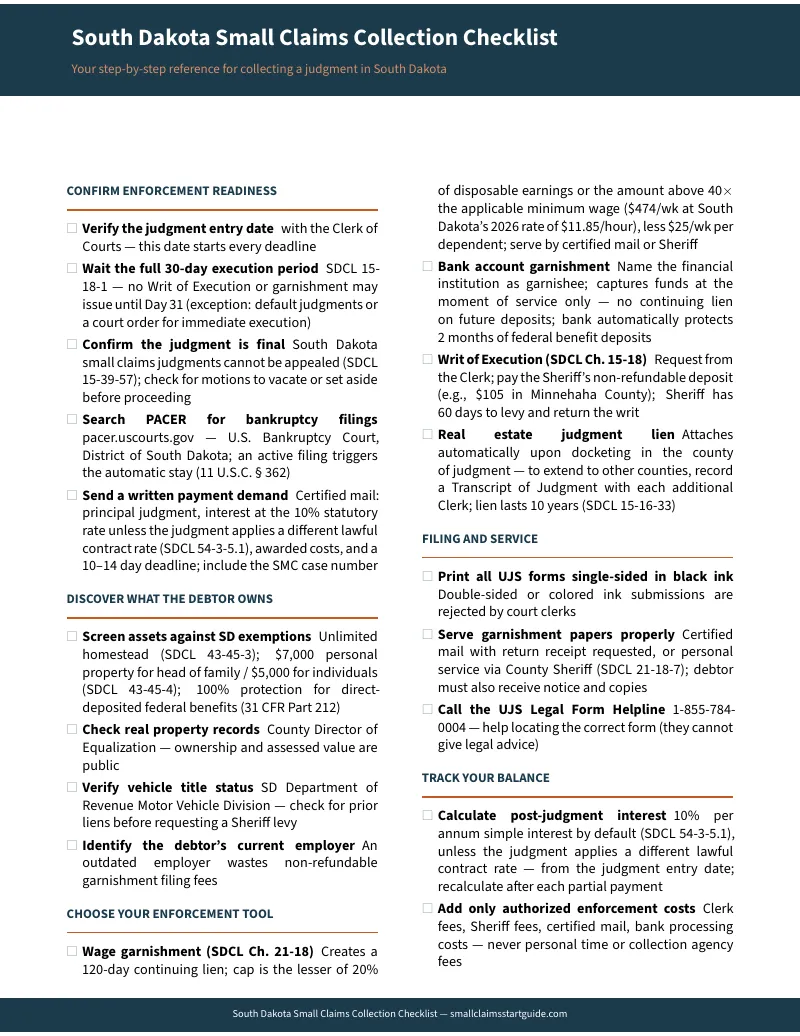
Start with the free checklist
Download the free collection checklist to see the five mandatory steps before filing any enforcement action. When you are ready for the full step-by-step process — every form, every fee, every exemption — the complete guide picks up right where the checklist leaves off.
Frequently Asked Questions
What if the rules change after I buy?
We update the guide when the rules change. Email us any time, even years later, and we'll send you the current edition free.