South Dakota gives you one shot. Walk in ready.
You're owed money. The contractor walked off with your deposit, your landlord is ghosting you on the security deposit, or a client never paid the invoice. You've tried asking nicely. You've tried firmly. Now you need the court to step in.
But here's what most people don't realize until it's too late: South Dakota small claims judgments are final. There is no appeal. If you file in the wrong county, name a trade name instead of the registered LLC, let certified mail service lapse without escalating to the sheriff, or show up with unsworn written statements that get excluded as hearsay — you lose. Permanently.
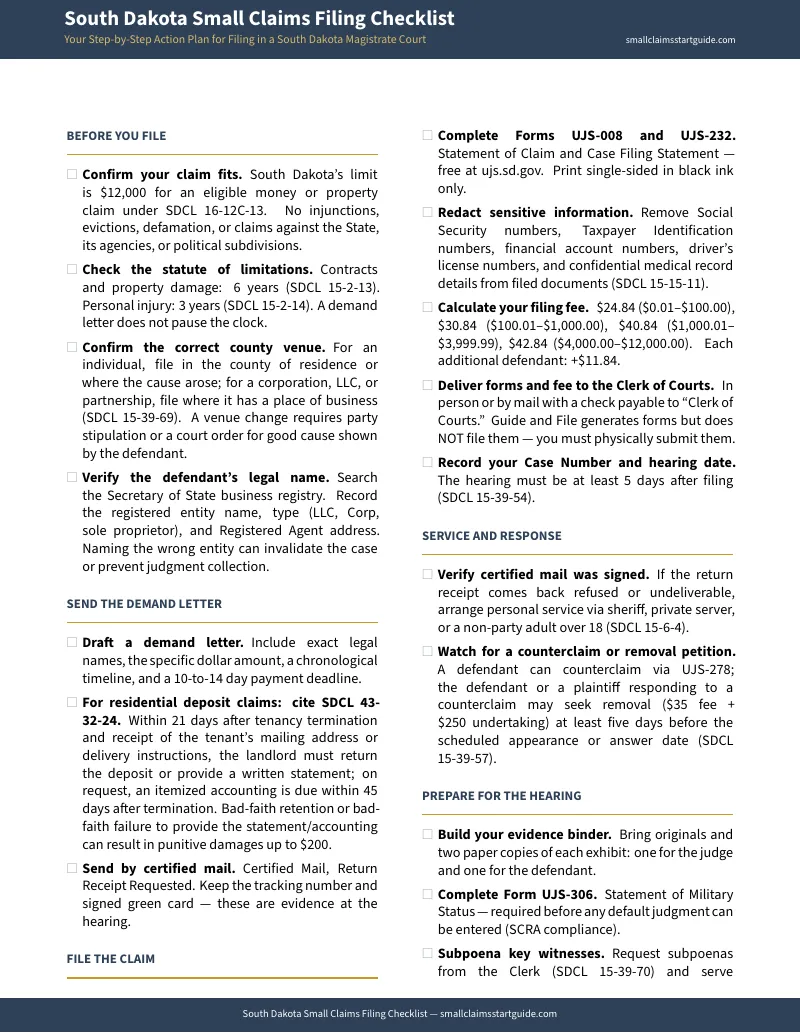
The South Dakota Small Claims Filing System is a step-by-step execution framework that takes you from "I'm owed money" to "I'm walking into court with everything filed, served, and organized." It is not a collection of tips. It is the complete sequence — demand letter through hearing — with every form, fee, deadline, and evidence rule in the order you need them. You get 9 PDFs: the 45-page guide, a pre-filing checklist, and 7 standalone fill-in worksheets you print and use at each stage.
What's inside
- Entity verification walkthrough — the Secretary of State business register search that tells you the defendant's exact legal name and registered agent before you file. Naming "Dave's Plumbing" instead of "David R. Miller LLC" gets your case dismissed, and the filing fee is gone.
- County venue map — South Dakota requires filing where the defendant lives or where the loss happened. File in the wrong county and you forfeit a non-refundable fee of up to $42.84 and start over.
- Form-by-form filing instructions — UJS-008 (Statement of Claim), UJS-232 (Case Filing Statement), and UJS-306 (Military Status Affidavit), with every field explained in plain language. Plus the mandatory single-sided, black-ink printing rules that the UJS enforces.
- Fee calculator — the exact filing fee for your claim amount ($24.84 to $42.84), plus the $11.84 surcharge for each additional defendant, so you write the right check the first time.
- Service tracking system — how clerk-handled certified mail works, how to confirm delivery, and exactly when to request sheriff hand-service if the defendant dodges the mail. A stalled service means a postponed hearing and more weeks of waiting.
- Security deposit timeline calculator — for tenants: the 21-day return/statement and 45-day itemized-accounting windows under SDCL 43-32-24, the $200 statutory penalty, and pre-formatted claim language for Form UJS-008.
- Evidence binder framework — contracts, receipts, photos, and text messages organized for the three-copy rule (judge, defendant, you), with guidance on what gets excluded as hearsay and how to get testimony admitted.
- Hearing preparation chapter — what to expect in front of the magistrate judge, how to present your case clearly, and the courtroom rules that trip up first-time filers.
- Deadline calendar — every statutory window on one page so nothing expires while you're figuring out the next step.
Who this is for
You are owed money, the amount is $12,000 or less, and you want to handle the court process yourself:
- A homeowner whose contractor took a deposit and never came back
- A tenant whose landlord missed the statutory deposit return deadline
- A small landlord with unpaid rent or damage beyond the deposit
- A sole trader or freelancer with an outstanding invoice
- A buyer refused a refund by a local business
- A neighbour with a vehicle, pet, or property damage bill
Why not just use the free court resources?
You should. The South Dakota Unified Judicial System publishes every form for free, and their Guide and File tool helps you fill them in online. The UJS Legal Form Helpline (1-855-784-0004) answers questions about completing forms.
What none of those resources do is put the steps in order. The UJS website gives you forms on one page, fees on another, and service rules on a third. The helpline can explain a field on a form but is legally prohibited from reviewing your evidence or advising on your case. And Guide and File — the tool most filers assume submits their claim electronically — does not file anything. It generates the PDF. You still have to print it single-sided, sign it in black ink, and physically deliver it to the Clerk of Courts with a check.
The guide is the execution layer those resources are missing: the sequence, the checklists, the tracking systems, and the worked examples that connect the court's scattered information into a filing you can follow from start to finish.
What this guide is not
This is an independent procedural guide. It is not published by, endorsed by, or affiliated with the South Dakota Unified Judicial System, any circuit court, or the State Bar of South Dakota. It does not give legal advice, predict outcomes, or tell you whether your claim will succeed. The magistrate judge decides every case on its merits.
If you need legal representation, East River Legal Services covers 33 eastern counties and Dakota Plains Legal Services covers 33 western counties and nine tribal reservations — both serve low-income residents through sdlawhelp.org.
Full refund, no time limit
If the guide is not what you expected, email [email protected] for a full refund. No deadline, no conditions.
Download the free checklist to see the filing steps, forms, fees, and deadlines at a glance. When you're ready for the complete system — entity verification, service tracking, evidence organization, and hearing prep — get the full guide.
Frequently Asked Questions
What if the rules change after I buy?
We update the guide when the rules change. Email us any time, even years later, and we'll send you the current edition free.