You Were Just Served. Now What?
A process server handed you papers — or they arrived by certified mail. Your name is on a Summons and Complaint from a South Carolina Magistrate Court. You have 30 calendar days from the day after service to file a written Answer. If you miss that window, the plaintiff can request a default judgment, and the court can rule against you without ever hearing your side.
That is the reality. And right now you are probably wondering: What do I actually need to do, in what order, and how do I not make a mistake that costs me the case before the hearing even starts?
The Defendant's Response System
The Responding to a Small Claims Case in South Carolina guide is a step-by-step system that takes you from staring at court papers to walking into the hearing prepared. It covers every procedural step the Magistrate Court expects from a defendant — the deadlines, the forms, the service requirements, the evidence rules — organized in the order you need them.
This is not a generic legal overview. Every page applies specifically to South Carolina's Magistrate Court, references the actual SCCA forms you need, and follows the South Carolina Rules of Magistrates Court (SCMCR) that govern your case.
What's Inside
- Served Papers Decoder — how to read the Summons (Form SCCA/704) and Complaint (Form SCCA/705), verify the case is real, spot service defects, and separate civil claims from debt-collection lawsuits that need entirely different handling
- 30-Day Deadline Calculator — the exact SCMCR Rule 3 formula with worked date examples, the weekend and holiday extension rule, and a fill-in worksheet so you know your actual filing date
- Answer Writing Walkthrough — how to complete Form SCCA/703 paragraph by paragraph, choosing between admitting, denying, or stating you lack knowledge for each allegation, plus how to raise affirmative defenses like improper venue, expired statute of limitations, and lack of jurisdiction
- Counterclaim Decision Framework — when filing a counterclaim protects you (compulsory counterclaim waiver), the $7,500 cap, and the mandatory transfer to the Court of Common Pleas under S.C. Code § 22-3-30 if your counterclaim exceeds it
- Filing and Service Protocol — the SCMCR Rule 8 requirements for serving your Answer on the plaintiff (first-class mail or hand delivery), filing a Certificate of Service with the clerk, and the common mistakes that invalidate otherwise valid filings
- Hearing Preparation System — organizing evidence into the required three-copy sets (Judge, opposing party, your copy), scheduling live witnesses (South Carolina Magistrate Courts do not accept written witness statements — a rule that catches most defendants off guard), subpoena procedures at $8.00 per witness, and courtroom etiquette
- Post-Decision Roadmap — the 10-day window for a Motion for a New Trial, the 30-day appeal to the Court of Common Pleas, and the enforcement realities including what happens if you win but the other side does not pay
- Business Entity Rules — how corporations, LLCs, and partnerships can use SCMCR Rule 21 to have a non-lawyer officer or employee represent them, including the SCCA/761 and SCCA/762 authorization forms
Who This Is For
This guide is for self-represented defendants in South Carolina Magistrate Court handling non-debt civil claims up to $7,500:
- Homeowners sued by contractors — disputing an unpaid invoice, work quality, or scope changes
- Former tenants or landlords — security deposit disputes, post-tenancy property damage claims
- Small business owners — customer complaints, service disputes, product defect claims
- Private vehicle sellers or buyers — undisclosed defect allegations, title transfer disputes
Not for debt-collection lawsuits. If the plaintiff is a credit card company, debt buyer, or collection agency, your case is governed by the South Carolina Consumer Protection Code and federal debt-collection law. The guide points you to free legal services for those situations.
Why Not Just Use the Free Court Forms?
Every form you need — the SCCA/703 Answer, counterclaim forms, subpoena requests — is available free from your county magistrate clerk or sccourts.org. That is not in question.
The problem is what comes between the forms. Court websites give you a stack of isolated PDFs without telling you the sequence: which to file first, how to count the 30-day deadline under the correct rule, how to serve the plaintiff properly, what evidence format the court actually accepts, or that gathering notarized written statements from your witnesses is a waste of time because magistrate judges reject them.
Magistrate clerks are legally prohibited from giving you advice on any of this — they can hand you blank forms and tell you what time the office opens, and that is the boundary (S.C. Code § 40-5-310).
This guide fills the gap between the blank forms and actually knowing what to do with them.
Your Purchase Is Protected
Full refund, no time limit. If the guide is not useful for your situation, email [email protected] and you will get a complete refund — no questions, no deadline.
Small Claims Start Guide is an independent legal information publisher. This guide is not affiliated with, endorsed by, or published by the South Carolina Judicial Department or any Magistrate Court. It provides procedural organization and clarity regarding public court steps. It does not provide legal advice, representation, or prediction of court outcomes.
Included: 6 Printable Worksheets + Free Checklist
The guide comes with 6 standalone printable worksheets designed to be filled in as you work through each stage: a 30-Day Deadline Calculator, an Answer Preparation Worksheet, an Evidence and Witness Organizer, a Filing and Service Checklist, a Hearing Day Checklist, and a Post-Decision Action Tracker. Print the one you need, fill it in, and bring it to court.
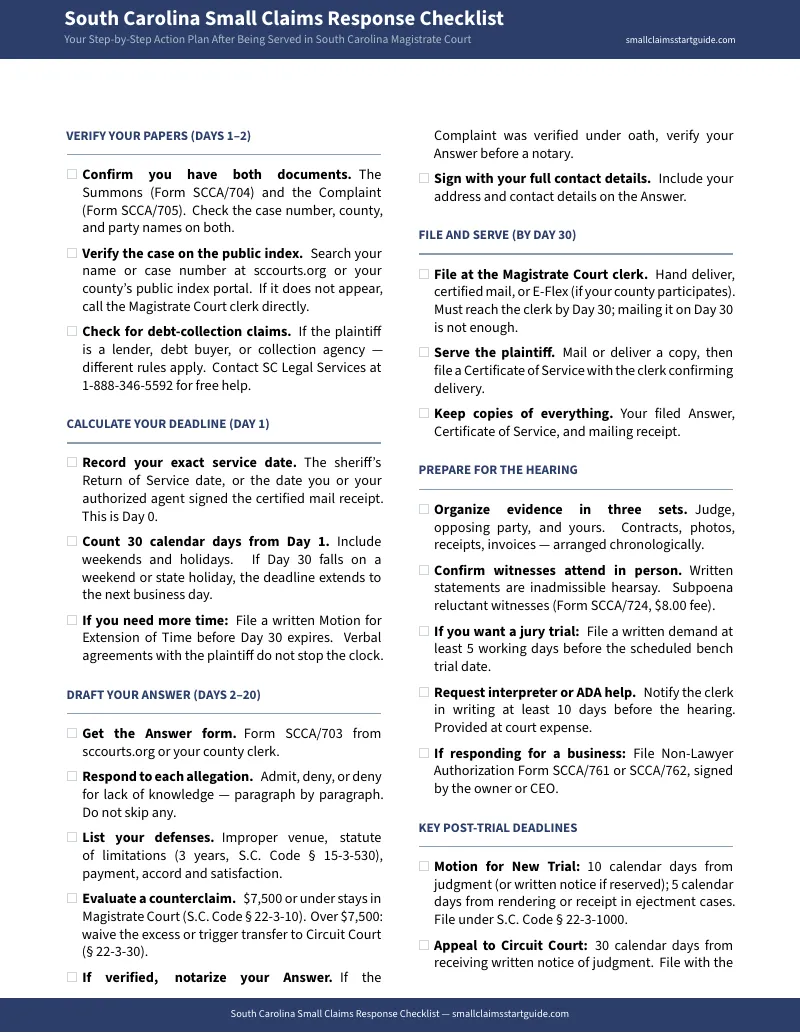
Every purchase also includes the free South Carolina Small Claims Response Checklist — a two-page printable with the deadline formula, the four response options, and the essential filing steps. Download the checklist on its own to see if the full guide is right for your situation.
Your hearing date is already set. The 30-day clock is already running. Get organized now — before a missed step decides the outcome for you.
Frequently Asked Questions
What if the rules change after I buy?
We update the guide when the rules change. Email us any time, even years later, and we'll send you the current edition free.