You Won the Judgment. Now Comes the Hard Part.
The magistrate ruled in your favor. Someone owes you money — and the court is done helping. No one will call the debtor, freeze their accounts, or redirect their paycheck. That is all on you now, and South Carolina makes it harder than most states because the enforcement system is split across two separate courts with different rules, different forms, and different powers.
Most creditors stall right here. They send an informal reminder, wait a few months, and eventually give up — convinced the system is broken or that collecting is only possible with a lawyer. It is not broken. But it is fragmented, poorly documented, and built on the assumption that you already know which court handles what.
The Dual-Court Collection Navigator
This guide is a complete enforcement roadmap built specifically for South Carolina's split-court system. It walks you through every tool available to a judgment creditor — from the Magistrate Court where your case was decided to the Court of Common Pleas where the more powerful enforcement mechanisms live.
You will learn exactly when enforcement can begin, how to move your judgment between courts, and which collection tool fits each situation — including why the one most people try first does not work in this state.
What's Inside
- The 30-day enforcement timeline — when you can start, what the appeal window means for your case, and how supersedeas bonds affect your options
- Demand letter framework — what to include, what is legally off-limits, and how to structure it so debtors take it seriously without crossing into deceptive practices
- Transcript and lien procedure — the step-by-step process for getting a certified Transcript of Judgment (Form SCCA/740) from Magistrate Court and docketing it in Common Pleas to create a 10-year real estate lien
- Execution writs and sheriff levies — how to direct the county sheriff to seize personal property, what happens at a judicial auction, and what a nulla bona return means for your next move
- Bank account levies — reaching the debtor's liquid assets through third-party debt execution under S.C. Code § 15-39-340, including which accounts are protected
- Supplementary proceedings — how to compel an uncooperative debtor to disclose bank accounts, property, and income under oath in a court-supervised examination
- The wage garnishment reality — South Carolina bans wage garnishment for civil judgments, and the guide explains exactly why and what to do instead
- Exemptions matrix — the specific dollar amounts the debtor can shield from execution, including the 2026–2027 indexed figures for trade tools, liquid assets, and the homestead
- Vehicle seizure and titled property — the practical steps for levying on a motor vehicle, including how the sheriff handles titled assets and what equity the debtor retains
- Interest calculation and payment tracking — post-judgment interest at Prime + 5% under S.C. Code § 34-31-20, plus a ledger for recording partial payments and keeping your enforcement math airtight
- Installment payment orders — how to request a structured payment plan from the court and what enforcement options remain if the debtor defaults
- The 10-year clock — South Carolina judgments expire permanently after 10 years with no renewal option, and the guide includes a deadline tracker so you do not lose your window
- Satisfaction of Judgment — the exact procedure for closing the case and clearing the debtor's record once you are paid in full, including the liability risk of failing to file
- Business entity representation — how corporations and LLCs can enforce judgments in Magistrate Court through Form SCCA/762 without retaining a lawyer
Who This Is For
- Individual creditors who won a Magistrate Court judgment for an unpaid loan, security deposit, property damage, or undelivered services — and the debtor has not paid
- Small-business owners with an unpaid judgment from a commercial dispute who need to enforce without spending more on legal fees than the judgment is worth
- Anyone who assumed the court would handle collection and discovered that obtaining the judgment was only the first half of the process
This guide is not for defendants, debt-collection agencies, or disputes involving child support, tax liens, or student loans.
Why Free Resources Leave You Stuck
The information exists — scattered across South Carolina's Judicial Branch website, county magistrate pages, Title 15 and Title 22 of the state code, and a handful of attorney blog posts. The problem is not access. The problem is assembly.
Official court portals publish blank forms without explaining when to file them or in which court. County websites focus almost entirely on starting a lawsuit, not collecting after you win. The state code is organized by legal topic, not by what a creditor needs to do next. And the top search result for "how to collect a small claims judgment in South Carolina" is a Nevada self-help guide that describes wage garnishment procedures — which are illegal here.
The guide connects what the free sources leave disconnected. It puts the forms in order, maps the dual-court handoff, and explains each enforcement tool with its requirements and limits — so you spend your time filing the right paperwork in the right court instead of piecing together a procedure from scattered pages.
What You Get
Your purchase includes 8 downloadable PDFs:
- The full guide — 15 chapters covering every enforcement tool, form, fee, and deadline in South Carolina's judgment collection process
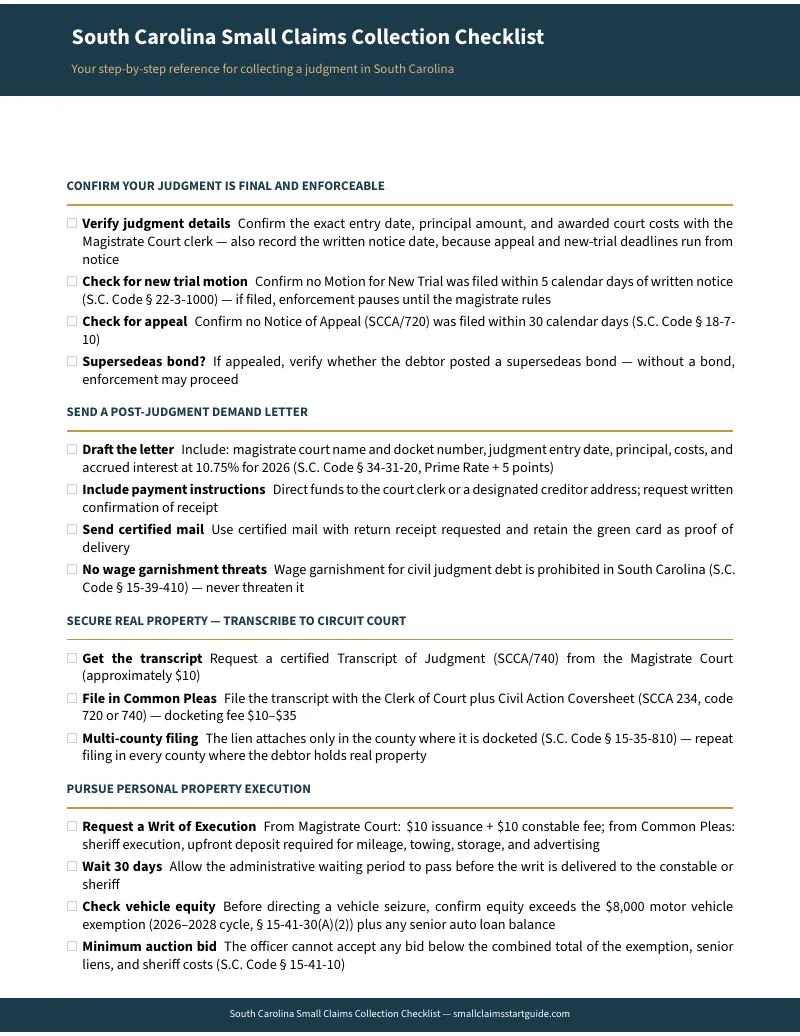
- The collection checklist — a printable reference with every enforcement step and key exemption thresholds
- Judgment Collection Timeline Planner — a fillable enforcement calendar from your judgment entry date through the 10-year expiration deadline
- Post-Judgment Interest Calculator — a structured worksheet for year-by-year interest calculation with a partial payment ledger
- Demand Letter Template — a fill-in-the-blank letter with all required elements and a compliance checklist
- Asset Discovery Checklist — a county-by-county reference for public record searches with space to record findings
- Enforcement Action Log — a chronological tracker for every filing, service, hearing, and payment
- Exemption Evaluation Worksheet — a form for calculating whether specific assets are reachable after the debtor's statutory exemptions
The free checklist gives you the steps at a glance. The full guide and six standalone worksheets give you the how — with every form number, every statutory citation, and every practical tool you need to execute each step yourself.
Full Refund, No Time Limit
If the guide is not what you expected, email [email protected] for a full refund. No time limit, no questions.
You already did the hard part — you went to court and won. The guide makes sure that judgment does not sit uncollected because the enforcement system was harder to navigate than the trial itself.
Frequently Asked Questions
What if the rules change after I buy?
We update the guide when the rules change. Email us any time, even years later, and we'll send you the current edition free.