
You know you're owed the money. You just don't know how to get it back.
The contractor who pocketed your deposit and vanished. The landlord who kept your security deposit and won't return your calls. The customer who received your work and never paid the invoice. You've got the receipts, the texts, the contract — but turning that into an actual court case feels like it was designed to confuse you.
South Carolina Magistrate Court handles claims up to $7,500, and it's built for people like you to use without a lawyer. But the court website gives you blank forms and statute numbers. It doesn't tell you which magistrate district to file in, how many copies to bring, what happens if the certified mail comes back unsigned, or how to organize your evidence so the judge takes you seriously.
The Filing-to-Hearing Roadmap
This guide turns South Carolina's Magistrate Court procedure into a single document you work through in order. It's not a generic legal overview — it's built specifically for South Carolina's forms, fees, service rules, and courtroom procedures under S.C. Code Title 22 and the SCRMC.
Where free court resources give you the pieces, the Filing-to-Hearing Roadmap gives you the sequence. You start with checking whether your claim fits. You end with the judge's decision and what to do next. Every step in between — the demand letter, the forms, the filing counter, the service of process, the evidence binder, the hearing itself — is covered in the order you'll actually do it.
What's inside
- Jurisdiction and venue check — confirm your claim fits the $7,500 cap, find the right magistrate district (including multi-district counties like Lexington), and understand the 3-year statute of limitations under S.C. Code § 15-3-530
- Demand letter framework — a step-by-step approach to writing the pre-filing demand that South Carolina courts expect to see before trial, with guidance on what to include, how to send it, and how to document the response
- Form-by-form filing instructions — line-by-line guidance for the Civil Complaint (Form SCCA/701) and every supporting document, including the duplicate-copy rules that trip up first-time filers at the intake counter
- Three service methods explained — sheriff delivery, magistrate's constable, and restricted certified mail under SCRMC Rule 4, with a tracking log for managing green card returns and filing your proof of service
- Entity identification for businesses — how to find the legal name and registered agent of an LLC, corporation, or sole proprietorship before you file, so your papers reach the right person and don't get dismissed on a technicality
- Evidence and hearing preparation — how to build an organized evidence binder, understand what counts as admissible testimony versus inadmissible hearsay, and present your case clearly to a magistrate judge
- Deadline calendar — every statutory window on one page: the 30-day answer period, your hearing date, the 30-day appeal window, and post-judgment timelines for enforcement
- Post-trial next steps — what to do after a judgment, including requesting costs, understanding South Carolina's wage garnishment prohibition under § 15-39-410, and when to hand off to the collection process
You also get 6 standalone printable tools — a master deadline calendar, a fill-in demand letter template, an evidence organisation log, a service of process tracker, a hearing preparation checklist, and a judgment collection worksheet. Print them, fill them in by hand, and bring them to the courthouse.
Who it's for
- Homeowners recovering contractor deposits or repair costs ($1,500–$7,500)
- Tenants claiming a withheld security deposit under the SC Landlord and Tenant Act
- Small landlords pursuing unpaid rent or property damage beyond the deposit
- Freelancers, tradespeople, and small business owners with unpaid invoices
- Buyers seeking refunds for defective goods or services
- Property owners with neighbour damage claims — fallen trees, fences, private-property collisions
Why not just use the free court forms?
You absolutely should use the free court forms — this guide tells you exactly which ones you need. The forms themselves are free on sccourts.org. What the court doesn't give you is the workflow around them: which magistrate district to file in when your county has multiple districts, how many copies to bring when Florence County requires duplicates but your county might not, what to do when the defendant's certified mail comes back unclaimed, and how to prepare an evidence presentation that a magistrate judge can follow.
Court clerks can accept your paperwork, but they're prohibited from advising you on how to fill it out or whether your case is in the right venue. The guide fills that gap — it's the organizational layer between "I know I'm owed money" and "I've filed correctly and I'm ready for the hearing."
Satisfaction guarantee
Full refund, no time limit. If the guide doesn't help you navigate the filing process, email [email protected] for a complete refund. No questions, no deadline.
Get started
Download the free checklist to see the key steps at a glance, or get the full guide for the complete Filing-to-Hearing Roadmap — every form, every deadline, every step in order.
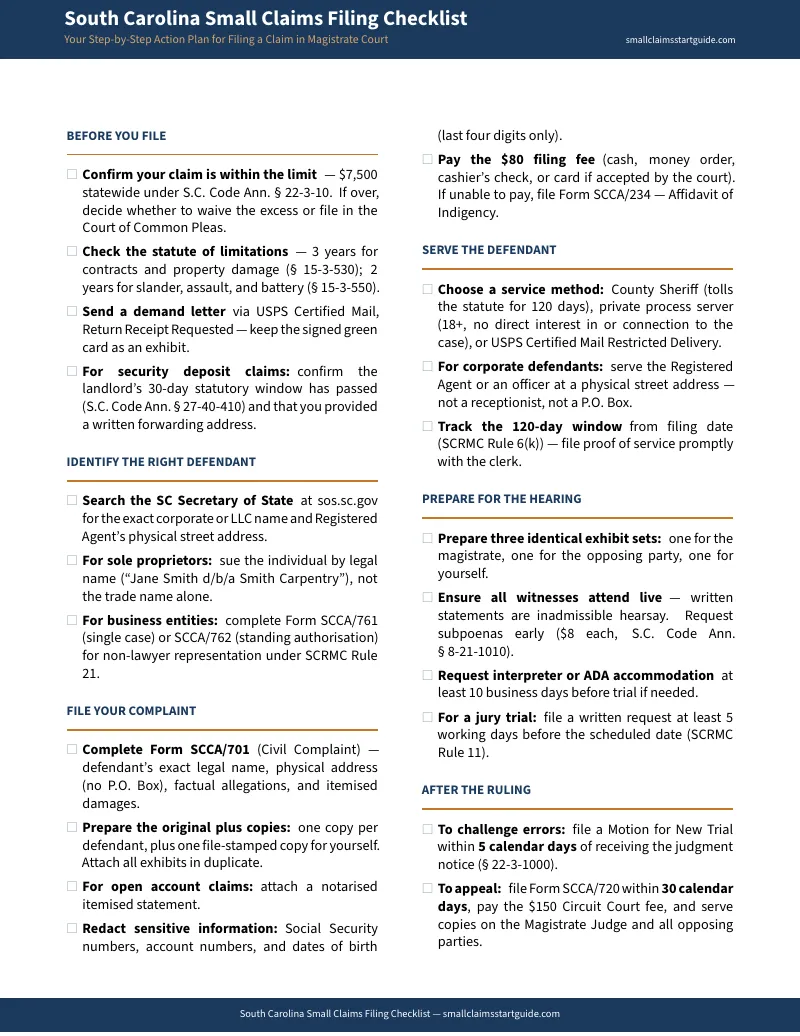
Not sure yet? Grab the free South Carolina Small Claims Filing Checklist. It covers the essentials — the $7,500 limit, the $80 filing fee, the form numbers, and the main deadlines — so you can see exactly what the filing process involves before deciding whether you need the full guide.
Frequently Asked Questions
What if the rules change after I buy?
We update the guide when the rules change. Email us any time, even years later, and we'll send you the current edition free.