You Were Just Served in Rhode Island. The Clock Is Already Running.
A state sheriff or constable handed you a stack of papers — a Small Claims Notice of Suit, an eight-page form called DC-SC-2, and four multi-language assistance notices. Somewhere in those pages is a dollar amount up to $5,000 and the name of the person who filed against you. You have exactly 20 calendar days from the date of service to file your Answer. Miss it by one day, and the court enters a default judgment against you for the full amount — no hearing, no chance to explain your side.
When you search online for help, you find a $25–$35 national book that covers 50 states and zero Rhode Island forms. You find Etsy templates formatted for courts that do not exist in Rhode Island. You find the court's own instruction PDF, which mixes plaintiff and defendant steps without explaining the one provision that catches most self-represented defendants off guard: filing a counterclaim permanently waives your right to appeal the judge's decision on that counterclaim.
The Rhode Island Defendant's Response Navigator
This guide replaces hours of research across scattered court PDFs, legal directory pages, and outdated forum advice with one clear path from served papers to resolved case. We call it the Defendant's Response Navigator — a single document organized around the seven parts of Form DC-SC-2, the official Answer form for self-represented litigants, revised in October 2024.
Instead of guessing which checkbox commits you to a payment plan and which one triggers the appeal waiver, you get a field-by-field explanation of every form section and the procedural consequences of each choice.
What's Inside
- Form DC-SC-2 Field-by-Field Decoder — a walkthrough of all seven parts of the self-represented Answer form, from the plaintiff's statement of claim in Part 1 through the Certificate of Service in Part 7, explaining what each section asks and what checking a particular box commits you to
- 20-Day Deadline Calculator — how to count the deadline from the date of service, how weekends and Rhode Island legal holidays roll it forward under Superior Court Rule 6(a), worked examples, and the worksheet to track your own calculation so you never rely on mental math for a default-judgment deadline
- Response Options Decision Guide — dispute the claim outright, admit and request a payment plan, settle before the hearing, file a counterclaim for up to $5,000, or combine approaches — with the forms, the $75.75 counterclaim filing fee, and the irrevocable appeal waiver in Part 5 explained for each path
- CMCRI Mediation Preparation Framework — when a self-represented plaintiff's case gets an Answer filed, the clerk automatically refers it to the Center for Mediation and Collaboration of Rhode Island. The guide explains what the mediator can and cannot do, how to prepare settlement terms and documentation, and what happens if mediation does not resolve the dispute
- Evidence and Exhibit Binder System — how to organize contracts, invoices, photos, text messages, and payment records into three identical exhibit sets (judge, plaintiff, and your copy), how to request and notify the court about expert witnesses under Part 3, and what evidence formats the court expects
- Two-Day Appeal Roadmap — Rhode Island gives defendants just two days from the entry of judgment, excluding weekends and holidays, to file a Notice of Appeal to the Superior Court — one of the shortest appeal windows in the country. The guide covers the appeal fee range, the de novo trial on appeal, and the critical distinction: you can appeal a ruling on the plaintiff's claim, but not on your own counterclaim
- Printable Kit (6 standalone worksheets) — a 22-item Response Checklist spanning five procedural phases, a Deadline Calculator Worksheet, a Response Route Decision Matrix, a Form DC-SC-2 Completion Guide, an Evidence Organization Worksheet, a Hearing Day Preparation Checklist, and a Post-Decision Action Tracker, ready to print and work through as your deadline approaches
Who This Guide Is For
This guide serves Rhode Island defendants in four common non-debt dispute categories:
- Homeowners sued by contractors over disputed scope of work, unpaid invoices, or claims of defective or unfinished repairs
- Tenants and landlords in security deposit disputes, property damage claims, or unpaid rent cases (monetary claims only — eviction actions go to regular District Court)
- Small business owners sued by customers over service disputes or contract disagreements. Sole proprietors can self-represent; corporations, LLCs, and LLPs with assets over $1,000,000 must retain licensed Rhode Island legal counsel
- Private vehicle sellers and buyers in post-sale disputes involving breach of contract or express warranty claims (motor vehicle accident and property damage torts are barred from small claims)
Not for debt-collection defendants. If you were sued by a debt buyer, collection agency, or credit card issuer, your case involves specialized consumer protection laws. The guide directs these defendants to free legal aid resources — including Rhode Island Legal Services (401-274-2652) and the Rhode Island Bar Association Volunteer Lawyer Program — rather than covering territory that requires specialized representation.
Why Not Just Use the Court Website?
The Rhode Island Judiciary publishes Form DC-SC-2, a five-page instruction manual, and a small claims web page on courts.ri.gov. We link to all of them. But those resources were built to serve everyone — plaintiffs, defendants, attorneys — across every case type the District Court handles. The defendant-specific steps are scattered across multiple PDFs, and the instruction manual does not explain the appeal waiver buried in Part 5 of the Answer form.
District Court clerks cannot help either. They are statutorily prohibited from giving legal advice, evaluating the merits of your defense, or helping you complete form fields.
Free legal aid through Rhode Island Legal Services and the RI Bar Association's Volunteer Lawyer Program provides excellent coverage — when you qualify. Financial eligibility limits exclude most middle-income homeowners, landlords, and business owners who end up self-representing in small claims court.
This guide does not replace those resources. It organizes them. It takes the defendant-specific rules from across Rhode Island's small claims procedure, strips out everything that applies only to plaintiffs, and arranges what remains into the order you actually need it: served papers first, deadline calculation second, response options third, mediation preparation fourth, evidence organization fifth, hearing day sixth, post-decision and appeal seventh.
Full Refund, No Time Limit
If the guide does not help you prepare for your case, email [email protected] for a full refund. No time limit, no questions, no forms to fill out.
The Free Checklist Gets You Started
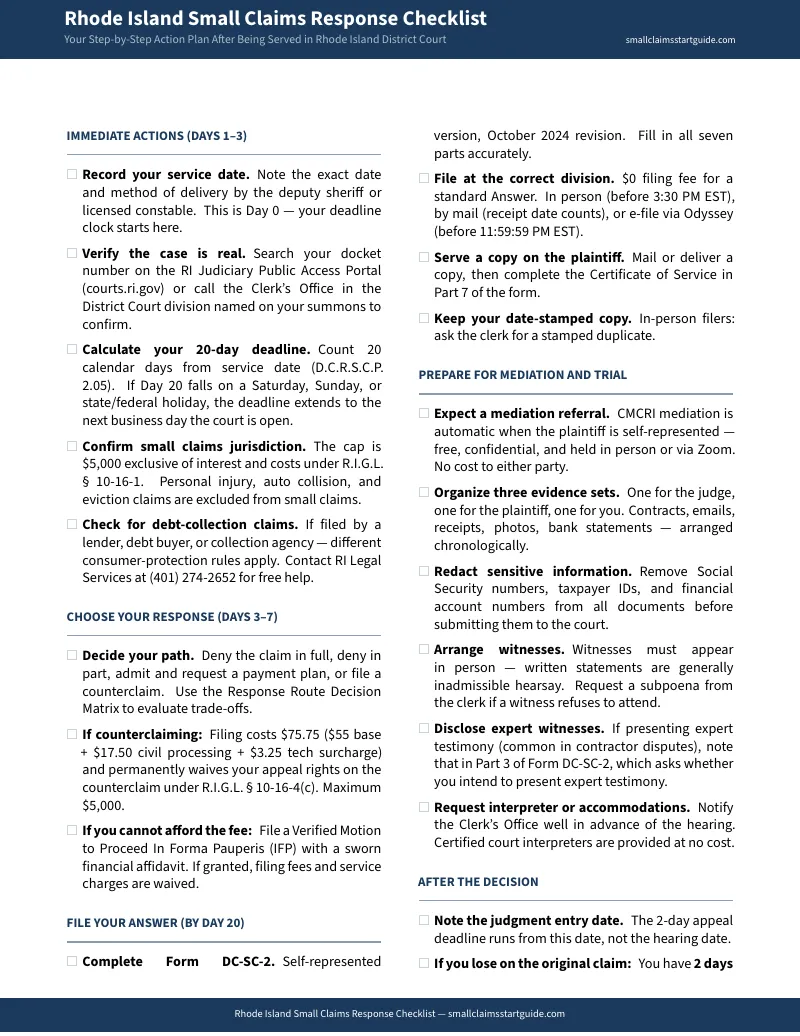
Download the free Rhode Island Small Claims Response Checklist — a quick-start summary covering your key procedural steps: verifying the papers, calculating the 20-day deadline, choosing a response option, preparing evidence, and understanding the two-day appeal window. It covers what to do. The full guide covers how — with Form DC-SC-2 field-by-field explanations, counterclaim trade-off analysis, CMCRI mediation preparation, evidence organization methods, and a printable checklist you can work through as your deadline approaches.
Frequently Asked Questions
What if the rules change after I buy?
We update the guide when the rules change. Email us any time, even years later, and we'll send you the current edition free.