You won. Now what?
The judge ruled in your favor. The hearing is over. You expected a check, or at least a phone call from the court telling you the money was on its way.
Instead: silence. Weeks pass. The debtor ignores the judgment. And when you call the District Court clerk, they tell you something nobody mentioned before the hearing — the court does not collect the money for you.
That part is entirely on you. And Rhode Island's enforcement process is not obvious.
The Enforcement Execution System
This guide is built around one idea: every collection step maps to a specific form, a specific office, and a specific officer. You don't need to guess which document to file, where to bring it, or who serves it. The Enforcement Execution System lays out each tool in the order you'll actually use them — from verifying your judgment is final through filing a Satisfaction of Judgment when the last dollar arrives.
It covers the full post-judgment lifecycle in the Rhode Island District Court Small Claims Division, and nothing else. No pre-trial advice, no generic national overviews, no upsells to attorney services.
What's Inside
- 48-Hour Appeal Verification Checklist — Rhode Island small claims defendants have just 48 hours to appeal. This checklist walks you through confirming the window has closed and your judgment is ready for enforcement, so you don't file a premature writ that gets rejected.
- Tool-to-Form Execution Matrix — Every enforcement option under District Court Rule 6.02 mapped to its exact form, filing fee, and the office or officer who handles it. Bank attachment, wage garnishment, property seizure, debtor examination — each one gets a step-by-step walkthrough.
- Sheriff vs. Constable Routing Guide — Rhode Island doesn't use county sheriffs the way most states do. Writs go to either the statewide Division of Sheriffs or a DBR-licensed constable. This section explains how to choose, what to bring, and what fees to expect — so your paperwork doesn't get bounced because you walked into the wrong office.
- Citation in Supplementary Proceedings Walkthrough — When you don't know where the debtor works or banks, this is the tool that compels them to appear and answer questions under oath about their assets. The guide covers the form, the motion, service requirements, and what to ask at the hearing.
- 12% Interest Calculator and Payment Ledger — Rhode Island statute awards 12% annual interest on unpaid judgments. The built-in ledger tracks every partial payment, every court fee you've advanced, and every dollar of accrued interest so you know exactly what's still owed at any point.
- Rhode Island Exemption Quick-Reference — Not everything the debtor owns is reachable. The guide details wage garnishment limits, the homestead exemption, and protected categories of personal property so you don't spend filing fees on assets you can't touch.
- Satisfaction of Judgment Instructions — Once the balance hits zero, you need to formally close the record with the court. This section covers the form, the filing, and why skipping this step can come back to bite you.
Who This Is For
- You won a judgment in Rhode Island District Court small claims and the debtor hasn't paid
- You're handling enforcement yourself without a lawyer
- You're a small business owner, landlord, or contractor with an unpaid judgment you need to collect
- You've been waiting for the court to do something and just realized it won't
Why Free Online Info Falls Short
The Rhode Island Judiciary website publishes forms and basic instructions — and you should absolutely use those free resources. They're linked throughout this guide. But here's the problem: the official resources focus almost entirely on filing a claim, not collecting after you've won.
Post-judgment enforcement gets a few summary paragraphs on the court website. The forms are listed without instructions for completing them. The clerk's office can hand you a blank document but is legally prohibited from telling you which one to file, or where to take it after it's issued.
National legal guides like Nolo cover small claims across all 50 states, which means they spend most of their pages on pre-trial preparation and devote a chapter or two to enforcement in general terms. They don't cover Rhode Island's specific forms, the 48-hour appeal rule, or the fact that your writs go to statewide sheriffs or DBR constables rather than a county office.
This guide does one thing: it bridges the gap between "you won" and "you collected," with every step specific to Rhode Island.
Satisfaction Guarantee
Full refund, no time limit. If the guide doesn't help, email [email protected] and you'll get your money back. No forms, no hoops.
Get Started
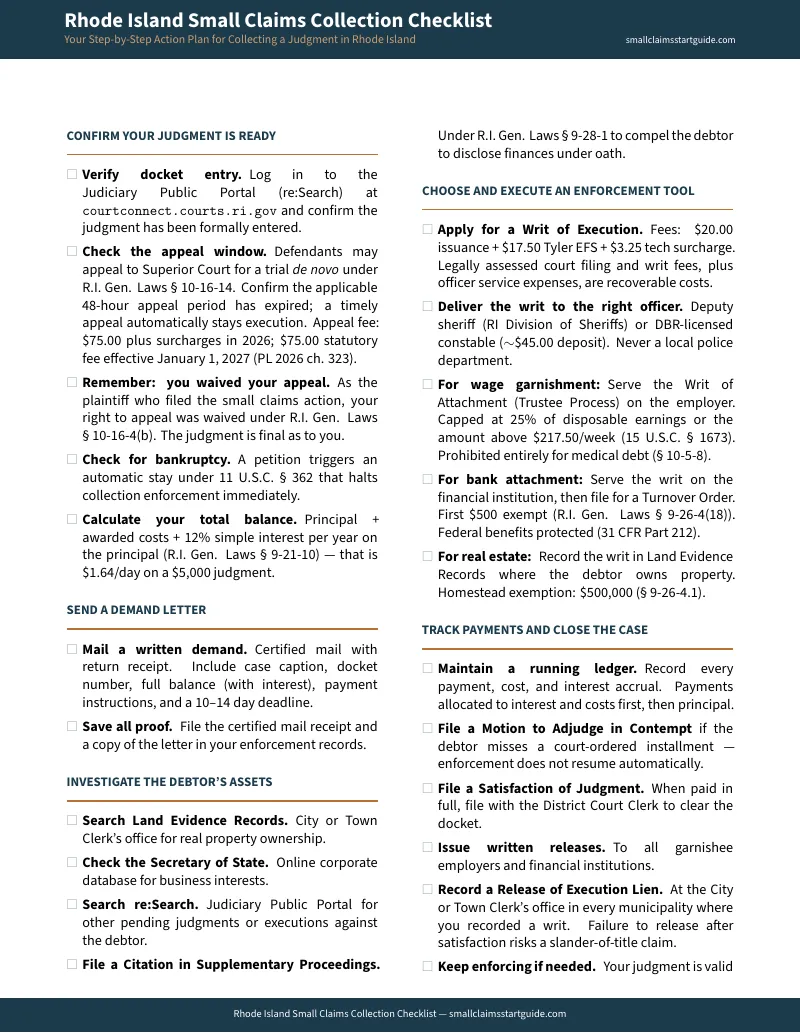
Download the free Rhode Island Small Claims Collection Checklist for a one-page overview of timing, enforcement options, and forms. When you're ready for the full step-by-step system — every form mapped, every hand-off explained, every fee listed — the complete guide is waiting for you at .
Frequently Asked Questions
What if the rules change after I buy?
We update the guide when the rules change. Email us any time, even years later, and we'll send you the current edition free.