You Won. The Court Agreed You're Owed Money. Now What?
If you expected the court to handle the rest after handing down your judgment, you already know the truth: Oregon courts do not collect judgments. They don't locate assets, send demand letters, garnish wages or seize bank accounts. The burden falls entirely on you — and the court clerk will not tell you what to file or in what order.
Meanwhile, every week the debtor ignores you is another week your judgment sits uncollected. And the multi-step enforcement process — writs, packets, sheriff fees, exemption calculations — is built for lawyers who already know the system, not for someone doing this for the first time.
The Enforcement Paperwork Map
This guide is a complete, Oregon-specific enforcement workflow — from the day your judgment is entered through every collection tool the statute gives you, all the way to closing the case when you've been paid.
Where court websites scatter instructions across dozens of pages and explicitly tell you to "purchase forms at legal stationery stores," this guide puts every step, every form requirement, every fee and every deadline into a single sequence you can follow from start to finish. We call it the Enforcement Paperwork Map because that's what it is: one document that routes you through the exact paperwork the Oregon Revised Statutes require, in the order you need to file it.
What's Inside
- When enforcement can start — the rules differ between Circuit Court and Justice Court judgments, and getting this wrong means a rejected filing and a wasted clerk fee
- The certified demand letter — the exact statutory notice that triggers your right to a debtor examination if the debtor doesn't respond within 10 days
- Asset discovery and debtor examinations — how to compel the debtor to appear in court and disclose their employer, bank accounts and property under oath
- The 5-document garnishment packet — every attachment Oregon law requires you to deliver with a Writ of Garnishment (miss one and the garnishment is void by operation of law)
- Wage garnishment with exemption calculations — how the 75% disposable-earnings protection works, the current wage floor figures and how to fill in the calculation form so the employer doesn't reject it
- Bank garnishment — including the mandatory $15 bank search fee that sheriffs and banks refuse to process without
- Property liens and seizure — recording a judgment lien on real property, requesting a levy on personal property, and the advance deposits county sheriffs require
- Sheriff fee routing — exact fees for garnishment delivery, property levies, mileage surcharges and standby time across Oregon's county sheriff civil units
- Interest and payment tracking — how to calculate 9% annual post-judgment interest, credit partial payments and add recoverable enforcement costs to the balance
- Closing the case — filing the Satisfaction of Judgment when you've been fully paid, including why failing to file one creates legal exposure for you
Who This Guide Is For
- You won a money judgment in an Oregon small claims court (Circuit Court Small Claims Department or Justice Court) and the debtor has not paid
- You've tried informal demands and they've been ignored
- You want to handle enforcement yourself rather than hand 25–50% of the judgment to a collection agency or pay an attorney hundreds of dollars per hour
- You need to know the specific Oregon forms, fees and filing sequences — not a 50-state overview
Why Not Free Court Resources?
Oregon's official court pages are accurate but incomplete. Multnomah County's small claims page explicitly states it does not provide Writ of Garnishment forms or help filling them out. The statewide plaintiff instructions end at the demand letter stage and say nothing about what happens when the debtor ignores it. County sheriff civil units publish fee schedules but no instructions for preparing the underlying paperwork.
The gap isn't accuracy — it's assembly. The statutes, forms and fees all exist, scattered across ORS Chapter 18, county court websites and sheriff civil unit pages. What doesn't exist anywhere for free is a single document that puts them in order and walks you through each step. That's what this guide does.
Why Not a National Legal Book?
National self-help books cover all 50 states in general terms. They'll tell you wage garnishments exist. They won't tell you that Oregon requires five specific attachments with every Writ of Garnishment, that the Circuit Court clerk fee is $47, that you need a separate $15 check made out to the bank, or that Multnomah County has a 7-day notice rule for debtor examinations that other counties don't. This guide covers Oregon and only Oregon — every rule, every fee, every form.
Satisfaction Guarantee
If the guide doesn't help you, email [email protected] for a full refund — no time limit, no questions.
Get Started
Your judgment is already accruing 9% annual interest. Every month you wait is money the debtor owes you that you haven't started collecting. The enforcement tools exist — you just need the map.
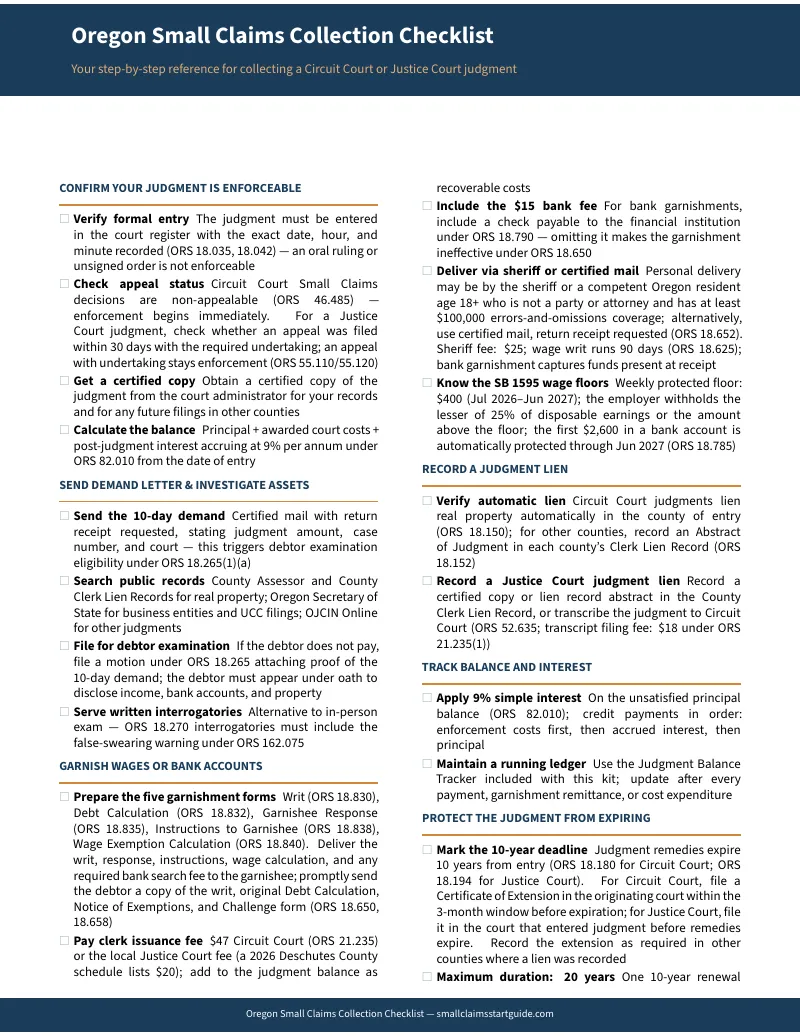
Download the free checklist to see every enforcement option at a glance, or get the full guide for the complete step-by-step workflow with every form requirement, fee and deadline — plus 5 printable worksheets: a pre-enforcement assessment, a judgment balance tracker, a garnishment packet assembly checklist, an enforcement action log, and a sheriff fee quick reference.
Frequently Asked Questions
What if the rules change after I buy?
We update the guide when the rules change. Email us any time, even years later, and we'll send you the current edition free.