You've been served — now what?
A process server handed you papers, or a certified letter arrived from the court. Your stomach dropped. The document says "Small Claims Affidavit and Order," and somewhere on it is a date you're supposed to appear. But the rest? Dense legal references, statute numbers, and language that assumes you already know the system.
You start searching online and the confusion gets worse. Some pages say you have 20 days to file a written answer. Others say you just show up. You find blank answer forms — but are they even the right ones for small claims? And buried in a statute you almost skipped: a 72-hour deadline for counterclaims that nobody flagged in bold.
The stakes are real. Miss the hearing, and the court enters a default judgment for whatever the plaintiff asked for — plus costs. File your counterclaim one day late, and the judge cannot hear it. Walk in without organized evidence, and you're arguing from memory against someone who brought a folder.
The Oklahoma Defendant Response System
This guide replaces hours of scattered research with a single, sequential action plan built around Oklahoma's Small Claims Procedure Act. It is not a book of legal theory and not a generic template — it is the procedure for defendants on the Small Claims Docket of the County District Court, organized so each step leads directly to the next.
The system is built around the three things that actually decide whether a defendant walks into court prepared or walks out with a default judgment: decoding the papers correctly, hitting every deadline, and organizing evidence the way Oklahoma judges expect to receive it.
What's inside
- Served-Papers Decoder — identify whether you have a Small Claims Affidavit and Order, confirm it is not a general civil summons or an eviction notice, locate the hearing date, courtroom, and judge assignment, and verify that service was proper (at least 7 days before the hearing)
- Five Response Pathways — Oklahoma is unusual: no written answer is required to defend yourself at the hearing. The guide maps each route — defend, counterclaim, settle, mediate, or transfer to regular civil court — with the exact filing steps, fees, and deadlines for each
- 72-Hour Counterclaim Engine — a countdown calculator and step-by-step filing sequence for the verified counterclaim under 12 O.S. § 1758, including the filing fee schedule, the verification requirement, and how to serve the plaintiff in time
- Hearing-Day Preparation Kit — the evidence triplication rule (three physical copies of every exhibit), witness logistics, subpoena basics, a courtroom protocol briefing, and a checklist to run through the morning of the hearing
- Post-Decision Roadmap — what to do after the judge rules, whether you won or lost: documenting a settlement with a signed Agreed Journal Entry, filing a Satisfaction of Judgment, exercising the 30-day window for a de novo appeal under 12 O.S. § 1770, or filing a motion to vacate a default judgment
- County-Level Navigation Notes — docket times, courtroom locations, and procedural differences between metro courts (Oklahoma County, Tulsa County) and rural county seats
Who this guide is for
- A homeowner served by a contractor over disputed work or a neighbour over property damage
- A former landlord or tenant in a security deposit or property damage dispute
- A small business owner or sole proprietor served over an unpaid invoice or service contract
- A private car buyer or seller in a dispute over vehicle condition, price, or title transfer
- Anyone who just received a Small Claims Affidavit and Order and needs to understand what it means and what to do next
The guide does not cover debt-collection lawsuits brought by lenders, debt buyers, or collection agencies. Those cases have different rules and free legal aid is available — the guide points you there.
Why not just use the free court information?
Every statute in this guide is publicly available on the Oklahoma State Courts Network. Every form is free from the County Clerk. That is not the problem.
The problem is that free resources are scattered across state websites, county clerk portals, and legal aid fact sheets — each covering one piece of the puzzle. The Oklahoma State Courts Network gives you raw statute text. County clerk sites post fee schedules and docket times. Legal Aid Services of Oklahoma publishes overviews. But none of them put it all into a start-to-finish sequence for a defendant who was just served.
Worse, the most common search results mix up general civil procedure (where you do need to file a written answer within 20 days) with small claims procedure (where you don't). Generic legal templates sold on other platforms often provide a standard civil answer form that Oklahoma small claims defendants do not need — and filing one can create confusion, not clarity.
This guide takes the statutes, the rules, and the county-specific details and puts them in the order you need them: decode papers, choose your response route, hit the deadlines, prepare your evidence, walk into the hearing, and handle whatever comes after.
Satisfaction guarantee
If the guide does not help you understand the process, email [email protected] for a full refund — no time limit, no questions.
Start with the free checklist
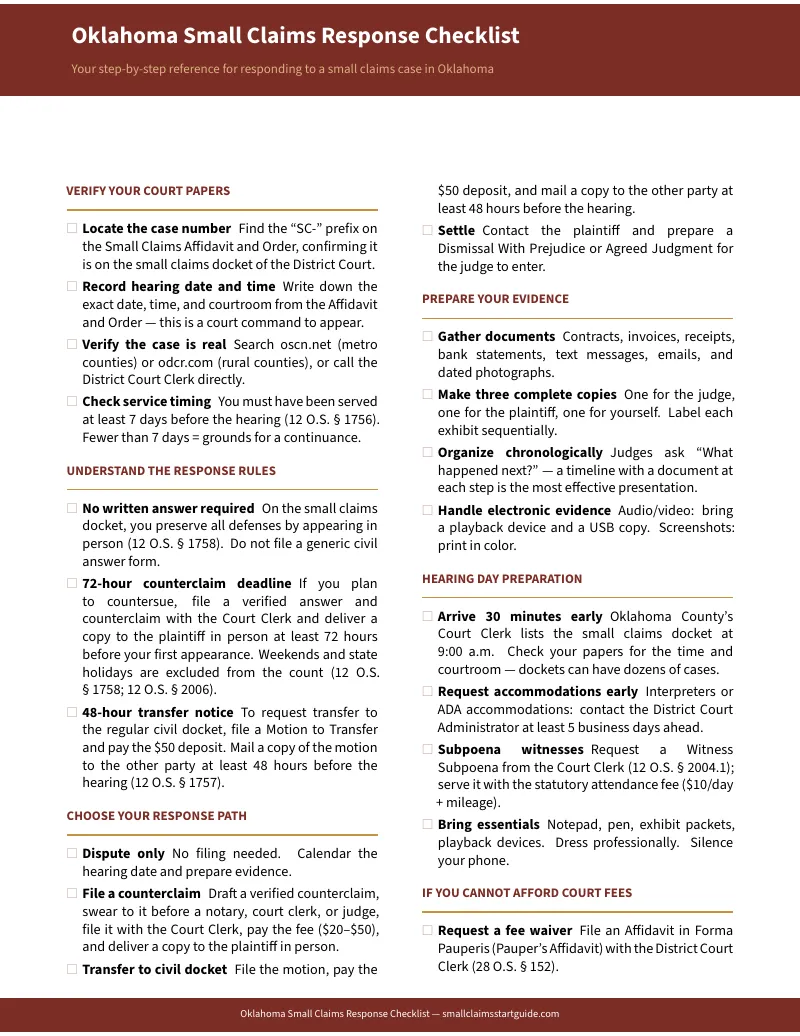
Not sure yet? Download the Oklahoma Small Claims Response Checklist — a one-page overview of the response deadline, your options, the documents to gather, and the hearing preparation basics. It covers what to do; the full guide covers how.
Frequently Asked Questions
What if the rules change after I buy?
We update the guide when the rules change. Email us any time, even years later, and we'll send you the current edition free.