You know the court exists. You do not know which Affidavit to file — or how to get service right.
Your contractor took your deposit and vanished. Your landlord kept your security deposit past the 45-day statutory window and stopped answering. A client owes you for work you finished months ago. You have already searched "how to file small claims in Oklahoma" and found a DocDraft page that says you can e-file in all 77 counties, a Reddit thread where half the advice is about the wrong state, and a Nolo book that devotes two paragraphs to Oklahoma out of four hundred pages.
You do not need fifty states. You need to know that Oklahoma runs its Small Claims Docket inside the District Court — not a separate court — under 12 O.S. § 1751. You need to know whether your claim fits the $10,000 cap, which statute of limitations applies, how to fill out the Small Claims Affidavit, what the filing fee is in your county, how to get certified mail service right under 12 O.S. § 158.1 so the hearing actually goes forward, and what evidence to bring. One wrong name on the Affidavit, one botched service attempt, and the judge dismisses your case before you say a word.
The Oklahoma Small Claims Filing Workflow
The Oklahoma Small Claims Filing Guide takes the entire process — from checking whether your claim fits the docket through preparing your evidence for the hearing — and puts it in one printable sequence with worksheets, a service tracking log, and a deadline calendar. Every step references the relevant Oklahoma statute, the form, and the timeline that applies.
This is not a 400-page national legal reference. It is not a $49-to-$99 document-generation service that builds a PDF but cannot walk it into the clerk's counter or explain what happens when certified mail comes back unsigned. It is a procedural workflow: what to do, in what order, by when — built for the Oklahoma District Court's Small Claims Docket, where fee schedules vary by county and service rules trip up even prepared filers.
What's Inside
Checking the Limit and the Clock
Oklahoma's Small Claims Docket caps claims at $10,000, money only — plus replevin up to $10,000 in property value. No injunctions, no specific performance, no libel or slander claims. If your loss exceeds $10,000, you can waive the excess and stay on the simplified docket, or file on the general civil docket with its higher fees and formal pleading requirements. But the dollar limit is only half the threshold — your claim also has a statute of limitations under 12 O.S. § 95: five years for written contracts, three for oral contracts, two for property damage, four for UCC sales of goods. Miss the deadline and the claim is barred. The guide walks through each limit with worked examples so you can calculate your own deadline.
The Demand Letter — Because the Judge Will Ask About It
Oklahoma law does not require a pre-filing demand letter for most claims, but judges routinely expect evidence that you attempted to resolve the dispute. Skipping it costs you credibility at the hearing. For security deposit claims under the Residential Landlord and Tenant Act (41 O.S. § 115), a written demand is mandatory: the tenant must send it within six months after the tenancy ends, and the landlord then has 45 days to return the deposit or deliver an itemized statement. The guide covers the required and recommended demand, certified mail mechanics, and the security deposit timeline — including when filing early is premature because the cause of action has not yet accrued.
Naming the Defendant — The Error That Makes Judgments Worthless
Filing against "Mike's Plumbing" when the registered entity is "Mike's Plumbing Services, LLC" can make your judgment unenforceable even if you win. Using a trade name instead of the registered legal entity, naming a d/b/a as though it were a corporate name, or serving a person who is not the statutory agent — these mistakes send people home with a piece of paper worth nothing. The guide walks through the Oklahoma Secretary of State business entity search, entity verification for sole proprietors, LLCs, and corporations, and the naming format the Affidavit requires.
Filing the Small Claims Affidavit — Field by Field, County by County
Oklahoma uses a standardized Small Claims Affidavit and Order under 12 O.S. § 1753, but filing fees vary sharply by county and claim bracket. In Oklahoma County, the fee is $58 for claims up to $5,000 and $219.14 for claims from $5,001 to $10,000, plus service fees. In Tulsa County, the same brackets cost $45 and $150. Add statutory surcharges — OCIS Revolving Fund, CASA fee, courthouse security, records management — and your total climbs beyond the base fee. The guide covers every field of the Affidavit, explains how to calculate total cost in your county, and walks through the Pauper's Affidavit fee waiver process for income-eligible filers. It also explains why e-filing is not available for most self-represented filers, despite what some online sources claim.
Serving the Defendant — The Step Where Cases Stall
Service is where claims fall apart. The court clerk sends your Affidavit by certified mail, but if the letter comes back unsigned, unclaimed, or refused, the hearing is continued and you restart the process. The guide covers the full service chain: standard certified mail ($10), restricted delivery certified mail ($18.88 in Oklahoma County), sheriff service ($50), and private process servers, with the cost and mechanics of each. It explains how to complete the return receipt, what to do at each failure point, and the 10-day minimum between completed service and the hearing date.
Evidence Preparation — The 3-Copy Exhibit Rule
Small claims hearings in Oklahoma are brief. You will not have time to scroll through your phone looking for the right message. Judges will not wait while you search for a screenshot. The guide shows you how to assemble three identical exhibit sets — one for the judge, one for the opposing party, one for yourself — in chronological order with contracts, invoices, text messages, photographs, and repair estimates. Show up with originals only and no copies, and you may not be able to present your evidence at all.
The Hearing — What Actually Happens
What the courtroom looks like, how the judge runs the proceeding, how to present your case clearly, and what happens if the other side does not show up. The guide also covers the business representation rules under HB 1611 (effective November 2024): corporations, LLCs, and partnerships may now appear through an officer, manager, or full-time employee — but independent contractors and outside agents still do not qualify.
After the Decision — Appeals and Collection
Winning a judgment and collecting the money are two different problems. The court does not collect on your behalf. The guide covers the 30-day appeal window to the Oklahoma Supreme Court, post-judgment interest calculation under 12 O.S. § 727.1, and your enforcement options, then directs you to the companion collection guide for the detailed wage garnishment, bank levy, and asset hearing procedures.
Worksheets, Tracking Log, and Deadline Calendar
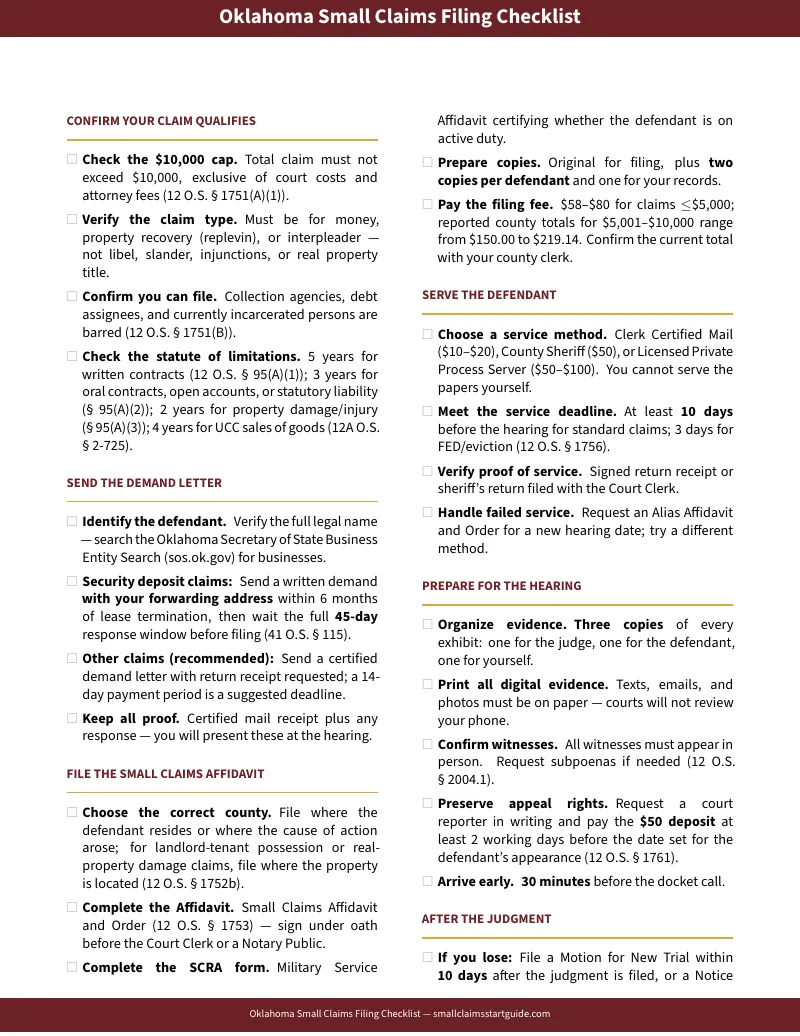
The guide comes with fill-in worksheets — including a Defendant Information Worksheet, Demand Letter Log, Service Tracking Log, Evidence and Exhibit Organizer, Deadline Calendar, Filing Cost Calculator, and a Hearing Day Checklist — plus the 26-item filing checklist. Print them, write on them, and know where you stand at every stage of the process.
Who This Is For
- Tenants owed a security deposit. Your landlord had 45 days after receiving your written demand and forwarding address to return the deposit or deliver an itemized statement under 41 O.S. § 115. If the landlord failed to comply, you may recover the amount owed. The guide covers the mandatory six-month written demand window, what counts as a proper demand, and how to calculate your claim.
- Homeowners with a contractor dispute. The contractor took your deposit and vanished, or the work is defective and they refuse to fix it. The guide covers entity verification through the Secretary of State, naming the correct defendant, and presenting repair estimates as evidence.
- Small landlords owed rent or facing property damage. Your former tenant left owing rent or caused damage beyond normal wear and tear. The guide covers locating a former tenant for service, documenting damage with photographs and invoices, and the distinction between money-only small claims and Forcible Entry and Detainer eviction proceedings.
- Sole traders and freelancers with unpaid invoices. A client stopped paying. The guide covers naming a business entity correctly, establishing breach of contract evidence, and presenting an invoice trail.
- Buyers refused a refund. You paid for something that never arrived or did not match the description. The guide covers identifying a business's registered agent through the Secretary of State and applying Oklahoma's venue rules.
- Anyone owed money in Oklahoma who wants to handle it without a lawyer. If your claim is $10,000 or less and you would rather spend an evening with a step-by-step guide than an afternoon on hold with a court clerk who cannot legally advise you on your case, this is for you.
Why Not Just Use the Free Court Resources?
You should use them — and the guide tells you exactly when and where. OSCN.net publishes the full statutory text. Court clerk offices provide the Small Claims Affidavit form. Legal Aid Services of Oklahoma publishes procedural overviews on oklaw.org. Early Settlement Mediation programs in Tulsa and elsewhere offer court-sponsored dispute resolution.
What those resources do not do is put the information in the order you need it. OSCN publishes statutes, not step-by-step workflows. Court clerk websites list fees and addresses but cannot walk you through service mechanics or evidence preparation — and clerks are legally prohibited from giving legal advice. Online guides from DocDraft and PettyLawsuit claim you can e-file in all 77 counties, which is not accurate for self-represented filers. Form aggregators like US Legal Forms sell you blank templates without procedural sequencing, demand letter scheduling, or hearing preparation.
The guide does the organisational work: every form, every fee, every deadline, in the order you encounter them, with a checklist you can print and work through. It sits between the free official resources (which you still need) and paid document-generation services that build a PDF but cannot explain what happens when certified mail fails or how to prepare your evidence for a judge who gives you fifteen minutes.
What This Is Not
This guide explains the procedure. It does not give legal advice, predict outcomes, or tell you how to argue your case. It is not published by, affiliated with, or endorsed by the Oklahoma judicial branch, any county District Court, or any government agency. If you need legal advice, contact a lawyer. If you need free help, the guide lists Legal Aid Services of Oklahoma and the free resources in your area.
Satisfaction Guarantee
Full refund, no time limit. If the guide is not what you expected, email [email protected] and we will refund you — no questions, no deadline.
Get Started
Download the free Oklahoma Small Claims Filing Checklist — a one-page summary of the $10,000 limit, the Small Claims Affidavit, filing fees, service steps, and deadlines. If you want the full guide with the demand letter template, worksheets, service tracking log, and deadline calendar, get the complete Filing a Small Claims Case in Oklahoma: Step-by-Step Guide for .
Frequently Asked Questions
What if the rules change after I buy?
We update the guide when the rules change. Email us any time, even years later, and we'll send you the current edition free.