You Were Just Served. Now What?
Someone filed a small claims case against you in Ohio, and you are holding a summons with a hearing date, a dollar amount, and language about default judgments. Your first instinct is to search online for what to do. Here is what you will find: 400-page national guidebooks written for plaintiffs, Etsy kits selling generic "Answer to Complaint" templates designed for a different court track, and scattered municipal court websites that bury the one fact you need most.
That fact: most Ohio small claims courts do not require a written answer. Under ORC Chapter 1925, you preserve every defense by showing up at your hearing. But "show up" is the beginning, not the end — and the difference between walking in prepared and walking in confused is the difference between presenting your case and losing it by default.
The Defendant's Case Preparation System
This guide is the only Ohio small claims resource built entirely around the defendant's journey. It does not spend hundreds of pages on how to file a lawsuit and then tack on one chapter about responding. Every page, every worksheet, every deadline calculation starts from the moment you were served and walks forward through your options.
We call it the Defendant's Case Preparation System — a single document that replaces hours of research across fragmented court websites, county portals, and outdated forum threads with one clear path from served papers to resolved case.
What's Inside
- Service Packet Decoder — every document in your certified-mail envelope annotated: the summons, the statement of claim, any exhibits, and the notice of hearing. You will know exactly what is being alleged, the dollar amount at stake, and whether the claim falls within Ohio's $6,000 statutory cap under ORC 1925.02
- Deadline Map with Worked Examples — Ohio time-computation rules under Civ.R. 6(A), the hearing date window (15–40 days after filing), the 7-day counterclaim filing deadline, continuance motion timing, and what to do when weekends or holidays shift your dates. Two worked examples show the math step by step so you can calculate your own deadlines with confidence
- Five-Option Decision Matrix — dispute the claim at trial, admit and request installment payments under ORC 1925.06, file a counterclaim against the plaintiff, negotiate a settlement or consent judgment, or request a docket transfer when a counterclaim exceeds $6,000 — with the forms, fees, and exact deadlines for each path
- Evidence Binder Protocol — small claims hearings run 10 to 20 minutes before a magistrate. Judges do not accept evidence displayed on a phone screen — Ohio Legal Help confirms you must bring printed physical copies. The guide shows you how to organize receipts, contracts, photos, and text-message printouts into a chronological evidence binder with copies for the magistrate and the plaintiff, so your strongest evidence actually gets considered
- Local Court Variation Index — filing fees, hearing schedules, e-filing availability, and written-answer requirements differ across Ohio's municipal and county courts. The guide covers the statewide rules and provides a framework to verify your court's local procedures, with specific examples from Franklin County Municipal Court, Erie County, and Findlay Municipal Court
- Post-Decision Roadmap — the 14-day window for filing Objections to a Magistrate's Decision under Civ.R. 53, appeals to the Court of Appeals within 30 days, and the Motion for Relief from Judgment under Civ.R. 60(B) if you missed your hearing and a default judgment was entered. Each route has its own requirements — the guide explains which one applies to your situation
- Printable Worksheets — Deadline Calculator Worksheet, Evidence Binder Checklist, Hearing Preparation Planner, Settlement Terms Worksheet, and Post-Decision Action Tracker included as ready-to-print, fill-in tools
Who This Guide Is For
This guide serves Ohio defendants in four common dispute categories:
- Homeowners sued by contractors over unpaid invoices, change orders, or disputed charges for unfinished or defective work
- Tenants and landlords in security deposit disputes under ORC 5321.16, property damage claims, or unpaid rent cases
- Small business owners (sole proprietors, LLCs, corporations) sued by customers over service disputes or vendor agreements
- Private vehicle sellers and buyers in post-sale disputes involving used car condition, misrepresentation, or towing claims
Not for debt-collection defendants. If you were sued by a debt buyer, collection agency, or credit card issuer, your case involves specialized consumer protection laws (including the Fair Debt Collection Practices Act and Ohio's Consumer Sales Practices Act). The guide directs these defendants to free legal aid resources — Ohio Legal Help, Legal Aid Society of Columbus, Legal Aid Society of Cleveland, and Legal Aid of Western Ohio — rather than covering territory that requires specialized representation.
Why Not Just Use the Court Website?
Ohio court websites provide forms at no cost — Franklin County Municipal Court publishes downloadable PDFs for counterclaims, cross-claims, continuance requests, and objections. Ohio Legal Help offers a generic small claims answer template. We link to all of them.
But those resources were built to serve everyone — plaintiffs, defendants, and multiple case types — which means the information a served defendant needs is scattered across dozens of pages, sub-pages, and county-specific PDFs. Standalone forms tell you nothing about which one you actually need, how to calculate the filing deadline, or what to do with your evidence once you arrive at the courthouse.
And the court clerk can tell you about schedules, docket numbers, and filing fees — but by law, clerks cannot give legal advice, evaluate your evidence, or help you draft a response. A phone call to the clerk does not preserve legal rights, extend deadlines, or file a counterclaim.
This guide does not replace those resources. It organizes them. It takes the defendant-specific rules from across the system, strips out everything that applies only to plaintiffs, and arranges what remains into the order you actually need it: served papers first, deadlines second, options third, evidence prep fourth, hearing day fifth, post-decision sixth.
Full Refund, No Time Limit
If the guide does not help you prepare for your case, email [email protected] for a full refund. No time limit, no questions, no forms to fill out.
The Free Checklist Gets You Started
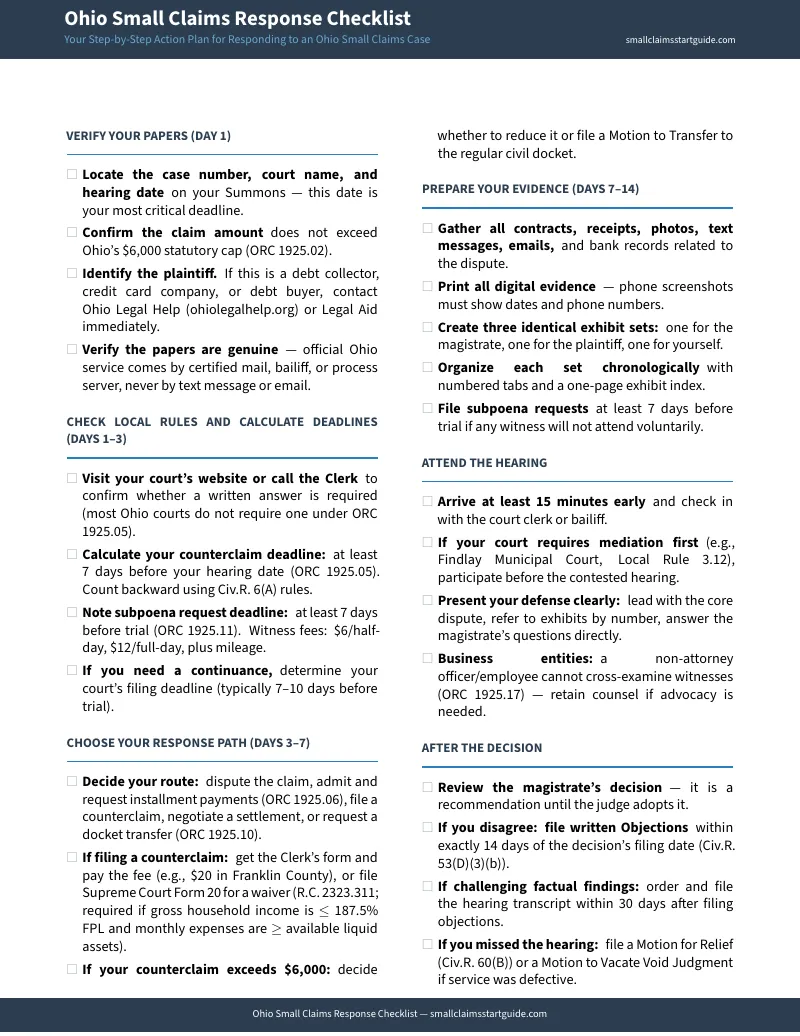
Download the free Ohio Small Claims Response Checklist — a two-page summary of your response deadline, procedural options, required documents, and hearing preparation basics. It covers what to do. The full guide covers how — with step-by-step instructions, court-specific rules, worked deadline examples, and printable worksheets you can fill in and bring to the courthouse.
The full Responding to a Small Claims Case in Ohio guide is available for — a one-time download, not a subscription.