You won. The court said you are owed money. Nobody is going to collect it for you.
You sat through the hearing, presented your evidence, and the magistrate entered a judgment in your favour. Then nothing happened. No cheque arrived. No clerk called with next steps. Nobody explained that Ohio courts decide who owes what — but leave it entirely to you to get the money.
Now you are looking at a garnishment packet from the Franklin County Municipal Court website — twelve pages of affidavits, orders, and statutory notices printed in small type. You are supposed to know that you need a USPS Form 3817 Certificate of Mailing (not certified mail), that you must file between 15 and 45 days after mailing the demand (not before, not after), and that the $85 filing fee is gone if any of these details are wrong. The forms assume you already understand the process. You do not. That is the problem.
The Ohio Post-Judgment Enforcement System
The Ohio Small Claims Judgment Collection Guide takes every enforcement tool available to an Ohio judgment creditor and puts it in a single, step-by-step procedural sequence. This is not a collection of generic legal tips and it is not a 400-page book that covers fifty states in broad strokes. It is a procedural workflow built for Ohio's municipal court system — the 15-day demand, wage garnishment under ORC Chapter 2716, bank account attachment, debtor examination, personal property execution, judgment liens on real estate, trusteeship, dormancy, revival, satisfaction, and the statutory interest calculation — with the specific forms, fees, deadlines, and filing routes for each step.
The guide covers what municipal court websites do not: the order you should use these tools, how to adapt when the first one fails, and the procedural traps — like filing a garnishment one day too early or failing to get proof of mailing — that forfeit your filing fee and force you to restart from scratch.
What's Inside
The 15-Day Statutory Demand
Before Ohio lets you garnish wages or attach a bank account, you must mail a formal notice to the debtor and wait. The filing window opens at 15 days and closes at 45 days after mailing. File one day outside that window and the clerk rejects your garnishment — and you lose the filing fee. The guide covers the notice content, the mailing method (ordinary mail with a USPS Form 3817 Certificate of Mailing, not certified mail), the timing calculation, and the proof you need to file with the court.
Wage Garnishment
The most common enforcement tool for a debtor who has a job. The guide walks through the complete filing packet — Affidavit, Order, Notice to Employer, and Employer Guide — and explains how the employer calculates the garnishable amount under federal and Ohio exemption limits. It covers what happens when the employer files the Interim Report and Answer, how to read the answer to know whether you are getting the full amount, and how to challenge an incomplete or incorrect return.
Bank Account Attachment
If the debtor has money in a bank account, you can reach it through an Order in Aid of Execution for Property Other Than Personal Earnings. The guide covers how to identify the debtor's bank — prior business dealings, cancelled cheques, debtor examination testimony — and the filing packet, fee, and answer timeline. It also explains the debtor's right to request a hearing on exempt funds and what that means for your collection.
Debtor Examination Under Oath
When you do not know what the debtor owns or where they work, you can ask the court to order them in for questioning under oath (ORC 2333.09 / ORC 1925.13). The guide includes the questions to ask — about employers, bank accounts, vehicles, real property, and other assets — and explains what to do with the answers. If the debtor does not appear, the guide covers the bench warrant process.
Personal Property Execution
For debtors who own non-exempt tangible property — vehicles, equipment, business inventory — the guide covers the writ of execution, the bailiff's or sheriff's role, and the cash deposit (which can exceed $450). It also covers the risk: if the property sells at auction for less than the deposit and costs, you are liable for the shortfall.
Judgment Liens on Real Estate
Recording a lien against the debtor's real property does not produce cash immediately, but it means the debtor cannot sell or refinance without paying your judgment. The guide covers the two-step process that most creditors miss: obtaining a Certificate of Judgment from the municipal court and then filing it with both the County Court of Common Pleas and the County Recorder. Skip either filing and the lien is unperfected.
Exemptions, Trusteeship, and Bankruptcy
Not every dollar is reachable. Ohio's exemption statute (ORC 2329.66) protects minimum wage levels, a homestead allowance, designated personal items, and public benefits. If the debtor files for trusteeship under ORC 2329.70 (court-supervised instalment payments) or bankruptcy, your enforcement stops. The guide explains what is exempt, what a trusteeship means for your timeline, and what to do when a bankruptcy petition is filed.
Interest, Dormancy, Revival, and Satisfaction
Ohio judgments accrue statutory interest at the rate published annually by the Tax Commissioner — 7% for 2026 under ORC 1343.03. The guide includes a worked interest calculation. A judgment goes dormant after five years without execution, but you can revive it. And once the debtor pays in full, you must file a Satisfaction of Judgment and release any recorded liens — fail to do so and you face liability for clouding the debtor's title.
Printable Checklist and Planning Tools
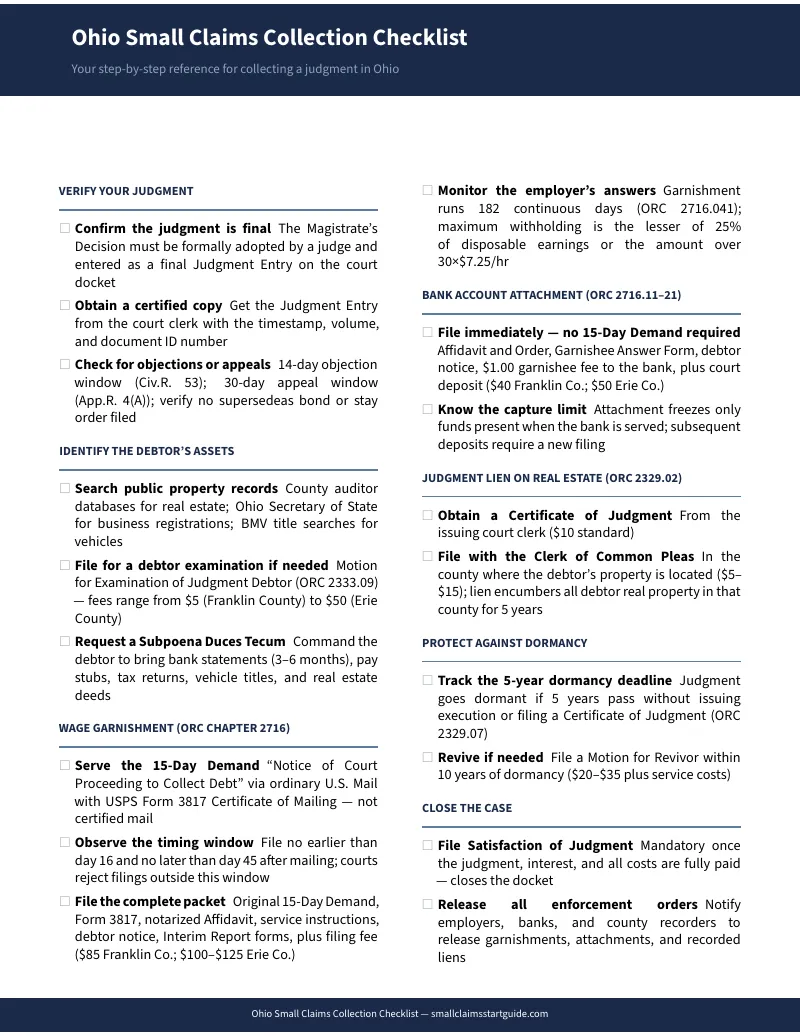
The 20-item collection checklist puts every enforcement step in sequence — from confirming the judgment entry through filing satisfaction. Six standalone planning tools ship alongside the guide: an enforcement flowchart that matches the debtor's assets to the best tool, a 15-day demand deadline tracker, an accounting ledger for principal, interest, and costs, a debtor examination prep worksheet with ready-to-use questions, an agency communication log, and a satisfaction and lien release checklist for closing the case.
Who This Is For
- Landlords who won a security deposit judgment. You proved your case under ORC 5321.16 and the former tenant still has not paid. The guide covers how to garnish their wages at a new employer or attach a bank account you identified from their old rent payments.
- Homeowners who won a contractor dispute. The contractor was ordered to pay damages and has disappeared. The guide covers how to request a debtor examination to find their bank, their employer, and any attachable business assets.
- Small business owners with an unpaid invoice judgment. You proved the debt in court. The guide covers wage garnishment, bank attachment, and judgment liens — and the ledger tracks every dollar of recoverable costs alongside the original award and accruing interest.
- Anyone in Ohio holding an unpaid small claims judgment. If the court ruled in your favour, the other side has not paid, and you do not know what to do next, this guide puts every enforcement option in the order you should consider it.
Why Not Just Use the Free Court Forms?
You should use them — and the guide tells you exactly when and where. Franklin County publishes a 462KB wage garnishment packet and a 299KB bank attachment packet. Findlay Municipal Court provides collection guidance and 15-Day Demand forms. Other courts have their own packets with their own local rules.
What those packets give you is a stack of blank legal forms with statutory boilerplate. What they do not give you is the order to use them, the timing rules that void your filing if you miss them, the questions to ask in a debtor examination, the two-step process for perfecting a judgment lien, or a way to track what you have spent and what you are owed. Court clerks — by law — cannot advise you on which form to file first or how to fill it out.
The guide does the organisational work: every enforcement tool, in the order you should consider it, with the forms, fees, and deadlines mapped to each step. It sits between the free court packets (which you still need) and a lawyer's hourly rate.
What This Is Not
This guide explains the enforcement procedure. It does not give legal advice, guarantee that you will recover any money, or tell you how to argue a case. It is not published by, affiliated with, or endorsed by the Ohio judicial branch, any county or municipal court, or any government agency. If you need legal advice, contact a lawyer. If you need free help, the guide lists the Legal Aid organizations and self-help resources in your area.
Satisfaction Guarantee
Full refund, no time limit. If the guide is not what you expected, email [email protected] and we will refund you — no questions, no deadline.
Ready to Start Collecting?
Download the Ohio Small Claims Judgment Collection Guide — the 47-page guide, the 20-item checklist, and 6 printable planning tools (enforcement flowchart, demand deadline tracker, accounting ledger, debtor exam prep worksheet, communication log, and satisfaction release checklist). Your judgment is not going to collect itself — but now you have every tool the court gives you, in the order you need them.
The free checklist gives you the enforcement steps at a glance. The full guide gives you the forms, fees, timing rules, worked examples, and the planning tools — everything you need to follow through.
Frequently Asked Questions
What if the rules change after I buy?
We update the guide when the rules change. Email us any time, even years later, and we'll send you the current edition free.