You know the court exists. You don't know which court — or which form.
Your contractor took your deposit and vanished. Your landlord kept your security deposit for "repairs" that never happened. A client owes you for three months of finished work. You have already searched "how to file small claims in Ohio" and found Ohio Legal Help, a Reddit thread, and a Nolo book that covers fifty states in four hundred pages.
You do not need fifty states. You need to know which of Ohio's 88 county and municipal courts has jurisdiction over your claim, which complaint form that court uses (there is no statewide form), what the fee is, how to get the papers served on the other side without the certified mail coming back "Unclaimed," and what to bring to a hearing that lasts fifteen to thirty minutes. One wrong name on the complaint, one late service attempt, and the magistrate dismisses your case before you say a word.
The Ohio Small Claims Filing Workflow
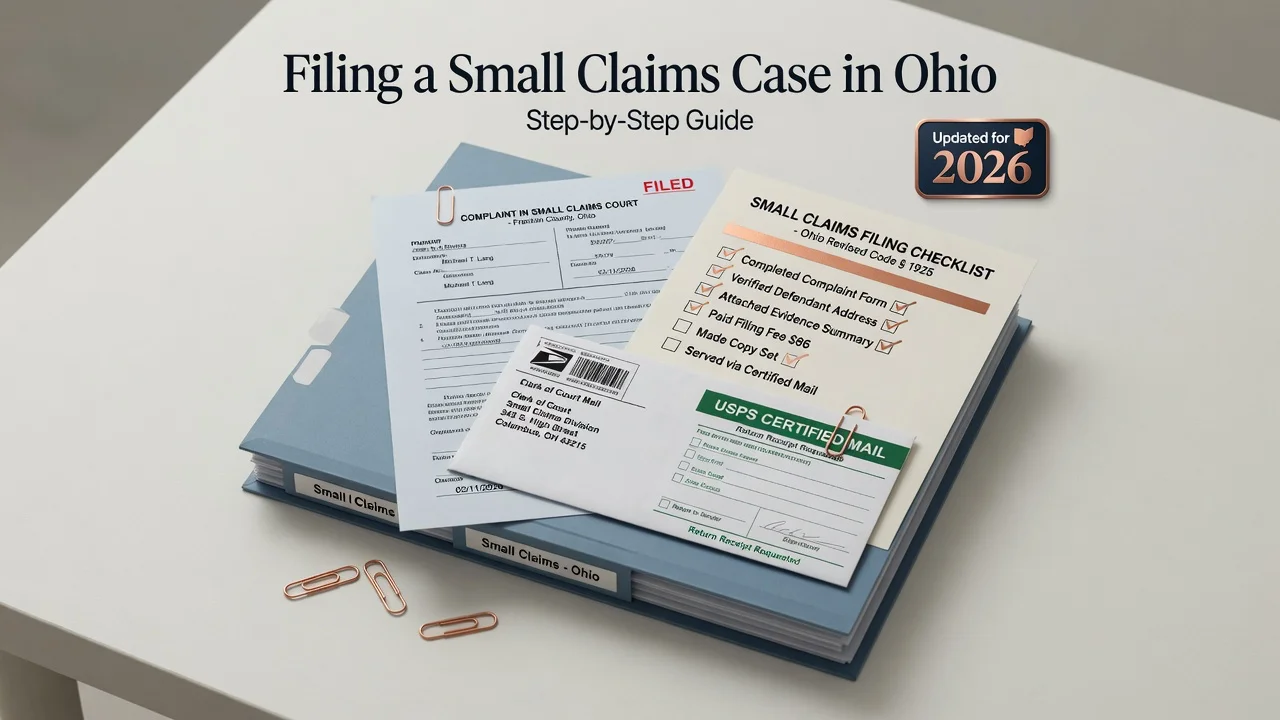
The Ohio Small Claims Filing Guide takes the entire process — from checking whether your claim fits the $6,000 cap through collecting the money after a judgment — and puts it in one printable sequence with checklists and a deadline calendar. Every step references the relevant ORC section, the forms, and the timelines that apply.
This is not a 400-page legal reference and it is not a $36-per-quarter filing app that generates a complaint PDF but cannot walk it into your local clerk's office. It is a procedural workflow: what to do, in what order, by when — tailored to Ohio's municipal court system, where every court runs its own rules.
What's Inside
Checking the Limit and the Clock
Ohio caps small claims at $6,000, money only — no property return, no injunctions, no evictions. If your loss exceeds the cap, the guide explains when waiving the excess makes strategic sense and when you are better off in the general civil division. It also walks through every statute of limitations: six years for written contracts, four for oral contracts and property damage, two for personal injury. Older web sources still quote a $3,000 limit — that figure is outdated since House Bill 387.
The Demand Letter — Because Magistrates Ask About It
Ohio does not legally require a demand letter, but magistrates routinely ask whether you tried to resolve the dispute before filing. The guide covers what the letter needs to say, how to send it by USPS Certified Mail with Return Receipt Requested so you have a signed delivery receipt for court, and why skipping this step weakens your position. For security deposit claims under ORC 5321.16, the demand process carries additional requirements — the guide covers the 30-day statutory return deadline and the double-damages provision.
Naming the Defendant — The Mistake That Makes Judgments Uncollectible
Filing against "Mike's Auto Body" when the registered entity is "Mike's Auto Body, LLC" can make your judgment unenforceable even if you win. Naming a trade name instead of the legal entity, failing to identify the statutory agent, or using a d/b/a designation as though it were a corporate name — these are the errors that send people home with a piece of paper worth nothing. The guide walks through the Ohio Secretary of State business database search, entity verification, and the corporate naming requirements for LLCs, corporations, and sole proprietorships.
Filing the Complaint — Field by Field, Court by Court
Ohio has no statewide complaint form. Franklin County uses an online guided interview. Cleveland uses a downloadable PDF. Findlay requires three physical copies and sends complaints through mandatory mediation before trial. The guide covers the requirements that apply everywhere — statement of facts, dollar amount, attaching the contract or invoice under Civ.R. 10(D) — and maps the local variations. Filing fees range from $45 in Cleveland to over $133 in other jurisdictions, with additional per-defendant fees. If you cannot afford the fee, the guide covers the Affidavit of Indigency under ORC 2323.311.
Serving the Defendant — And What to Do When Certified Mail Fails
In Ohio, the clerk handles service — you cannot hand the papers to the defendant yourself. The clerk sends your complaint by certified mail. When the letter comes back "Unclaimed" or "Refused" — which happens regularly — most people assume the court automatically resolves it. It does not. You need to request ordinary mail service in writing, and if the address itself is wrong, you need to locate a new one, re-request service, and pay additional fees. The guide covers the full service sequence: certified mail, ordinary mail, personal service through the county sheriff or a private process server, and the timeline requirements under ORC 1925.04.
Evidence Preparation — The Three-Copy Rule
Small claims hearings run fifteen to thirty minutes. You will not have time to dig through a phone looking for the right screenshot. Ohio magistrates do not accept evidence displayed on personal devices — everything must be physically printed. The guide shows you how to assemble three identical exhibit sets (magistrate copy, opposing party copy, your copy) in chronological order, with redacted sensitive information under Sup.R. 45(D) and clearly labeled tabs. For auto-damage claims in Hamilton County, you must bring the physical vehicle title to prove standing — the guide flags court-specific requirements like this before they surprise you.
The Magistrate Hearing — What Actually Happens
What the courtroom looks like, how the magistrate runs the proceeding, how to present your evidence without rambling through a story, and what happens if the other side does not show up. The guide also covers the corporate representation rules under ORC 1925.17: a corporate officer or salaried employee can file a complaint and testify to facts of personal knowledge, but is strictly prohibited from cross-examining witnesses, filing legal motions, or making legal arguments without a licensed attorney.
After the Decision — Objections, Appeals, and Collecting What You Are Owed
A magistrate's decision is not a final judgment — it becomes one only after 14 days if no objection is filed. The guide covers the objection window under Civ.R. 53(D)(3)(b), the 30-day appeal period, and — if the defendant does not pay — your enforcement options: wage garnishment under ORC Chapter 2716, bank account attachment, debtor examination, and judgment liens on real property under ORC 2329.02.
Printable Checklists, Worksheets, and Deadline Calendar
Eight fill-in tools plus the 13-chapter guide and the 24-item filing checklist: the Local Court Verification Worksheet, Demand Letter Template and Tracker, Defendant Naming Worksheet, Filing and Service Follow-Up Log, Evidence and Exhibit Organizer, Hearing Day Checklist, Deadline Calendar, and Post-Judgment Collection Tracker. Print them, write on them, and know exactly where you are in the process at any point.
Who This Is For
- Tenants owed a security deposit. Your landlord had 30 days after you moved out to return your deposit or send an itemized statement of deductions under ORC 5321.16. If the landlord failed to do either after you provided a written forwarding address, you may be entitled to double damages. The guide covers the statutory timeline and how to calculate your claim.
- Homeowners with a contractor dispute. The contractor took your deposit and disappeared, or the work is defective and they will not fix it. The guide covers entity verification through the Secretary of State database, naming the correct defendant, and presenting repair estimates.
- Small landlords owed rent or facing property damage. Your former tenant left owing rent or caused damage beyond normal wear. The guide covers locating a former tenant for service and documenting damage with photographs and invoices, including the ORC 1925.17 representation constraints if you file through an LLC.
- Sole traders and freelancers with unpaid invoices. A client stopped paying. The guide covers naming a business entity correctly, establishing breach of contract evidence, and presenting an invoice trail.
- Buyers refused a refund. You paid for something that never arrived or did not match the description. The guide covers identifying a business's registered agent and establishing venue.
- Anyone owed money in Ohio who wants to handle it themselves. If your claim is $6,000 or less and you would rather spend an evening with a step-by-step guide than an afternoon on hold with a court clerk who cannot legally walk you through the process, this is for you.
Why Not Just Use the Free Court Resources?
You should use them — and the guide tells you exactly when and where. Ohio Legal Help at ohiolegalhelp.org publishes procedural overviews and guided form-building interviews. Municipal court websites publish their complaint forms and fee schedules. Legal Aid organizations serve eligible low-income residents.
What those resources do not do is put the information in the order you need it. Ohio Legal Help covers statewide rules but directs you to your local clerk for court-specific fees, forms, and hearing schedules. Each court's website covers its own rules but not the statewide procedural framework. And court clerks — under ORC 4705.01 — are prohibited from giving you legal advice or explaining how to fill out the forms.
The guide does the organisational work: every form, every fee, every deadline, in the order you encounter them, with a checklist you can print and work through. It sits between the free information (which you still need) and a $36-per-quarter filing app that generates a complaint PDF but cannot walk it to the clerk, serve the defendant, or prepare you for the hearing.
What This Is Not
This guide explains the procedure. It does not give legal advice, predict outcomes, or tell you how to argue your case. It is not published by, affiliated with, or endorsed by the Ohio judicial branch, any county or municipal court, or any government agency. If you need legal advice, contact a lawyer. If you need free help, the guide lists the Legal Aid organizations and self-help resources in your area.
Satisfaction Guarantee
Full refund, no time limit. If the guide is not what you expected, email [email protected] and we will refund you — no questions, no deadline.
Get Started
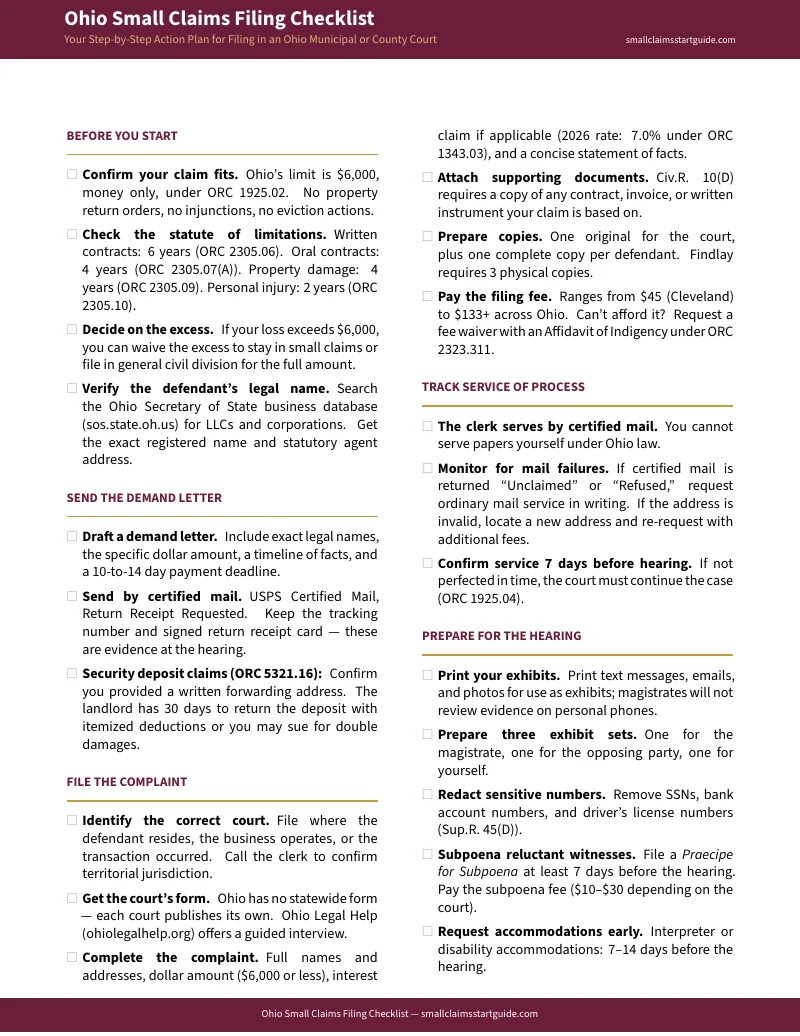
Download the free Ohio Small Claims Filing Checklist — a two-page, 24-item summary of the limit, forms, fees, service steps, and deadlines. If you want the full 13-chapter guide with the Demand Letter Template and Tracker, worksheets, and the Deadline Calendar, get the complete Filing a Small Claims Case in Ohio: Step-by-Step Guide for .