You Filed. You Served. Then Form 6 Bounced — and the Clock Reset.
You know someone owes you money. You have the texts, the receipts, the broken promise in writing. You looked up North Dakota small claims court and found ten PDF forms, three separate instruction sheets, and a self-help page that lists the steps but never tells you when each one matters. The District Court clerk cannot walk you through it — they are legally prohibited from giving legal advice.
So you start filling out Form 2 (the Claim Affidavit). You pick what feels like the right county. You mail the form to the defendant. And two weeks later you learn that serving Form 2 alone — without the five blank forms the defendant is entitled to receive — invalidates your service entirely. The 20-day response window never started. Your $20 filing fee is spent, but the case has not moved.
It is not that the information does not exist. It is that it is scattered across ten PDFs, buried in paragraph-long instructions most people skim, and built for someone who already understands how courts work. Small claims court is designed for people without lawyers, but the paperwork reads like it was designed by one.
The North Dakota Filing Procedural System
The Filing a Small Claims Case in North Dakota guide puts every filing step into the order you actually do them — from the demand letter through the hearing — with tracking tools, assembly checklists, and deadline worksheets that keep the process on rails.
This is not a collection of tips or a summary of the court website. It is a procedural system: open it at the step you are on, follow the instructions, check the boxes, and move to the next step. Each chapter ends where the next one begins.
What's Inside
- Jurisdiction and limit check — whether your dispute fits the $15,000 cap, the right statute of limitations for your claim type, and which county to file in. You answer these questions before you pay a cent.
- Demand letter system — a certified-mail demand with a specific response deadline, structured so it becomes Exhibit A if the other side ignores it. The guide covers what to include, how to send it, and how long to wait.
- Ten-form master reference — every form in the North Dakota small claims packet (Forms 1–10), explained in plain language: what it does, who fills it out, and when it enters the process. No more opening random PDFs to figure out which one you need next.
- Form 2 walkthrough — how to complete the Claim Affidavit correctly: naming the right defendant (including LLC and corporate entity lookups through the Secretary of State's FirstStop portal), choosing the right claim category, and describing the claim within the form's limits.
- Service packet assembly checklist — a verification checklist ensuring Form 2 is accompanied by blank Forms 1, 3, 4, 5, and 7 before the envelope is sealed. This is the step most self-represented filers miss — and the one that invalidates service without warning.
- Three service methods side-by-side — USPS Certified Mail with Restricted Delivery, sheriff service, and personal service by a non-party adult. Each method has its own tracking log so you have proof of service ready for Form 6.
- 20-day response calculator — a calendar-day worksheet that counts every day (weekends and holidays included) from the date service was completed, so you know exactly when the defendant's window closes and when you can request default.
- Removal and fee-shifting alert — what happens if the defendant files Form 3 to move the case to District Court, the $160 removal fee they pay, and the fee-shifting rule that requires the court to award you attorney's fees if the defendant removes and loses.
- Hearing preparation blueprint — how to take loose receipts, text-message screenshots, photos, and contracts and turn them into a three-copy indexed binder for a 30-minute informal hearing. Includes an exhibit index template and a witness preparation outline.
- Post-judgment roadmap — what to do the day the judicial referee rules, including the 10% annual post-judgment interest rate and the hand-off point to collection tools.
- Two worked cost examples — a $1,200 security deposit dispute (with treble damages reaching $3,600) and a $6,000 contractor dispute, mapping every fee and deadline from demand letter to judgment.
Who It's For
This guide is for anyone in North Dakota who is owed money and wants to recover it through small claims court without hiring a lawyer:
- A tenant whose landlord kept the security deposit without delivering an itemised list of deductions within 30 days — and who may be entitled to treble damages under N.D.C.C. § 47-16-07.1
- A homeowner whose contractor took a deposit and abandoned the job, or left defective work behind
- A sole trader or freelancer with an unpaid invoice or open account under $15,000
- A buyer who was sold a defective product or a service that was never delivered, and the seller refuses a refund
- A property owner with a damage claim from a vehicle accident, neighbour dispute, or third-party negligence
Why Not Free Tools?
The court forms are free. You should download them — you will need them to file. But the forms are not instructions, and the instructions are not a system.
The North Dakota self-help page lists forms in order without showing when they connect. The fillable PDFs clear all your typed data the moment you close the browser — no local save. Form 6's service instructions bury the five-form assembly requirement inside a paragraph. The 20-day response window counts calendar days including weekends and holidays, but nothing on the court website gives you a calculator or a concrete deadline date. And hearing preparation advice is scattered across separate documents with no printable checklist or exhibit organiser.
Paid document services (DocDraft, LegalAtoms) charge $29–$199 to generate filled forms — but some still display outdated filing fees and none walk you through the service assembly, the deadline calculations, or the hearing preparation. The Nolo national guidebook covers small claims principles well, but omits North Dakota's ten-form system, the $20 filing fee, the 20-day removal window, and the no-appeal rule entirely.
There are currently zero dedicated North Dakota small claims filing guides on Etsy, Gumroad, or Amazon Kindle.
This guide exists because the gap between "here are the forms" and "here is how to get from demand letter to hearing without a procedural error" is exactly where self-represented filers get stuck.
What This Guide Does Not Do
This guide does not give legal advice. It does not predict whether you will win your case, evaluate the strength of your evidence, or tell you what arguments to make. It is not an official court publication and is not affiliated with any North Dakota court. Courts and tribunals publish their forms free, and this guide links to them.
What it does is explain the procedure — every form, every fee, every deadline, every service step — in the order you need to do them, with the organisational tools that the court website does not provide.
Satisfaction Guarantee
Full refund, no time limit. If the guide does not help, email [email protected] and you will get your money back.
Get Started
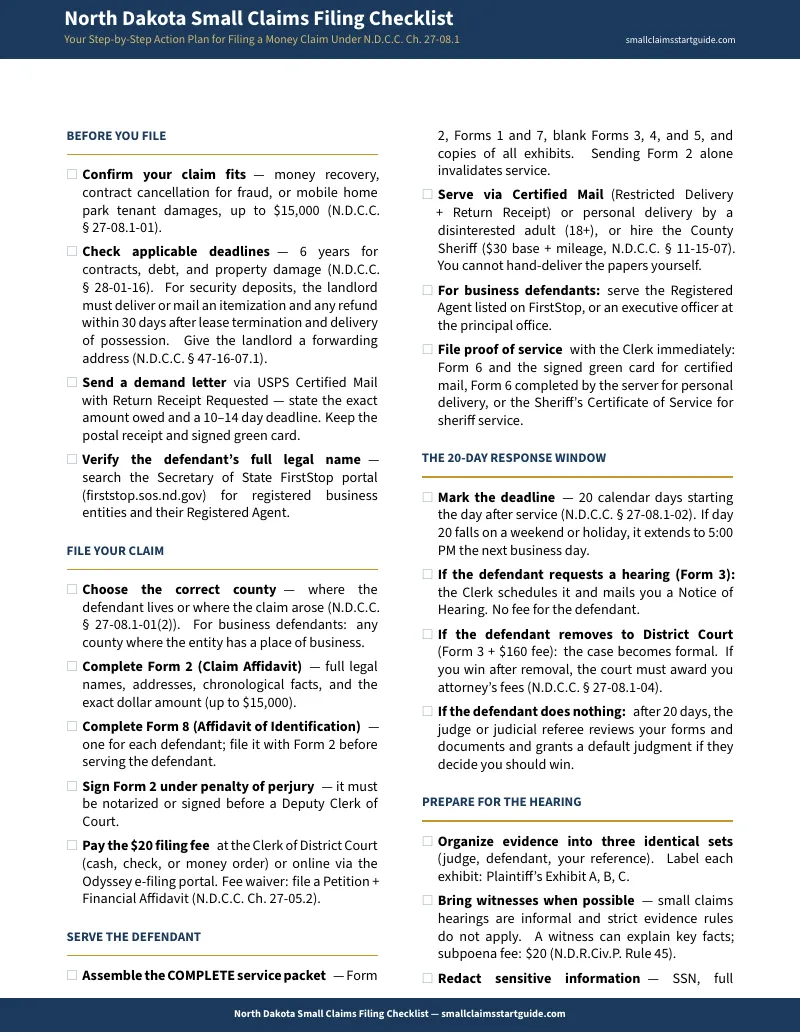
Download the free checklist to see the steps, forms, fees, and deadlines on one page. If you want the full procedural system — the ten-form reference, the service assembly checklist, the deadline calculator, and the hearing preparation blueprint — get the complete guide for .
Frequently Asked Questions
What if the rules change after I buy?
We update the guide when the rules change. Email us any time, even years later, and we'll send you the current edition free.