A sheriff just handed you court papers. Now what?
You're staring at a North Carolina Magistrate Summons — Form AOC-CVM-100 — and the legal language makes your stomach drop. A contractor, a former landlord, a customer, or a car buyer is taking you to small claims court. You have a hearing date printed on that summons, and you are not sure whether you need to file something, what to bring, or what happens if you get it wrong.
The internet says you have 20 or 30 days to file a written answer or you lose automatically. That advice is for District Court, not magistrate court. In North Carolina small claims, no written answer is required — the statute (N.C.G.S. § 7A-218) treats your silence as a general denial, and your one mandatory obligation is to show up at the hearing. But knowing that one fact is not enough. You still need to organize your evidence, understand what the magistrate expects, and protect the 10-day window to appeal if things go sideways.
The Magistrate Hearing Preparation System
This is not a generic legal primer. The Magistrate Hearing Preparation System is built for one person in one situation: a North Carolina defendant served with a small claims summons who needs to walk into that courtroom organized, prepared, and clear on every procedural step from today until the case is closed.
Where free court resources give you blank PDF forms and tell you "good luck," and national legal books bury North Carolina in a 50-state footnote table, this guide follows your timeline — from the moment the sheriff hands you those papers through the hearing, the judgment, and the appeal window — with every NC-specific form number, deadline, and courtroom protocol in plain English.
What's Inside
- Court Papers Decoder — a field-by-field walkthrough of Forms AOC-CVM-100 and AOC-CVM-200 so you understand exactly what the plaintiff is claiming, where your hearing is, and what the case number means for your county clerk's records
- Response Options Framework — your four paths mapped out: dispute the claim, admit part of it, file a counterclaim (up to $10,000 under N.C.G.S. § 7A-219), or negotiate a settlement before the hearing date
- 3-Copy Evidence Binder System — the method magistrates expect: one organized set for the judge, one for the plaintiff, and one for yourself, with indexing worksheets for photographs, receipts, text messages, and contracts
- Hearing Day Walkthrough — what happens when you arrive at the courthouse, the order of testimony (plaintiff first, then your turn), how to present documents to the magistrate, and courtroom etiquette that signals you came prepared
- Clerk Communication Notes — which questions your county clerk can answer (docket dates, filing fees, service confirmation) and which they cannot, so you do not waste time at the counter
- 10-Day Appeal Timeline Guard — a step-by-step breakdown of the appeal process under N.C.G.S. § 7A-228, including Form AOC-CVM-303, the District Court trial de novo, and when to file a fee waiver (Form AOC-G-106)
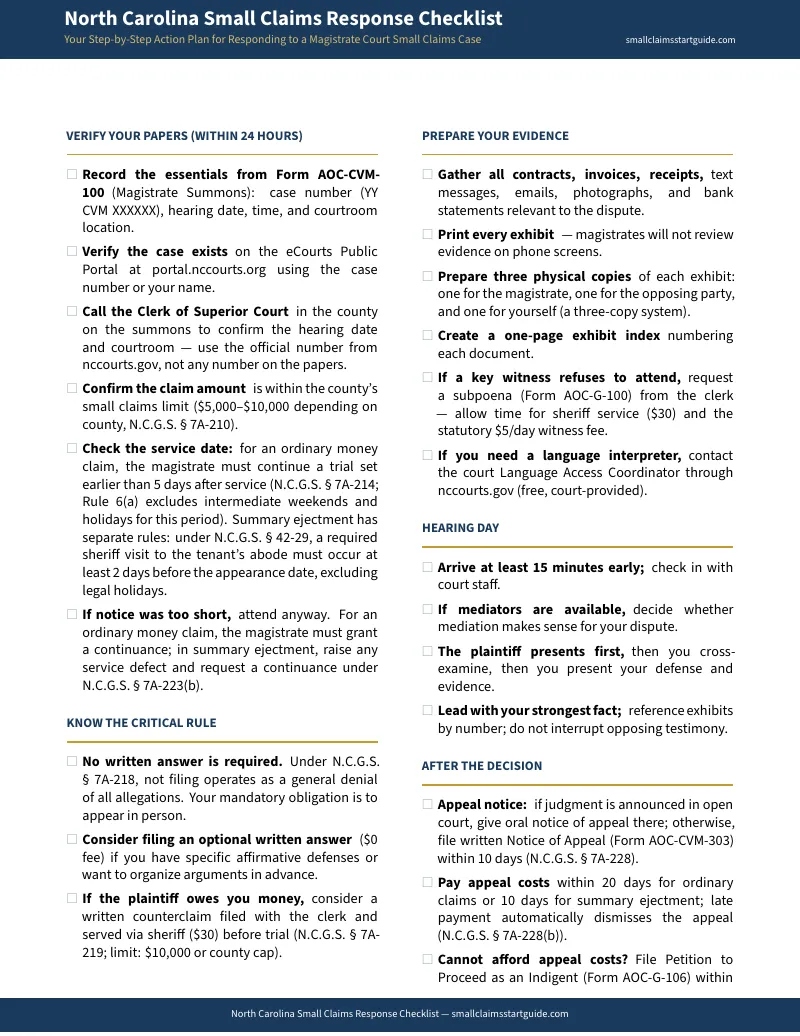
- Printable worksheets — Summons Verification Worksheet, Evidence Inventory and Exhibit Index, Hearing Day Preparation Checklist, Post-Decision Action Tracker, and Settlement Documentation Log, plus a two-page response checklist of every deadline from service day through post-judgment
Who This Is For
- A homeowner sued by a contractor over a disputed invoice or unfinished project
- A former tenant or landlord in a security deposit dispute
- A small business owner sued by a customer or vendor for up to $10,000
- A private vehicle seller facing a post-sale defect claim
- Anyone in North Carolina served with a Magistrate Summons who wants to understand the process before stepping into the courtroom
Not covered: eviction cases (Summary Ejectment / Form AOC-CVM-201) and debt collection lawsuits by lenders, debt buyers, or collection agencies. Those situations involve different legal protections, and the guide directs you to free specialized resources including Legal Aid of North Carolina.
Why Not Just Use the Free Court Website?
The North Carolina Judicial Branch website (nccourts.gov) publishes every official form for free — and you should download them. But those forms arrive as blank PDFs with no instructions. The Legal Aid guide gives you accurate statutory overviews but no printable evidence organizers or hearing preparation tools. The UNC School of Government manuals are written for magistrates and judges, not for someone who just got served last Tuesday.
Meanwhile, every search result on the first page is built for plaintiffs — Squabble, PettyLawsuit, DocDraft — companies that help people file lawsuits, not defend them. A served defendant does not need to file a complaint or pay a $96 platform fee. You need to organize what you have, understand what the magistrate expects, and walk in ready.
This guide collects the scattered NC-specific rules, forms, and courtroom protocols into one document that follows your timeline from service day to case closed.
Full Refund, No Time Limit
If the guide does not help you, email [email protected] for a full refund. No time limit, no questions, no hoops.
This is an independent educational publication. It is not produced by, endorsed by, or affiliated with the North Carolina Judicial Branch, the Administrative Office of the Courts, or any legal aid organization. It does not provide legal advice or predict case outcomes.
You have a hearing date. The guide gets you ready for it.
Frequently Asked Questions
What if the rules change after I buy?
We update the guide when the rules change. Email us any time, even years later, and we'll send you the current edition free.