You Won Your Case. The Court Won't Collect a Dime for You.
The magistrate ruled in your favor. You have a judgment on paper. But the debtor hasn't paid — and now you're learning something the court never warned you about: enforcement is entirely your problem.
The Clerk won't chase the debtor. The sheriff won't investigate. And if you file the wrong form first — or skip the mandatory exemption notice — your paperwork gets rejected and you're back to square one, minus the filing fees.
Most people who win in North Carolina small claims court never collect. Not because the law lacks enforcement tools, but because the tools have a strict sequence that nobody explains in plain English.
The NC Judgment Enforcement Roadmap
This guide is built around one thing competitors don't give you: the mandatory 3-step execution sequence that North Carolina law requires before the sheriff can touch a single asset. Miss a step, file out of order, or serve the wrong notice, and the Clerk sends you home.
Every chapter follows the same pattern: what the law requires, which AOC form to use, who to serve it on, and what happens next. No legal jargon, no national overviews that gloss over North Carolina's rules — just the procedure you need, in the order you need it.
What's Inside the Guide
- The Exemption Notice Trap — Before requesting a Writ of Execution, you must serve the debtor with Form AOC-CV-406 and wait a full 20 days. The guide walks you through proper service methods and how to calculate the deadline, so the Clerk doesn't reject your filing before enforcement even starts.
- Writ of Execution Instructions — Form AOC-CV-400 is the document that authorizes the sheriff to seize assets. The guide shows you how to complete it correctly, including post-judgment interest calculations at the statutory 8% rate under N.C.G.S. § 24-5.
- Bank Account Levies — The sheriff needs precise instructions to freeze and seize funds: the bank name, branch address, and your signed authorization. The guide includes a structured instruction framework so the sheriff can act immediately instead of returning your writ unsatisfied.
- Real Property Liens — By docketing a Transcript of Judgment (Form AOC-CV-403) in any county where the debtor owns real estate, your judgment becomes a lien that earns 8% annual interest for up to 10 years. The guide explains when to docket, how to search property records, and what the lien means if the debtor tries to sell or refinance.
- The Wage Garnishment Myth — North Carolina flatly prohibits wage garnishment for ordinary civil money judgments. The guide explains this upfront so you don't waste months pursuing an enforcement tool that doesn't exist — and shows you what works instead.
- Supplemental Proceedings — When the debtor hides assets or the sheriff returns your writ unsatisfied, you can compel the debtor to appear in court and disclose everything they own under oath. The guide covers how to request these proceedings under N.C.G.S. § 1-352.
- Multi-County Enforcement — If the debtor or their assets are in a different county, you need a Transcript of Judgment to establish jurisdiction there. The guide walks you through the cross-county process step by step.
- Exemptions and Bankruptcy — North Carolina law protects certain property from seizure. The guide maps out what the debtor can shield and what happens to your judgment if they file for bankruptcy.
- Satisfaction of Judgment — Once you collect, you have a legal obligation to file a Certificate of Satisfaction (Form AOC-CV-413) to cancel the judgment. Failing to file exposes you to statutory liability. The guide shows you exactly how to close the case.
Who This Guide Is For
- Individuals who won a small claims judgment over unpaid rent, security deposits, property damage, or personal loans
- Freelancers and sole proprietors chasing unpaid invoices under the small claims limit
- Small business owners who secured a magistrate's judgment for goods or services delivered but never paid for
- Anyone holding a North Carolina small claims judgment who wants to know every enforcement tool available — and the correct order to use them
Why Free Resources Aren't Enough
The North Carolina Judicial Branch publishes every form you need — for free. But it doesn't tell you which form comes first, when to file it, or what to write on the sheriff's instruction sheet.
The eCourts system (Guide & File) generates forms for filing a case — but has no automated workflows for post-judgment enforcement. You're on your own for writs, levies, and liens.
Legal aid organizations focus on defending low-income debtors, not helping creditors collect. National books like Nolo's guide dedicate a few pages to generic enforcement across all 50 states. None of them map North Carolina's mandatory exemption notice, the specific AOC forms, or the sheriff instruction requirements that apply only here.
This guide fills the gap between "here are the blank forms" and "here's how to actually collect your judgment."
The Full Refund Promise
If the guide doesn't help you understand the enforcement process, email [email protected] for a full refund — no time limit, no questions.
Start Collecting What You're Owed
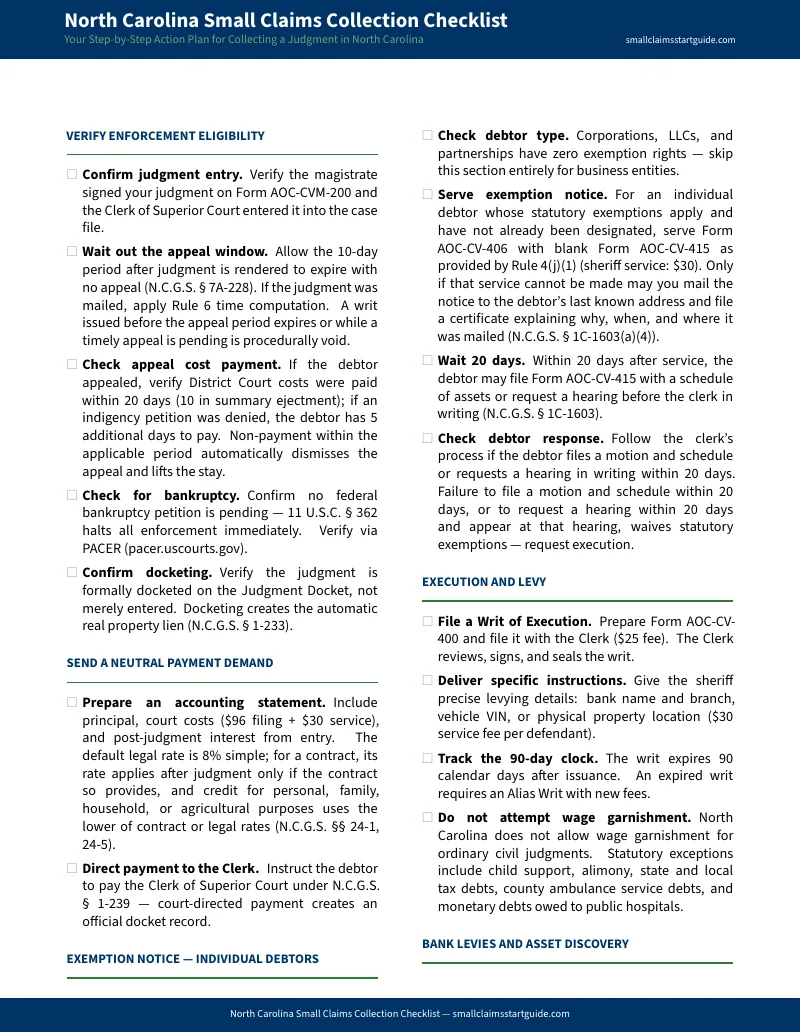
The free checklist gives you a one-page overview of the enforcement steps and the key forms. If you need the complete procedure — every enforcement tool, the mandatory filing sequence, sheriff instruction frameworks, interest calculations, and multi-county strategy — the full guide has it all, plus 5 printable worksheets to track your balance, organize sheriff instructions, log costs, map your timeline, and document every interaction.
Download the free checklist to see the enforcement roadmap at a glance, or get the full guide for the complete step-by-step procedure. The price shows in your local currency — .
Frequently Asked Questions
What if the rules change after I buy?
We update the guide when the rules change. Email us any time, even years later, and we'll send you the current edition free.