You know someone owes you money. You just don't know how to make the court work for you.
You have looked up the North Carolina small claims forms. You have found the court website. Maybe you have even started filling in Form AOC-CVM-200. But somewhere between finding the right legal name for the defendant, figuring out the SCRA military affidavit, working out whether to file online or on paper, and wondering what to actually bring to the hearing, the process stopped feeling straightforward.
The court gives you forms. It does not give you a sequence. The clerk can tell you where to file — not whether you have the right defendant name, the right service method, or the right evidence layout for a fifteen-minute hearing where the magistrate is moving through a packed docket.
That gap — between having the forms and knowing what to do with them — is where cases stall out. A rejected filing because the trade name doesn't match the registered entity. A continuance because the sheriff couldn't serve the summons. A ruling against you because the magistrate couldn't find the receipt in your stack of phone screenshots.
The NC Filing Roadmap: every step in order, nothing left to guess
The Filing a Small Claims Case in North Carolina guide is a step-by-step system that puts the entire filing process — from checking the jurisdictional limit to presenting your evidence at the hearing — into the exact order you need to follow. It covers both the traditional paper path and the eCourts online filing system, now live across all 100 counties.
This is not a generic fifty-state overview. Every form number, fee amount, deadline, and procedure is specific to North Carolina magistrate court. Every chapter builds on the last, so you never have to wonder what comes next.
What's inside
- Jurisdictional limit verification — the $10,000 statewide ceiling, how to check whether your district sets it lower, and what to do if your claim exceeds the limit
- Statute of limitations calculator — the exact deadline for your type of claim (breach of contract, security deposit, property damage, unpaid invoice), with worked examples showing when the clock starts and when it runs out
- Demand letter framework — what to include, the recommended 10-to-14-day deadline, and why a well-drafted demand changes how the magistrate views your case
- Entity search walkthrough — step-by-step instructions for searching the NC Secretary of State Corporations Division and County Register of Deeds, so you file against the correct legal entity instead of a trade name the clerk will reject
- Form-by-form completion guide — AOC-CVM-200 (Complaint for Money Owed), AOC-CVM-100 (Magistrate Summons), AOC-G-250 (SCRA military affidavit), and AOC-CV-662 (Affidavit of Service by Certified Mail), with line-by-line instructions
- Fee breakdown and payment rules — the $96 filing fee, the $30-per-defendant sheriff service fee, the split-payment requirements for paper filers, and how to apply for an indigency waiver using Form AOC-G-106
- Dual-track filing instructions — both the eCourts Guide & File online path and the traditional paper path, including copy-count rules (three copies for one defendant, four for two)
- Service of process verification — sheriff delivery, certified mail with the green card and Form AOC-CV-662, and what to do when the sheriff returns "not to be found"
- Evidence preparation system — how to convert phone screenshots, texts, receipts, contracts, and photos into numbered physical exhibits that a magistrate can review in fifteen minutes
- Hearing preparation — what to expect in the courtroom, how to present your case to the magistrate, and what happens after the ruling
- Appeal and post-judgment overview — the 10-day appeal window under N.C.G.S. § 7A-228, appeal costs, and when to hand off to the judgment collection process
Who this is for
- A tenant whose landlord has not returned a security deposit after the 30-day accounting window
- A homeowner whose contractor took a deposit and did not finish the work
- A sole trader or freelancer chasing an unpaid invoice under $10,000
- A consumer who paid for goods or services that never arrived
- Anyone in North Carolina owed money who wants to file the claim themselves, correctly, without paying for a lawyer
Why not just use the free forms?
The forms are free — and the guide links to every one of them. What the court website does not give you is the workflow that connects them. It does not tell you to search the Secretary of State database before you write the defendant's name on the summons. It does not walk you through the SCRA military status check. It does not explain the difference between the green card receipt and Form AOC-CV-662 that you actually need to file with the court. And it does not show you how to format your evidence for a hearing where the magistrate is reviewing dozens of cases in a single session.
You could piece all of this together from nccourts.gov, Legal Aid of North Carolina, the UNC School of Government bench manuals, and Reddit threads from other pro se filers in Charlotte and Raleigh. It would take hours, and you would still have to figure out the right order on your own. The guide does that work for you — one document, one sequence, every step verified against current North Carolina statutes and eCourts procedures.
Your purchase includes
- The full guide — 45 pages, thirteen chapters, covering every phase of the filing process
- The filing checklist — a printable checklist of the limit, forms, fees, service steps, and deadlines, so you can track your progress at a glance
- Defendant entity search worksheet — walk through the Secretary of State and Register of Deeds searches step by step and record the exact legal name before you file
- Pre-filing cost calculator — add up your filing fee, sheriff service fees, and certified mail costs before you go to the courthouse
- Filing and service tracker — track every document filed, every service attempt, every payment receipt, and every key date in one place
- Demand letter template outline — a fill-in framework for the five required elements of your demand letter
- Evidence index sheet — number and label every exhibit in your hearing binder so the magistrate sees what you have at a glance
- Hearing day checklist — a morning-of checklist covering documents, copies, witnesses, courtroom location, and what to expect
- Deadline calendar — track every critical deadline from the statute of limitations through the appeal window
Both files are yours to download immediately. Full refund, no time limit — email [email protected].
Start with the free checklist
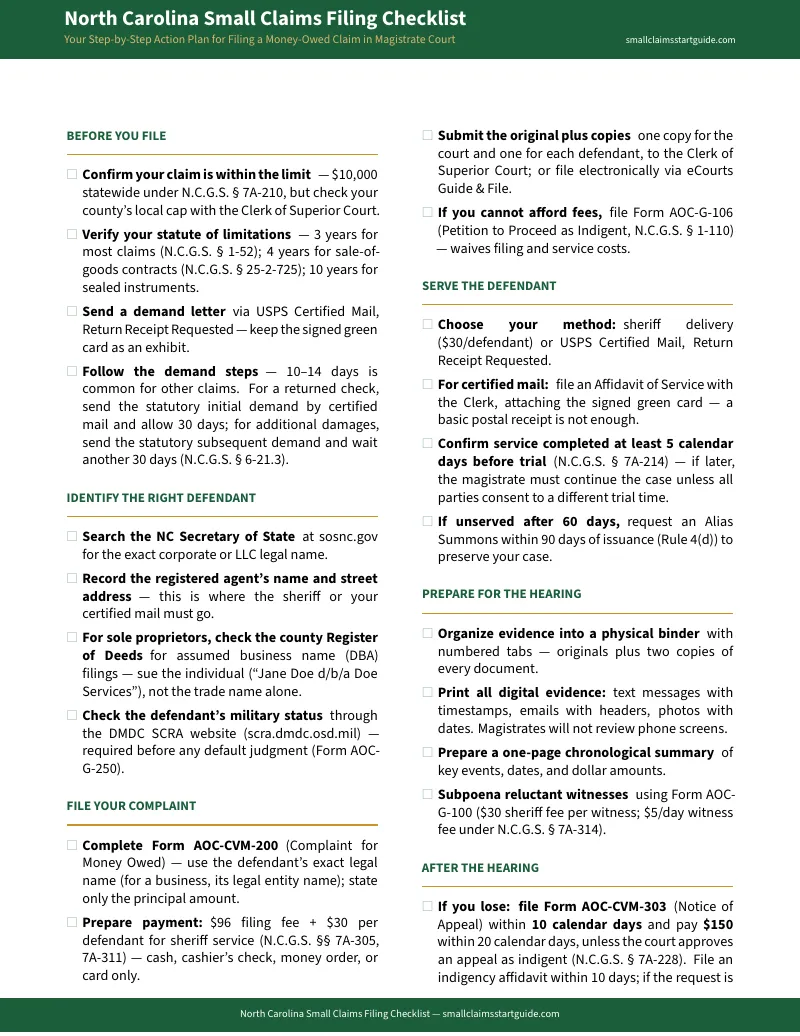
Not ready for the full guide? Download the North Carolina Small Claims Filing Checklist for free — it covers the jurisdictional limit, required forms, filing fees, service steps, and key deadlines on one page. If you decide you need the step-by-step details, the full guide picks up where the checklist leaves off.
Frequently Asked Questions
What if the rules change after I buy?
We update the guide when the rules change. Email us any time, even years later, and we'll send you the current edition free.