You have the receipts. You have the texts. You just need to know what happens between the demand letter and the courtroom.
Filing a small claim in New Hampshire sounds simple until you try to do it. New Hampshire requires all small claims to be filed electronically through TurboCourt — not the attorney File & Serve portal — and the court's own website spreads the instructions across rule pages, PDF forms, a sample complaint with outdated fees, and a Department of Justice consumer page that lists a completely different filing cost. If your business is an LLC, you cannot even file without two authorization forms that the e-filing instructions barely mention. And once you file, the court serves the defendant by ordinary first-class mail — if it comes back undeliverable, a 60-day clock starts ticking, and if you miss it, the case is dismissed automatically.
Most people do not lose because they have a weak claim. They lose because they name a trade name instead of the legal entity and the judgment is unenforceable. They file through the wrong portal and get locked out. They miss the 60-day service window because nobody told them it existed. They show up to what they think is their trial and discover it is a mediation session they are not prepared for.
The New Hampshire Small Claims Filing Sequence is a single-document procedural guide that takes you from the demand letter through to the post-decision deadlines. It is not a book about small claims law. It is a filing system: every step in order, every form identified, every deadline on a calendar, every fee accounted for.
What makes this different from the court's free materials
The rules at courts.nh.gov are free. The TurboCourt portal generates the complaint form for you. The Court Information Center at 1-855-212-1234 answers basic questions. None of them walks you through the process in the order you actually need to do things. The court rules are organised by rule number, not by step. The TurboCourt portal asks for information without explaining what matters and what does not. The sample complaint page still shows fees from before the current Rule 1.28 schedule took effect. And if you file on behalf of a business entity, nothing on the court's e-filing pages explains that you need Form NHJB-2936-De (Authorization for Representation under RSA 503:11) and Form NHJB-2804-De (Rule 1.3D Statement) uploaded with your complaint — skip them and the clerk rejects the filing.
The Filing Sequence reorganises all of it into a chronological sequence you follow from start to finish, with six standalone worksheets that handle the parts the free materials skip entirely: the Demand Letter Tracker, Party and Entity Verification Worksheet, Service of Process Log, Evidence and Exhibit Inventory, Hearing Preparation Sheet, and Post-Judgment Timeline Calendar.
What's Inside
The guide
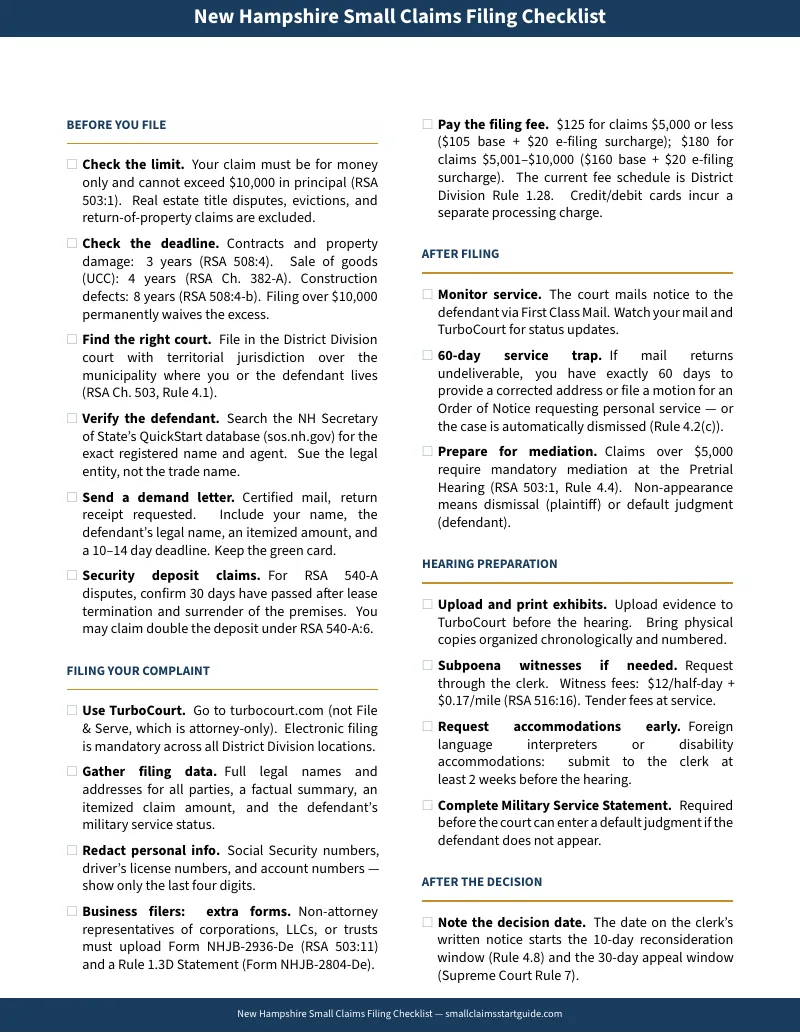
Checking the limit and the clock. Your claim must be $10,000 or less under RSA 503:1, exclusive of interest and court costs. Claims involving title to real estate are excluded. But the dollar limit is only half the question — the guide walks through the statute of limitations (three years for most personal actions under RSA 508:4) and shows you how to calculate your deadline from the date the claim arose.
The demand letter. New Hampshire does not require one, but judges notice whether you tried to resolve it first. For security deposits, the landlord has 30 days after the tenancy ends to return the deposit or send an itemised deduction statement under RSA 540-A:7. The guide covers what to include, how to send it by certified mail so you have proof, and how long to wait before filing.
Filing through TurboCourt. Every small claims case in New Hampshire is filed electronically through TurboCourt. Claims of $5,000 or less cost $125 ($105 base plus $20 e-filing surcharge under Rule 1.28). Claims between $5,001 and $10,000 cost $180 ($160 base plus $20). The guide covers creating your TurboCourt account (not the attorney File & Serve account, which will lock you out), completing each screen field by field, naming the defendant correctly, and uploading the business authorization forms if you are an LLC, corporation, partnership, or trust.
Business-entity filing rules. If you are filing on behalf of an LLC, corporation, partnership, or trust without a lawyer, you must upload two additional forms with your complaint under RSA 503:11 and District Division Rule 1.3D. The guide walks through both forms — Form NHJB-2936-De (Authorization for Representation) and Form NHJB-2804-De (Rule 1.3D Statement) — and explains exactly what each one requires.
Service of process — and the 60-day trap. The court serves the defendant by first-class mail under Rule 4.2(a). You do not serve them yourself. If the mail comes back undeliverable, Rule 4.2(c) gives you exactly 60 days to provide a verified updated address or request alternative service — otherwise the case is dismissed automatically. The guide covers every service method (court mail, sheriff service under RSA 510), the costs, and how to track the deadlines so you never lose a case to a returned envelope.
Mediation and the pre-trial hearing. New Hampshire does not send you straight to trial. Claims of $5,000 or less get voluntary mediation at the pre-trial hearing. Claims over $5,000 get mandatory mediation through the Judicial Branch Office of Mediation and Arbitration. If the claim is above $1,500, the defendant can request a jury trial, which transfers the whole case to Superior Court. The guide explains what to expect at each stage and how to prepare for a same-day settlement discussion.
Evidence — organised, printed, ready. Three copies: one for the court, one for the defendant, one for yourself. Contracts, invoices, text messages, photographs, and estimates in chronological order. The guide shows you how to assemble and index them.
After the decision. Either party has 30 days to appeal to the New Hampshire Supreme Court (Supreme Court Rule 7). If no appeal is filed and the judgment goes unpaid, you can file a Motion for Periodic Payments ($25), seek a Writ of Execution ($40), or record a lien. The guide maps every post-decision deadline so nothing catches you off guard.
Six standalone worksheets
- Demand Letter Tracker — records the certified-mail send, green-card delivery, and response before you open TurboCourt
- Party and Entity Verification Worksheet — Secretary of State QuickStart lookup for the exact legal name, plus the RSA 503:11 and Rule 1.3D forms checklist for LLC and corporate filers
- Service of Process Log — logs court first-class mail, returns, and sheriff attempts, with the 60-day Rule 4.2(c) deadline built in
- Evidence and Exhibit Inventory — numbered index for assembling three matching exhibit sets before TurboCourt upload and the hearing
- Hearing Preparation Sheet — opening points, exhibit order, witnesses, and same-day mediation path (mandatory over $5,000)
- Post-Judgment Timeline Calendar — 10-day reconsideration window, 30-day Supreme Court appeal, Motion for Periodic Payments, and Writ of Execution steps
Who It's For
Tenants owed a security deposit. Your landlord had 30 days after the tenancy ended to return the deposit or send an itemised deduction statement under RSA 540-A:7. If they did neither — or the deductions do not hold up — small claims court is the standard route. The guide covers the statutory timeline and how to document the condition of the unit.
Homeowners with a contractor dispute. The contractor took your deposit and vanished, or the work is defective and they will not come back. The guide covers verifying their business registration on the Secretary of State database, naming the correct legal entity, and presenting repair estimates.
Sole traders and freelancers with unpaid invoices. Your client owes for completed work. If you operate as an LLC, you will need the RSA 503:11 and Rule 1.3D forms to file without a lawyer. The guide walks through both.
Small landlords owed rent or property damage. Your former tenant left owing money or caused damage beyond normal wear. The guide covers locating a departed tenant for service and documenting damage — but not eviction, which is a separate proceeding.
Anyone owed $10,000 or less in New Hampshire. If you would rather spend an evening with a step-by-step guide than a morning navigating TurboCourt, scattered court rule pages, and a phone tree that cannot give you legal advice, this is for you.
Why Not Just Use the Free Resources?
You should. The court rules at courts.nh.gov cost nothing. TurboCourt generates the complaint form. The Court Information Center will answer basic procedural questions over the phone.
Here is what none of them do:
- Walk you through the entire process in chronological order from demand letter to post-decision enforcement
- Show you how to look up a business defendant on the Secretary of State database and convert the result into the correct legal name for your complaint
- Explain the RSA 503:11 and Rule 1.3D business authorization forms that TurboCourt's own instructions do not mention
- Give you the Service of Process Log with a built-in 60-day Rule 4.2(c) deadline that most filers do not learn about until after their case is dismissed
- Distinguish between the pre-trial hearing, voluntary mediation, mandatory mediation, and the bench trial — most court materials use the words interchangeably
- Provide the Post-Judgment Timeline Calendar that maps the 30-day Supreme Court appeal window, the Motion for Periodic Payments, and the Writ of Execution steps
The guide does not replace the court's forms — TurboCourt generates those. It organises everything around the portal so you file once, serve correctly, and arrive prepared.
Satisfaction Guarantee
Full refund, no time limit. If the guide does not help you, email [email protected] and you will get your money back. No questions, no deadline.
Get Started Tonight
Download the guide, open the Party and Entity Verification Worksheet, and fill in the defendant's legal name from the Secretary of State search. By the time you finish, you will know who to name on the complaint, your filing fee, and whether the statute of limitations is still open.
Already have a free checklist? Get the full Filing Guide →
Frequently Asked Questions
What if the rules change after I buy?
We update the guide when the rules change. Email us any time, even years later, and we'll send you the current edition free.