You won your case. The court does not collect the money for you. Now what?
The judge ruled in your favour. The clerk entered the judgment. And then nobody handed you a cheque, called the debtor's bank, or garnished a paycheck. In Nevada, the Justice Court does not enforce its own judgments. It issued a ruling. You are the one who has to turn that ruling into cash — using a set of enforcement tools the court never explains in full.
You searched online and found the Civil Law Self-Help Center, which has blank forms for Clark County. You found the Washoe County forms page, which has a few more for Reno and Sparks. You found Nolo's national book, which devotes a couple of paragraphs to post-judgment collection across all fifty states. And you found automated filing platforms that charge a monthly subscription and still do not cover the township-specific details you need.
The forms are free. You should download them. But a blank Writ of Execution does not tell you whether the appeal window has closed, which officer to deliver it to, how many certified copies you need, or what happens when the debtor claims an exemption on the frozen funds.
The Nevada Enforcement Sequencer inside this guide is what makes the difference. It maps every enforcement step — from the 7-calendar-day appeal deadline and 30-day enforcement stay through writs, garnishments, levies, and liens to the final Satisfaction of Judgment — against the specific rules of each Justice Court township. Not a national overview. Not a stack of blank forms. A single-state, township-by-township collection roadmap built from NRS Chapter 73, the Justice Court Rules of Civil Procedure, current officer fee schedules, and the local rules that trip up creditors who file paperwork in the wrong order.
What's Inside the Guide
Appeal Wait Calendar
Enforcement cannot begin until the initial stay under JCRCP Rule 62(a) expires — generally 30 days after service of written notice of entry — and you have confirmed no supersedeas bond or other stay is in effect. Separately, either party may appeal within 7 calendar days after service of the judgment under JCRCP Rule 98(b). Filing a writ of execution during the stay gets it rejected. The kit includes a fillable Appeal Wait Calendar that counts both clocks and marks the first date you can file an enforcement paper.
Debtor Examination Workflow
When the debtor claims they have nothing, a Motion and Order for Examination of Judgment Debtor forces them to appear in court under oath and disclose every bank account, employer, vehicle, and piece of real property they own. If they lie, it is perjury. If they do not show up, the court can issue a bench warrant for contempt. The guide covers the motion, the service requirements (personal service by a constable or sheriff is required), the hearing itself, and a structured set of questions that systematically uncover assets the debtor would rather not mention.
Writ of Execution — Township by Township
A writ of execution is the court order that sends a constable or sheriff to seize money or property. The guide covers every step: requesting the writ from the court clerk, paying the issuance fee, preparing the Notice of Execution, drafting Instructions to Constable or Sheriff with the required certified copies, and enclosing the mandatory garnishee fee cheque. Las Vegas Justice Court requires e-filing through the Odyssey portal. Henderson, North Las Vegas, Reno, Sparks, and rural courts each have their own procedures. The guide covers all of them.
Wage Garnishment Calculator
Nevada wage garnishment lasts 180 days and is subject to three caps: 25% of disposable earnings when gross weekly wages on the most recent writ date exceeded $770, 18% when they were $770 or less, and the excess over 50 times the federal minimum wage ($362.50 per week at $7.25/hour). The lowest number wins. The kit includes a fillable Wage Garnishment Calculator, plus how to serve the writ on the debtor's employer, what the employer must do, and what to do when the debtor changes jobs or the 180-day period expires before the judgment is paid.
Bank Levy Procedure
A bank levy freezes funds in the debtor's account and turns them over to the officer. The guide covers identifying the debtor's bank through the debtor examination, filing the writ with the correct constable or sheriff, and handling the automatic exemption for electronic government benefit deposits — Nevada protects the first $2,000 in the account under NRS 21.090, and the debtor has the right to claim additional exemptions on the frozen funds.
Real Property Lien Recording
Recording an Abstract of Judgment with the county recorder creates a lien on any real property the debtor owns in that county. The lien lasts six years and blocks the debtor from selling or refinancing without paying the judgment. The guide covers obtaining the Abstract from the court, the recorder's fee, recording in multiple counties, and the reality of the homestead exemption — Nevada protects up to $605,000 in equity in a primary residence, so a property lien is worth recording only when the debtor's equity exceeds that amount or the property is not a primary residence.
Post-Judgment Interest Ledger
Post-judgment interest in Nevada accrues at the prime rate plus two percent, adjusted every January 1 and July 1 under NRS 17.130. The kit includes a fillable Cost and Payment Ledger that tracks the judgment balance, each partial payment, interest accrued by period, and all recoverable court costs and officer fees. When you file the Satisfaction of Judgment, you know exactly what the debtor owed and exactly what was collected.
Exemption Response Guide
When the debtor files a Claim of Exemption under NRS 21.112, you have 8 judicial days after the claim is served to file an objection and notice of hearing. Nevada protects specific property under NRS 21.090: up to $605,000 in homestead equity, household goods up to $12,000, tools of trade up to $10,000, one vehicle up to $15,000 in equity, and 75% or 82% of disposable earnings depending on gross weekly wages when the most recent writ issued. The kit includes a fillable Exemption Claim Response Tracker covering every category, the non-exempt assets creditors most commonly target, and the objection deadline.
Judgment Renewal and Satisfaction
A Nevada judgment expires six years after entry. The renewal window is the 90-day period before expiration — file the Affidavit for Renewal too early or too late, and the judgment dies. The guide covers the calculation, the form, and the filing procedure. When the debtor has paid in full, you are required to file a Satisfaction of Judgment and release any recorded liens. The guide covers that too, including the statutory penalties for failing to file after full payment.
Who This Guide Is For
- Tenants who won a security deposit judgment — The court ruled in your favour and your former landlord has not paid. You need to find their bank accounts, file the enforcement papers, and collect what you are owed — including interest that has been accruing since the ruling.
- Homeowners who won a contractor dispute — The court ordered the contractor to pay and they ignored it. You need to force them into a debtor examination, garnish their wages or levy their business accounts, and put a lien on their property if needed.
- Small-business owners with unpaid judgments — A customer or vendor owes you by court order. You need the enforcement tools and the paperwork to collect without hiring a lawyer.
- Anyone whose debtor claims to have nothing — The debtor examination procedure exists for exactly this. The court orders them to appear under oath and disclose every asset. The guide walks you through the process.
- Creditors with aging judgments — If years have passed and the debtor still owes money, you need to know the renewal deadline before your judgment expires forever.
Why Not Just Use the Free Court Forms?
You should use the free court forms. The Civil Law Self-Help Center in Las Vegas has downloadable forms and automated document interviews. Washoe County publishes its own set. The Nevada Judiciary portal links to the statutes. Use all of it.
The problem is not access to forms. The problem is that forms without sequencing create expensive mistakes. A creditor who files a writ during the 30-day stay gets it rejected. A creditor who delivers the wrong number of certified copies to the Constable's office gets turned away. A creditor who runs a bank levy without accounting for the $2,000 NRS 21.105 protection on qualifying exempt deposits gets a Claim of Exemption filed against them. A creditor who collects the full judgment but never files a Satisfaction faces statutory penalties. Each mistake costs money and time — process server fees, clerk filing fees, and weeks of delay.
The guide puts the forms into a sequence. It tells you which enforcement tool to use first based on what you know about the debtor's assets, which officer to deliver the paperwork to in your township, how many copies to bring, how much each step costs, and what to do when the debtor pushes back. If you already know your way around NRS Chapter 21 and your local constable's civil division, you do not need it. If you would rather have the entire process in one document, this is built for that.
What You Get
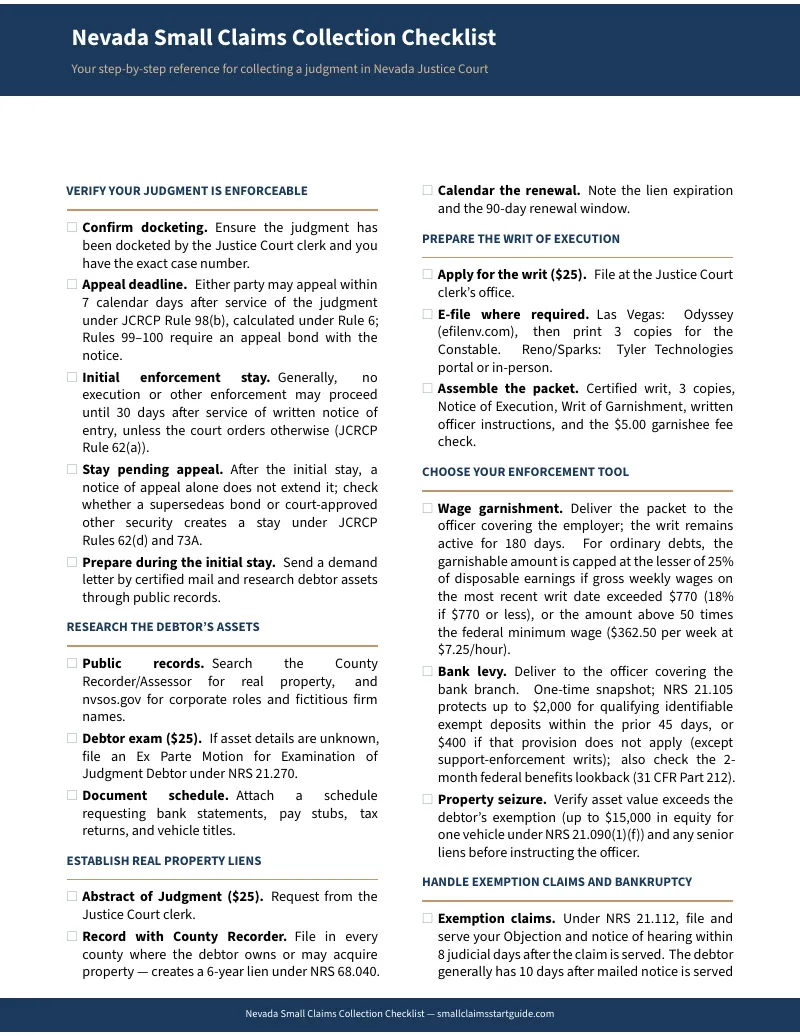
The full kit is an instant download. Printable PDFs. You get the 51-page collection guide (14 chapters covering every enforcement tool from debtor examinations through satisfaction of judgment), eight fillable worksheets (Appeal Wait Calendar, Enforcement Timeline Tracker, Cost and Payment Ledger, Debtor Examination Preparation Sheet, Execution Packet Checklist, Wage Garnishment Calculator, Exemption Claim Response Tracker, Satisfaction and Lien Release Checklist), plus the free two-page collection checklist (26 items covering the enforcement sequence at a glance).
Full refund, no time limit. If the guide does not help, email [email protected] and you get your money back.
There is also a free checklist — 26 items covering the waiting period, enforcement options, forms, exemptions, and deadlines. It covers what to do. The full guide covers how to do it, township by township, with the fillable ledger and tracking worksheets that keep every enforcement step on track.
Get the Nevada Collection Guide —
Frequently Asked Questions
What if the rules change after I buy?
We update the guide when the rules change. Email us any time, even years later, and we'll send you the current edition free.