You Won Your Case. The Court Won't Collect a Dime for You.
You sat through the hearing. The judge ruled in your favor. You walked out expecting a check — or at least some kind of next step from the court. Instead, you got silence. No payment, no instructions, no follow-up. When you called the clerk, they told you the court's job was done and collection was your problem.
That is how Montana's system actually works. Justice Courts enter judgments. They do not enforce them. The entire burden of turning that court order into actual money — finding out where the debtor works, which bank they use, what they own, and then filing the right paperwork with the right officer at the right time — falls entirely on you.
Most people get stuck right here. Not because the law is against them, but because nobody explains the next steps in one place.
The Montana Judgment Enforcement Toolkit
This guide is a complete post-judgment enforcement system built specifically for Montana's Justice Court procedures. It covers every enforcement tool the state provides — organized in the order you are most likely to need them, with the exact forms, fees, deadlines, and officer instructions at each step.
Where the court gives you a blank form and a shrug, this guide gives you the workflow that connects form to officer to money.
What's Inside
- The 10-Day Appeal Verification — a step-by-step check to confirm your judgment is final and enforceable before you spend a dollar on execution fees
- Debtor Examination Procedures — how to compel the debtor to reveal their employer, bank accounts, vehicles, and property under oath using MCA § 25-14-101, with the prerequisite sequence most creditors miss
- Sheriff Praecipe Instructions — because a Writ of Execution is useless without specific written instructions telling the sheriff exactly what to levy and where. The guide shows you exactly what language to use for bank levies, wage garnishments, and property seizures
- Wage Garnishment Calculations — the correct withholding formula (the lesser of 25% of disposable earnings or the amount exceeding 30× federal minimum wage), with a worked example showing monthly withholding amounts on a real salary
- Bank Account Levy Procedures — how to seize funds in a single action, including service on the financial institution, the 10-day hold period, and what happens when accounts are jointly held
- Personal Property Seizure — directing the sheriff to seize and auction non-exempt assets, with Montana's full exemption matrix so you know what's protected before you waste fees on uncollectable items
- Real Property Lien Recording — the 3-step process for docketing a transcript of judgment in District Court to create a lien that survives for 10 years and forces payment at any future property sale or refinancing
- Post-Judgment Interest Calculator — a printable worksheet using Montana's current statutory rate (Federal Reserve Prime + 3%, simple interest under MCA § 25-9-205), so your writ amount includes every dollar the law allows
- Cross-County Enforcement — what to do when the debtor's wages, bank, or property are in a different county than your Justice Court
- Collection Tracking Ledger — an itemized log for partial payments, costs, and interest that keeps your records audit-ready if the debtor ever challenges your balance
Who This Is For
- You hold an unpaid monetary judgment from a Montana Justice Court Small Claims Division
- You are enforcing the judgment yourself — without a collection agency or attorney
- You need the actual procedures, not general legal information that stops at "consult a lawyer"
This guide is strictly for creditors who have already won their case. It contains zero advice on filing a claim, presenting evidence, or arguing liability.
Why Not Just Use the Free Court Forms?
The official forms at courts.mt.gov are completely free — and you should download them. This guide does not replace those forms. It solves a different problem: the forms are blank templates with no instructions. They do not tell you how to draft a Sheriff Praecipe, which bank branch to specify for a levy, how to calculate interest under the current statutory formula (not the outdated 10% rate many creditors assume), or what to do when the debtor claims an exemption.
The court clerk cannot help you with any of this. Justice Court clerks are prohibited by court rules from offering legal advice or completing execution paperwork. They will hand you the forms and send you on your way.
A collection agency will do the work for you — and keep 30% to 50% of whatever they recover. An attorney consultation runs $200 to $350 per hour in Montana, which can exceed the judgment itself on smaller claims.
This guide gives you the procedural clarity to do it yourself, correctly, the first time.
Satisfaction Guarantee
Full refund, no time limit. If the guide does not help you move forward with collecting your judgment, email [email protected] and you will get your money back.
Get Started
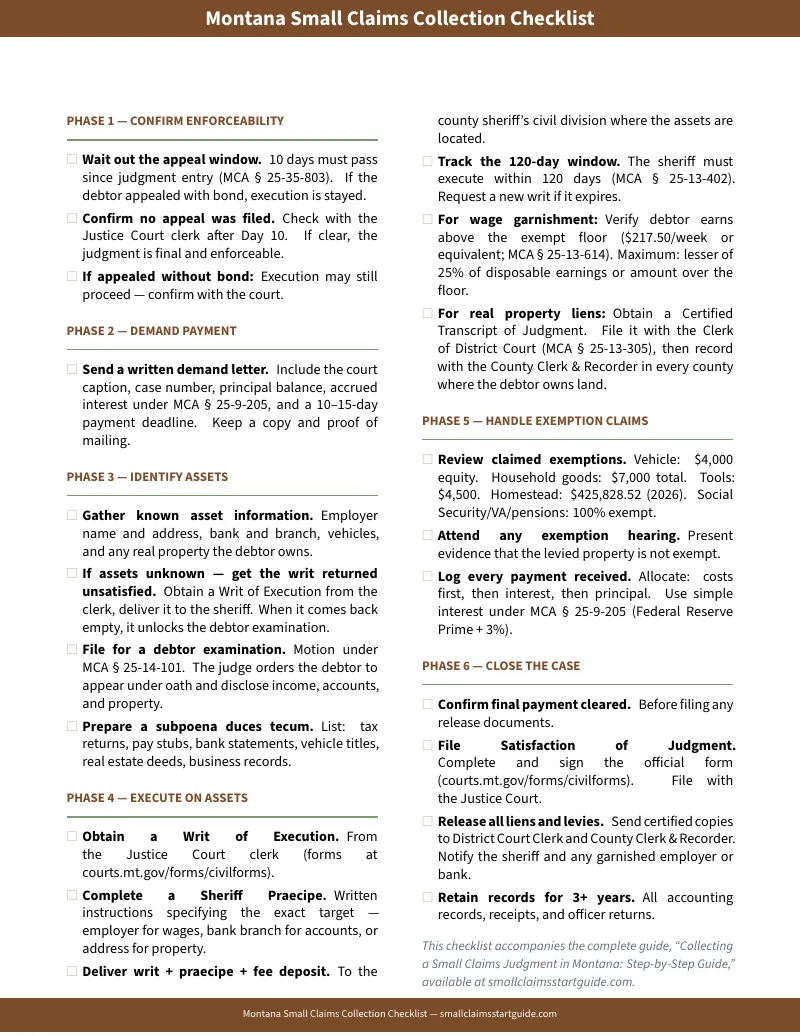
The free checklist gives you the 21-item overview — every milestone from the appeal window through the Satisfaction of Judgment filing. The full kit adds the 50-page guide plus five print-and-fill PDFs: the Post-Judgment Interest Calculator, Sheriff Praecipe Instruction Sheet, Collection Tracking Ledger, Exemption Response Timeline, and Satisfaction and Lien Release Checklist.
Download the free checklist to see if you are on track. When you are ready for the full enforcement system, the complete guide is — a one-time purchase with instant PDF download.
Frequently Asked Questions
What if the rules change after I buy?
We update the guide when the rules change. Email us any time, even years later, and we'll send you the current edition free.