You have got the forms. You still do not know what to do with them.
Montana's courts.mt.gov gives you a blank Small Claims Complaint and Order of Court. The Department of Justice publishes a brochure that lists the $7,000 limit, the $30 filing fee, and the 10-day appeal window. County clerk websites add a few local rules — Park County takes cash or check only, Madison County wants your certified-mail receipt before they will accept the complaint, Carbon County's sheriff charges $65 plus a $15 processing fee to serve papers.
None of them put it in order. None of them tell you what goes on the form, which county to file in, how to name a business correctly, what to bring to court, or what happens when service fails. You are left toggling between a state brochure, a blank PDF, and a half-dozen county websites, trying to build a procedure from fragments.
The Montana Small Claims Filing Roadmap — every step from the demand letter to the courtroom, in one place
The Filing Roadmap is a 45-page step-by-step guide, plus eight printable worksheets, that takes you from "I think I have a claim" to "I am standing in front of the Justice of the Peace with organised evidence." It replaces the tab-juggling with a sequence you can follow — and the worksheets track what you have done, what is outstanding, and when every deadline hits.
This is not a legal advice service and it is not a court publication. It is an independent workbook that organises free, publicly available information into a sequence you can follow without missing steps.
What is inside
Pre-Filing Eligibility Checklist
Before you spend a morning at the courthouse, the printable Pre-Filing Eligibility Checklist walks you through the threshold questions: Is your claim $7,000 or less under MCA § 25-35-502? Is it a fixed, liquidated amount (not general damages or a property-possession dispute)? Can the defendant be physically served within the county where you plan to file? If any answer is no, the guide explains your alternatives — General Civil Division, District Court, or voluntarily reducing the claim — so you do not file a complaint that gets turned away.
Demand Letter Template and Certified Mail Log
Multiple Montana Justice Courts require proof that you sent a written demand by certified mail before they will accept your complaint. The Demand Letter Template has the elements courts want to see, paired with a Certified Mail Log for the tracking receipt and the signed or refused postal card you present to the clerk. It also covers how long to wait after mailing before filing.
Filing Day Preparation Checklist
The Small Claims Complaint and Order of Court form is straightforward once you know what goes where. The guide walks through every field — plaintiff name, defendant name and address, the amount claimed, the basis for the claim — with notes on naming sole traders, LLCs, and corporations correctly. The Filing Day Preparation Checklist ensures you arrive at the clerk's counter with the form completed, the filing fee in the right format, and the demand-letter receipt in hand.
County Logistics Finder
Montana has 56 counties, and the administrative details vary more than you would expect. The guide covers what you need to know about your county's payment rules, office hours, and service fees so you do not make a wasted trip to a clerk who cannot process your payment or a sheriff who charges more than you budgeted.
Service Tracking Worksheet
You cannot hand the papers to the defendant yourself. The Sheriff or a private process server must deliver them at least five days before the hearing. The Service Tracking Worksheet logs every service attempt — date, method, who carried it, result — and checks that the Civil Affidavit of Service is filed with the court before your hearing date. If service fails on the first attempt, the guide covers what to try next.
Evidence Organization Checklist
Justices of the Peace expect printed, organised evidence — not a stack of loose papers or a phone screen. The Evidence Organization Checklist walks you through three matching binder sets (judge, defendant, you) in chronological order with tabbed exhibit dividers, an exhibit index, and a witness-question outline so you walk in knowing what to show and when.
Deadline Calendar
Every critical deadline on a printable calendar: the statute of limitations for your claim type, the 40-day maximum window from filing to hearing, the 5-day minimum service notice, the 72-hour counterclaim service rule, and the strict 10-day appeal window under MCA § 25-35-803. Fill in your dates once and the calendar tracks the rest.
Who this is for
- Tenants whose landlord kept the security deposit past the 30-day statutory deadline or sent deductions that do not match reality
- Homeowners whose contractor took a deposit and disappeared or left defective work
- Small landlords owed rent or facing tenant damage beyond normal wear
- Sole traders and freelancers with unpaid invoices from clients who stopped responding
- Buyers refused a refund on goods that never arrived or did not match the description
- Anyone in Montana owed $7,000 or less who wants to handle it without a lawyer
Why not just use the free court forms?
The court forms are free — and you should absolutely download them from courts.mt.gov. The forms give you the blank fields. What they do not give you is the order of operations: which form to file first, what to attach, how to calculate whether your claim qualifies, how to track service, or how to prepare evidence that does not get shuffled aside in court. The DOJ brochure adds some context, but it is a summary, not a procedure. It does not tell you that Park County requires cash or check, that Madison County checks your certified-mail receipt before accepting the complaint, or that Carbon County's sheriff charges $80 for service.
The national legal guides — Nolo's Everybody's Guide to Small Claims Court is the standard — give good general advice on evidence gathering and courtroom behaviour. But they cover all 50 states in one volume. They do not cite MCA Title 25, Chapter 35. They do not mention the consent-based attorney rule under § 25-35-505(2). They reference a standard 30-day appeal window; Montana's is 10 days. A Montana litigant relying on a national guide can miss the appeal deadline without realising the clock was different.
The Filing Roadmap is not a replacement for the court forms or a substitute for legal advice. It is the organisational layer between "I downloaded the forms" and "I filed correctly on the first visit."
What you get
- guide.pdf — 45 pages covering every step from the pre-filing check to the hearing
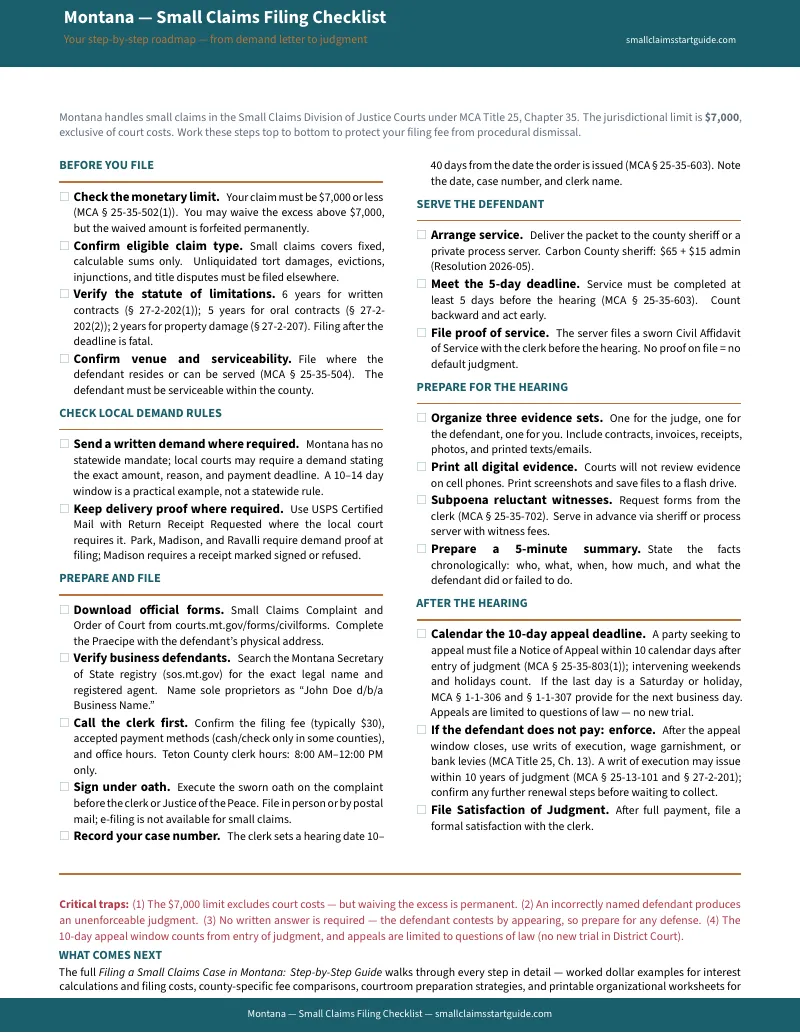
- checklist.pdf — a two-page printable checklist of every item you need before you walk into the clerk's office
- Eight fillable worksheets — Pre-Filing Eligibility Checklist, Demand Letter Template and Certified Mail Log, Filing Day Preparation Checklist, Defendant Identification Worksheet, County Logistics Finder, Service Tracking Worksheet, Evidence Organization Checklist, and Deadline Calendar
Full refund, no time limit. If the guide is not what you expected, email [email protected] and you will get your money back.
Start with the free checklist
Not sure you are ready for the full guide? Download the free Montana Small Claims Filing Checklist — a two-page summary of the limit, forms, fees, service steps, and deadlines. It covers what to do. The full guide covers how.
Frequently Asked Questions
What if the rules change after I buy?
We update the guide when the rules change. Email us any time, even years later, and we'll send you the current edition free.