You Won. They Haven't Paid. Now What?
You sat through the hearing, presented your evidence, and the judge ruled in your favor. But weeks have passed and the debtor still has not sent a check. The court congratulated you on winning — then left you completely on your own to collect.
Here is what nobody told you at the courthouse: the Missouri court system does not enforce its own judgments. No one is going to garnish the debtor's wages, freeze their bank account, or track down their assets for you. That is your job now. And the forms, fees, deadlines, and exemption rules you need to navigate are scattered across county clerk websites, state statutes, and Supreme Court rules that assume you went to law school.
The Missouri Judgment Collection System
This guide turns the scattered post-judgment enforcement rules into a single, ordered system — what to do first, which form to file, how much to pay, and where to send it. It connects the dots between the circuit clerk's office, the county sheriff, the debtor's employer, the debtor's bank, and the recorder of deeds so you stop bouncing between offices wondering what comes next.
Other guides give you a one-page summary of your options. This one gives you the full procedural workflow — from the day the judge signs the judgment through the day you file the satisfaction of judgment and close the case.
What's Inside
- The 10-day countdown — exactly when enforcement can start after judgment, what a trial de novo appeal means for your timeline, and how to verify the appeal window has closed before filing anything
- Asset discovery protocol — lawful methods for identifying the debtor's employer, bank accounts, vehicles, and real property using public records, Secretary of State filings, and county assessor databases — before you spend a dollar on court fees
- Wage garnishment walkthrough — line-by-line completion of OSCA Form CV92, the 25% disposable earnings cap, the reduced 10% cap when the debtor claims head-of-family status, continuous garnishment administration under Supreme Court Rule 90, and coordination with the county sheriff for service
- Bank account garnishment — the levy process from application through the 30-day withholding window, the garnishee interrogatory responses on OSCA Form CV110, and what to do when the bank claims the account is exempt
- Real estate lien pathway — why your small claims judgment does not automatically attach to the debtor's property (RSMo § 482.365.1), and the certified-transcript procedure under RSMo Chapter 511 to create a 10-year enforceable lien through the circuit clerk
- Exemption rules and caps — homestead equity ($15,000 through 2026, $40,000 from 1 January 2027), motor vehicle equity ($3,000 through 2026, $5,000 from 1 January 2027), wildcard personal property ($600 through 2026, $1,700 from 1 January 2027), and minimum-wage protections so you know what is off limits before you file
- Post-Judgment Balance Tracker — how to calculate and track post-judgment interest under RSMo § 408.040 (9% per year on non-tort judgments, or the contract rate if higher; tort judgments use the Federal Funds Rate plus 5% fixed in the judgment), allocate partial payments to costs, interest, and principal, and avoid common accounting errors that delay satisfaction
- Printable collection kit — eight fillable PDFs: the Balance Tracker, Agency Communication Log, Asset Discovery Worksheet, Enforcement Action Tracker, Exemption Quick-Reference Card, Debtor Examination Notes, Satisfaction Filing Checklist, and Wage Garnishment Cap Worksheet
- Satisfaction of judgment — filing the acknowledgment under RSMo § 511.570 once the debtor pays in full, and the statutory penalties you face under RSMo § 511.620 if you fail to file promptly after payment
Who This Is For
- Individuals who won a money judgment in Missouri small claims court and have not been paid
- Sole proprietors and small businesses collecting on an unpaid invoice, returned check, or contract balance
- Family members helping a relative navigate the collection process after a court win
Why Free Court Forms Are Not Enough
The Missouri Courts portal gives you blank OSCA forms — CV92, CV110, CV96 — at no cost. What it does not give you is any explanation of what those forms do, how to fill them out correctly, or the order in which to use them.
A single filing error on OSCA Form CV92 — miscalculating the interest accrued, omitting the garnishee's mailing address, or failing to attach the required fee — results in a clerk rejection. You then re-file, pay the sheriff process fee again, and lose another two to three weeks. The Missouri Bar handbook devotes exactly one page to collection. County circuit court websites contradict each other on local fees and procedures. National self-help books cover 50 states in broad strokes and skip Missouri's specific transcript-of-judgment requirement for real estate liens entirely.
This guide eliminates the guesswork. Every form, fee, deadline, and filing location is documented in the order you need it.
Your Purchase Is Protected
Full refund, no time limit. If the guide does not help you, email [email protected] and we will refund your purchase — no questions, no deadline.
No guide can guarantee you will collect every dollar. If the debtor is truly insolvent, no enforcement tool will produce money that does not exist. What this guide does is ensure you use every lawful tool available, in the right order, without wasting money on clerk fees and sheriff service for approaches that cannot work in your situation.
Get Started Now
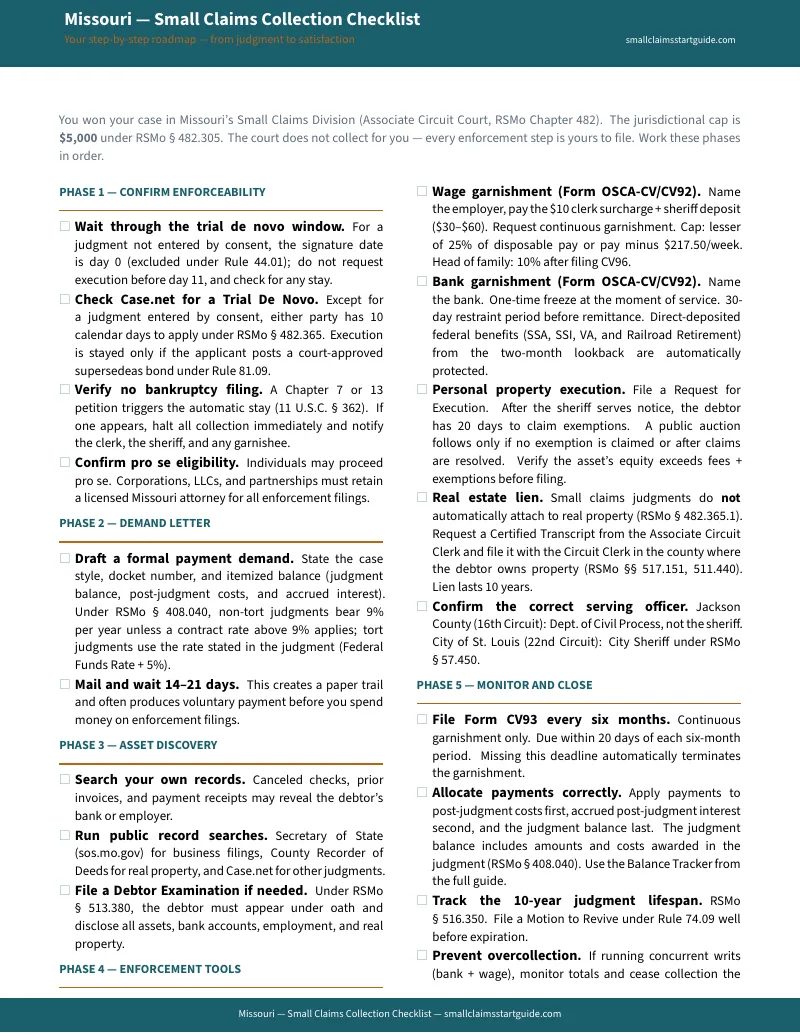
Download the free Missouri Small Claims Collection Checklist to see the high-level enforcement roadmap. When you are ready for the full step-by-step system — including form walkthroughs, fee schedules, exemption tables, and the Post-Judgment Balance Tracker — get the complete guide for .
Frequently Asked Questions
What if the rules change after I buy?
We update the guide when the rules change. Email us any time, even years later, and we'll send you the current edition free.