You have the receipts. You have the texts. You just need to know what happens between the demand letter and the courtroom.
Filing a small claim in Missouri sounds straightforward until you try to do it. Missouri does not have a standalone small claims court — your case goes to the Small Claims Division of the Associate Circuit Court, and every county runs its own clerk's office with its own fees, its own service rules, and its own way of scheduling hearings. The state website gives you a blank petition form and a few paragraphs of explanation. It does not tell you how to complete it, how to name a business defendant correctly, how much your county charges, or what to bring to a hearing where you get ten minutes to present your case.
Most people lose before they walk into the courtroom. They name the defendant wrong and the judgment is unenforceable. They send certified mail that comes back unsigned and do not know the next step. They arrive with evidence on their phone instead of in three printed binders. They win and then miss the 10-day window to protect the judgment from a Trial de Novo.
The Missouri Small Claims Filing Roadmap is a single-document procedural guide that takes you from the demand letter through to the post-hearing deadlines. It is not a book about small claims law. It is a filing system: every step in order, every form identified, every deadline on a calendar, every county fee variation accounted for.
What makes this different from the court's free materials
The official petition form is free at courts.mo.gov. The Missouri Bar's handbook is free. Neither one walks you through the process in the order you actually need to do things. The Bar handbook is a dense legal reference last updated in 2021 that organises information by topic, not by step. The official form comes without line-by-line completion instructions. County clerk pages assume you already know which court to file in and how to serve the defendant.
The Filing Roadmap reorganises all of it into a chronological sequence you follow from start to finish, with six standalone tools that handle the parts the free materials skip entirely: the filing worksheet, the defendant identification worksheet, the demand letter worksheet, the service of process tracker, the evidence binder organizer, and the deadline calendar.
What's Inside
The 47-page guide
Checking the limit and the clock. Your claim must be $5,000 or less under RSMo § 482.305, and you cannot file more than twelve small claims in a year. But the dollar limit is only half the question — the guide walks through every statute of limitations (ten years for written contracts, five for oral contracts, five for property damage) and shows you how to calculate yours.
The demand letter. Missouri does not always require one, but showing up in court without it tells the judge you skipped a step. For residential security deposits, a tenant recovers twice the amount wrongfully withheld under § 535.300. The guide covers what to include, how to send it by certified mail, and how long to wait before filing.
The petition and the fees. The Petition Small Claims Court form (form ID 706) requires you to name the defendant by their exact legal name, state the dollar amount, and describe the facts. Filing fees range from $20.50 in St. Louis County to $35.50 in Greene County to $100 in some rural circuits where the fee includes service. The guide covers entity verification through the Missouri Secretary of State, county fee breakdowns, and filing in person, by mail, or through Case.net.
Serving the defendant. The clerk sends the summons by certified mail for $10–$15 per defendant in most counties. If it comes back unsigned, refused, or signed by someone else, you need sheriff personal service ($46.00 per defendant under RSMo § 57.280, plus mileage) or an alias summons. The guide covers every method, every cost, and what to do when the first attempt fails — because it often does.
The evidence binder. Three matching copies: one for the judge, one for the defendant, one for yourself. Contracts, invoices, text messages, photographs, and repair estimates in chronological order, tabbed and ready to reference. The guide shows you exactly how to assemble them.
The hearing. What the courtroom looks like, how the associate circuit judge runs the proceeding, how much time you get, and what happens if the defendant does not show up.
After the decision. Either side has 10 days to file an Application for Trial de Novo under § 482.365 — a brand-new hearing in regular circuit court. Miss that window and the judgment is final. The guide maps every post-hearing deadline so nothing catches you off guard.
Six standalone tools
- Filing Worksheet — fill-in form that captures your claim amount, defendant details, county courthouse, filing fee, and service method before you visit the clerk
- Demand Letter Worksheet — fill-in letter with the statutory references for security deposits, contractor disputes, and unpaid invoices
- Service of Process Tracker — logs every service attempt by date, method, tracking number, and outcome so you have a paper trail if the judge asks
- Evidence Index and Hearing Binder Organizer — a numbered index sheet for assembling three matching exhibit sets
- Deadline Calendar — maps every date from the statute of limitations through the 10-day appeal window
- Defendant Identification Worksheet — walkthrough for looking up a business on the Secretary of State portal and determining the correct legal name for your petition
Who It's For
Tenants owed a security deposit. Your landlord had 30 days to return it or send an itemised statement. If they wrongfully withheld any part of it, you may recover twice that amount under § 535.300. The guide covers the timeline, the demand letter, and the double-damages calculation.
Homeowners with a contractor dispute. The contractor took your deposit and vanished. The guide covers verifying their business registration, naming the correct entity, and presenting repair estimates.
Sole traders and freelancers with unpaid invoices. Your client owes for completed work and has stopped responding. Written-contract claims get ten years; oral contracts get five.
Small landlords owed rent or property damage. Your former tenant left owing money or caused damage beyond normal wear. The guide covers locating a former tenant and documenting damage — but not eviction, which is a separate action under Chapter 535.
Anyone owed $5,000 or less in Missouri. If you would rather spend an evening with a step-by-step guide than a morning navigating county clerk websites and courthouse phone trees, this is for you.
Why Not Just Use the Free Resources?
You should. The official petition form at courts.mo.gov costs nothing. The Missouri Bar's handbook is free. Your associate circuit clerk will answer basic fee questions over the phone.
Here is what none of them do:
- Walk you through the process in chronological order from demand letter to post-hearing appeal deadline
- Show you how to look up a business defendant on the Secretary of State portal and convert the result into the exact name the petition requires
- Give you a service of process tracker for recording every attempt, every tracking number, and every outcome
- Tell you what to do when certified mail comes back refused or unsigned
- Provide a deadline calendar that maps the 10-day Trial de Novo window and every other critical date
- Organise an evidence binder with numbered index sheets so you arrive with three clean copies instead of a phone screen
The guide does not replace the court's forms — it organises everything around them so you file once, serve correctly, and arrive prepared.
Satisfaction Guarantee
Full refund, no time limit. If the guide does not help you, email [email protected] and you will get your money back. No questions, no deadline.
Get Started Tonight
Download the guide, open the filing worksheet, and fill in your claim details. By the time you finish, you will know your county's filing fee, whether your statute of limitations is clear, and exactly which form to take to the clerk's office.
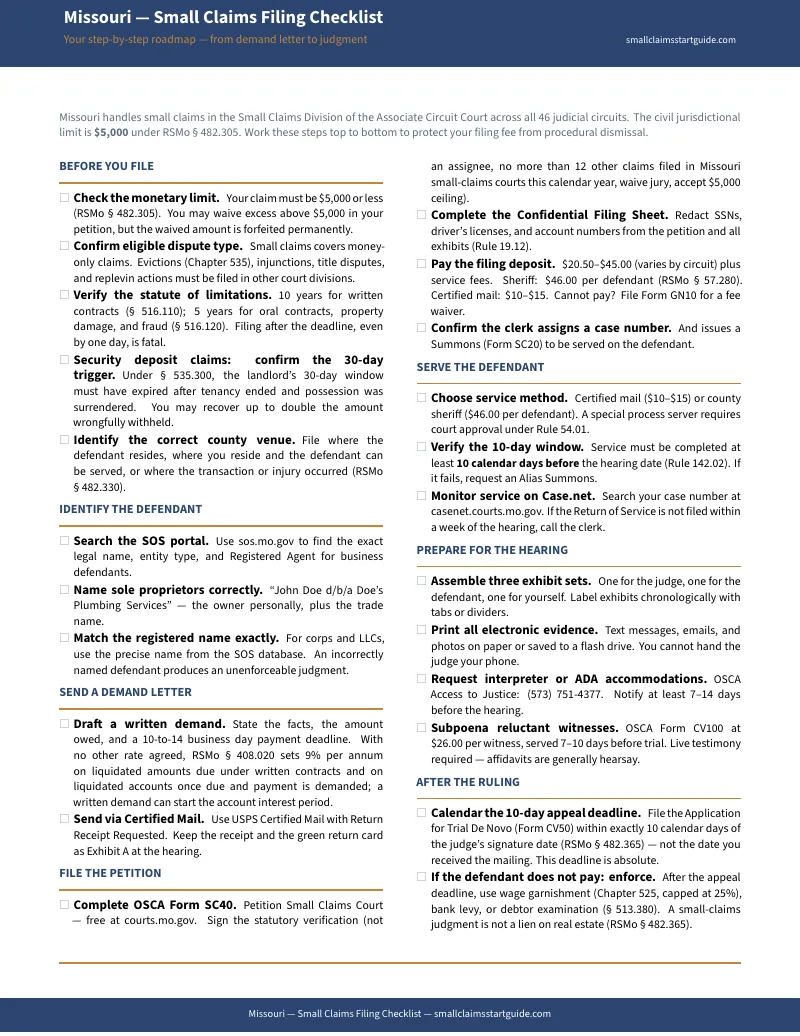
The free Missouri Small Claims Filing Checklist gives you the high-level overview: the $5,000 limit, the forms, the fees, and the filing stages at a glance. The full guide goes deeper — every step broken down, every tool ready to print, every deadline on a calendar.
Frequently Asked Questions
What if the rules change after I buy?
We update the guide when the rules change. Email us any time, even years later, and we'll send you the current edition free.