You Won. They Haven't Paid. Now What?
You sat in that Justice Court, made your case, and the judge ruled in your favor. But weeks later, the other side still hasn't handed over a dime — and the clerk's office just told you they can't help you collect.
That's because Mississippi courts don't enforce judgments for you. They expect you to figure out garnishments, liens, and writs on your own — navigating between the Justice Court Clerk, the Circuit Court Clerk, the county constable, and a stack of statutes that were never written in plain English.
Meanwhile, every week that passes is another week the debtor could move money, change jobs, or transfer property out of reach.
The Mississippi Judgment Collection Execution System
This guide replaces the confusion with a structured, step-by-step enforcement workflow built specifically for Mississippi Justice Court judgments. It's not a generic overview that mentions garnishment exists — it walks you through exactly how to file one in your county, what it costs, and what to expect when the 30-day wage exemption kicks in.
Where free court websites give you raw statute numbers and blank forms, the Execution System gives you the sequence: which office, which form, which fee, which deadline — and what to do when the debtor claims everything is exempt.
What's Inside
- The 10-day enforcement countdown — how to count 10 days from docket entry and confirm no supersedeas bond or stay order is on file before you file
- Judgment Debtor Examinations — how to compel the debtor to appear under oath, disclose their employer, bank accounts and property, and bring financial records with a subpoena duces tecum
- Wage garnishment from filing to collection — the Suggestion for Writ of Garnishment, the 30-day grace period where all wages are protected, the 25% disposable earnings cap, and the federal minimum wage floor that makes low-wage debtors garnishment-proof
- Bank account levies — how to garnish a debtor's checking account and the federal benefits lookback rule that protects Social Security and disability deposits
- Writ of Execution — seizing personal property through the county constable or sheriff, including what the $10,000 personal property exemption actually covers
- Real property liens — the two-office process of obtaining an Abstract of Judgment from the Justice Court Clerk and enrolling it with the Circuit Court Clerk to attach a lien to the debtor's real estate
- The complete exemptions table — every protected asset class in Mississippi, from the $75,000 homestead to Social Security, SSI, disability, veterans benefits, and wages below 30 times the federal minimum wage
- Interest, renewal and cost recovery — calculating post-judgment interest at the rate in your judgment or contract under Miss. Code § 75-17-7, renewing the judgment before the 7-year clock expires, and adding your enforcement costs to the balance
- Satisfaction of Judgment — closing the case on the court record so neither party carries an open judgment indefinitely
- Six fillable worksheets — Enforcement Readiness Checklist, Judgment Balance and Interest Tracker, Debtor Examination Preparation Sheet, Enforcement Tool Decision Matrix, Satisfaction of Judgment Filing Checklist, and Agency Communication Log
Who This Guide Is For
- You won a judgment in a Mississippi Justice Court and the other side has not paid
- You want to enforce the judgment yourself without hiring an attorney whose hourly rate would eat the entire award
- You need to understand which enforcement tool — garnishment, lien, seizure or examination — fits your debtor's situation before you spend money on filing fees
This guide is not for people who haven't been to court yet. If you need to file a claim, see the Mississippi Small Claims Filing Guide. If you've been served with a claim, see the Mississippi Small Claims Response Guide.
Why Not Just Use Free Resources?
Free information on Mississippi judgment collection exists — scattered across the state judiciary portal, county fee schedules, FindLaw statute pages, and Nolo overviews written for all 50 states at once. Here's what that actually looks like in practice:
- The state judiciary website publishes the Uniform Rules of Procedure, but no step-by-step instructions for filing a garnishment or enrolling a lien
- County clerk websites list fees, but most post-judgment forms aren't downloadable — you have to drive to the courthouse to get them
- National publishers like Nolo explain that garnishment exists, but don't cover Mississippi's 30-day wage exemption hold or the two-office process for creating a real property lien
- Legal aid organizations in Mississippi serve low-income debtors — not creditors trying to collect
The result: creditors spend hours piecing together fragments from a dozen sources, often missing critical timing rules that mean the difference between collecting and wasting filing fees on a garnishment-proof debtor.
This guide puts every enforcement tool, deadline, fee, form reference and exemption in one organized workflow — so you can make an informed decision about how to proceed before you advance a single dollar in court costs.
Satisfaction Guarantee
The guide comes with a full refund, no time limit. If it's not what you expected, email [email protected] and you'll get your money back.
This is an independent guide — not a court document, not legal advice, and not affiliated with any Mississippi court, government agency or legal aid organization. It explains the procedure in plain language so you can navigate it yourself.
Get Started
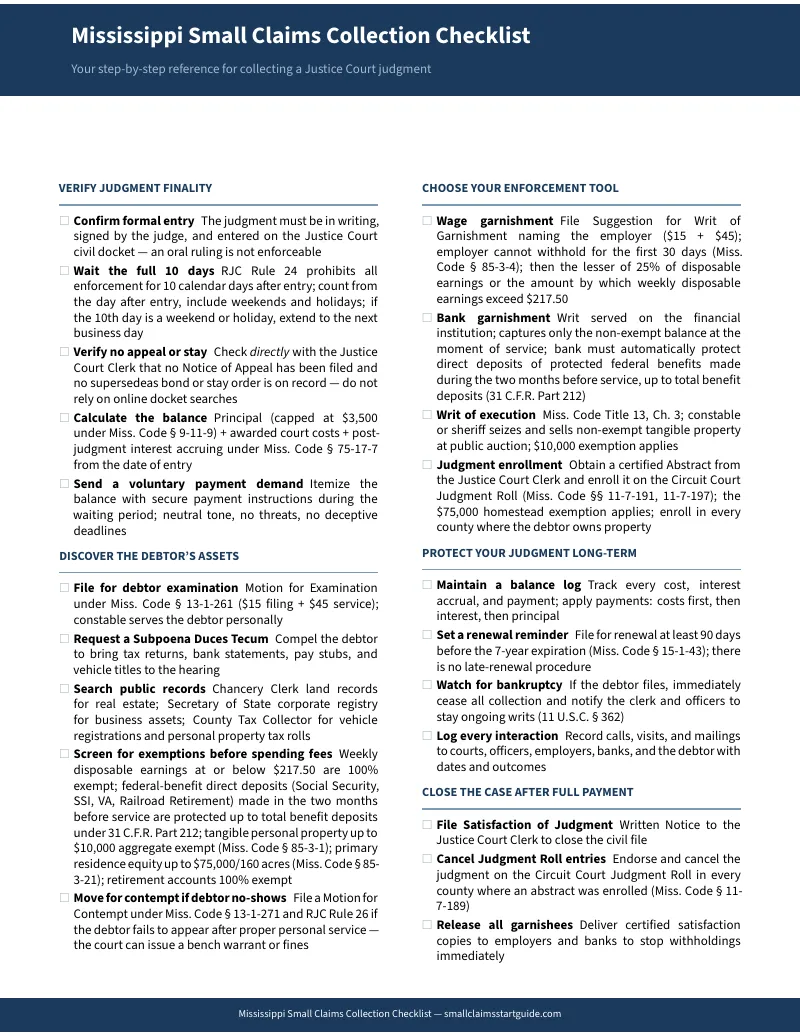
Download the free checklist to see the enforcement options at a glance. When you're ready for the full step-by-step system — every tool, every form, every deadline — get the complete guide.
Frequently Asked Questions
What if the rules change after I buy?
We update the guide when the rules change. Email us any time, even years later, and we'll send you the current edition free.