Served With Conciliation Court Papers in Minnesota? Here Is What Happens Next.
A Statement of Claim and Summons just arrived — Form CCT102, naming you as the defendant in a Minnesota Conciliation Court case for up to $20,000. The form warns about default judgments, lists a hearing date, and says nothing about what you are supposed to do between now and then. Court staff cannot advise you. The free fact sheets on mncourts.gov describe pieces of the process without putting them in order. And the national small claims books spend most of their pages on plaintiffs.
The Minnesota Conciliation Court Defense Binder is a single-jurisdiction, defendant-only procedural guide that puts every step from "papers in hand" to "after the decision" in sequence, with the forms, deadlines, and worked examples that generic resources leave out.
Why a binder, not a checklist?
A checklist tells you what to do. The Defense Binder shows you how — and when, down to the calendar day. It ties the critical procedural nuances together: the fact that no written answer is required (which District Court rules do require, which is why everyone panics), the 14-day counterclaim filing-and-service deadline (not the stale 5-day deadline some legal aid PDFs still cite), the 3-day exhibit pre-submission rule, and the post-decision removal trap that costs $322–$422 in District Court fees with a $50 penalty if you do not improve the result enough.
What you get
- 12-chapter step-by-step guide (PDF) — reading the papers, verifying service, the no-written-answer rule, your four options (dispute, admit, settle, counterclaim), filing Form CCT202, requesting a continuance, evidence preparation, hearing day, default judgments, the decision and appeals, paying a judgment, and key resources.
- Deadline Calculator Worksheet — enter your hearing date and the worksheet maps every critical date backward: the 14-day counterclaim deadline, the 3-day exhibit submission deadline, the continuance window, and the 21-day post-decision removal window.
- Evidence Inventory Worksheet — organize contracts, invoices, photos, texts, and receipts into the three-copy format the court expects (one for the referee, one for the opposing party, one for you).
- Counterclaim Decision Worksheet — a structured walkthrough: Is your claim monetary? Does it exceed the $20,000 cap? Do you need to serve by certified mail? Will a transfer to District Court under Rule 510 help or hurt?
- Settlement Terms Worksheet — document agreed terms before you complete Form CCT105, including the payment schedule, what each side gives up, and the consequences of non-compliance.
- Hearing Preparation Checklist — what to bring, what to wear, how to address the referee, and Zoom setup for remote hearings in Hennepin, Ramsey, and other metro counties.
- Post-Decision Action Planner — evaluate your options after the hearing: removal to District Court (with the cost-benefit calculation), vacating a default judgment under Rule 520, or negotiating payment terms.
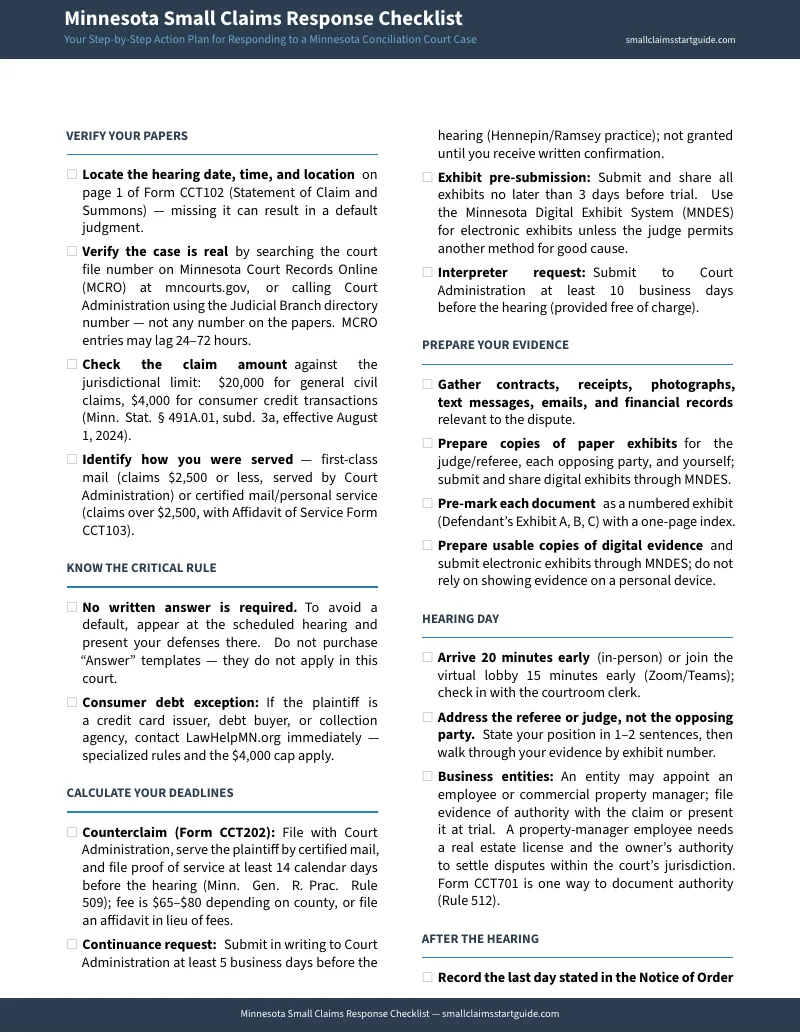
- Free checklist (separate download) — a two-page overview of the timeline, your options, and the documents you need. Download it free to see if the full guide is right for your situation.
Who this is for
The guide is built for four types of Minnesota Conciliation Court defendants in non-debt civil disputes:
- Contractors and trades professionals sued over alleged defective workmanship, project delays, or scope disputes — claims often run $5,000 to $20,000 and require organized invoices, signed change orders, and timestamped communication logs.
- Tenants and landlords in deposit disputes — former tenants sued for damage beyond the deposit, or former landlords defending a counterclaim under Minnesota's 21-day deposit accounting rule (Minn. Stat. § 504B.178), where non-compliance can trigger statutory double damages.
- Small business owners and freelancers sued by dissatisfied clients — where a corporate entity or sole proprietorship can send an officer or manager under Form CCT701 instead of hiring a lawyer.
- Private car sellers sued by buyers over undisclosed mechanical defects — disputes that turn on "as-is" bill of sale terms versus implied warranty claims.
Not for debt defendants: If you were sued by a lender, debt buyer, or collection agency, your case falls under a separate statutory framework (capped at $4,000 in Conciliation Court) with specialized defenses. The guide points you to free help through LawHelpMN, Mid-Minnesota Legal Aid, and the Volunteer Lawyers Network.
Why not just use the free court resources?
The Minnesota Judicial Branch publishes forms, fee schedules, and FAQs across dozens of sub-pages. LawHelpMN publishes fact sheets. Both are valuable starting points — and the guide cites them throughout. But they share three structural limitations:
- Neutrality mandate: Court staff and self-help center staff are legally prohibited from giving you tactical guidance. They can point to Form CCT202 — they cannot tell you whether filing a counterclaim helps or hurts your situation, how to calculate the 14-day deadline from your specific hearing date, or how to organize exhibits for a 15-minute hearing.
- Fragmented information: You have to correlate the claim form instructions on one page, the counterclaim form on another, the General Rules of Practice on the state revisor's site, the county fee schedule on a third page, and the remote hearing instructions on yet another. The Defense Binder sequences every step in the order a defendant encounters them.
- Stale details: Several legal aid PDFs still reference the old $15,000 jurisdictional limit (raised to $20,000 in 2024), the old 5-day counterclaim deadline (now 14 days), and procedures that predated the July 2026 plain-language structural update to Title VI of the General Rules of Practice.
Satisfaction guarantee
Full refund, no time limit. If the guide does not help, email [email protected] and you get your money back — no deadline, no questions.
Get started
Download the free Minnesota Small Claims Response Checklist to see the timeline and your options at a glance. When you are ready for the full step-by-step procedure, the Minnesota Conciliation Court Defense Binder is available for — instant PDF download, printable, and usable for in-person or remote hearings in any Minnesota county.
Frequently Asked Questions
What if the rules change after I buy?
We update the guide when the rules change. Email us any time, even years later, and we'll send you the current edition free.