You won. The court agreed. And nothing happened.
You sat in Conciliation Court, made your case, and the judge ruled in your favor. You expected the system to handle the rest — garnish the wages, freeze the account, send a letter. Instead, you got a piece of paper and silence. Maybe the debtor promised to pay and didn't. Maybe they disappeared. Either way, you're stuck holding a judgment that feels worthless.
Here's what the court won't tell you: Minnesota's Conciliation Court cannot enforce its own judgments. It can decide who owes what, but it has no power to collect. That power belongs to District Court — and getting there requires a formal transfer process that most people don't even know exists.
The Judgment Collection Roadmap — A Complete Enforcement System for Minnesota
This is not a generic overview of "how courts work." The Judgment Collection Roadmap is a structured, step-by-step system built specifically for Minnesota's two-court enforcement process. It takes you from the moment your judgment is entered through every enforcement tool available, with the exact forms, fees, deadlines and procedures at each stage.
Where free court pages give you a list of forms with no context, the Roadmap puts them in order — when to file each one, what it costs, what happens next, and what to do when the debtor doesn't cooperate.
What's Inside
- The 21-day finality period explained — what you cannot do before the judgment is final, how to check for appeals or vacation attempts, and exactly when the clock starts
- Transcription and docketing walkthrough — how to move your judgment from Conciliation Court to District Court using Form JGM104, including the $40 fee and county-specific instructions
- The asset discovery protocol — filing the Order for Disclosure (Form JGM302), tracking the 16-day response deadline, and escalating to an Order to Show Cause (Form JGM303) when the debtor ignores it
- Wage garnishment with the dual-cap formula — a worked example showing exactly how the 25% / 40-times-minimum-wage rule limits what you can take from each paycheck, plus the forms to serve on the employer
- Bank account garnishment — freezing funds, handling exemption claims, and collecting the balance through the sheriff
- Writs of execution — personal property seizure through the county sheriff's civil process unit, with advance deposit requirements and auction procedures
- Real property liens — filing with the County Recorder (Abstract property) or Registrar of Titles (Torrens property) so your judgment attaches to the debtor's home or land
- Exemptions guide — what the debtor can legally protect and how to avoid wasting fees on assets you can't touch
- Interest and cost recovery ledger — calculating Minnesota's statutory 4% annual rate on every dollar owed, tracking partial payments, and keeping a running balance that holds up in court
- Satisfaction of Judgment — filing Form JGM201 within the mandatory 10-day or 30-day deadline so you don't face penalties after you've been paid
- Special situations — driver's license suspension for motor vehicle judgments, judgment-proof debtors, and interstate enforcement
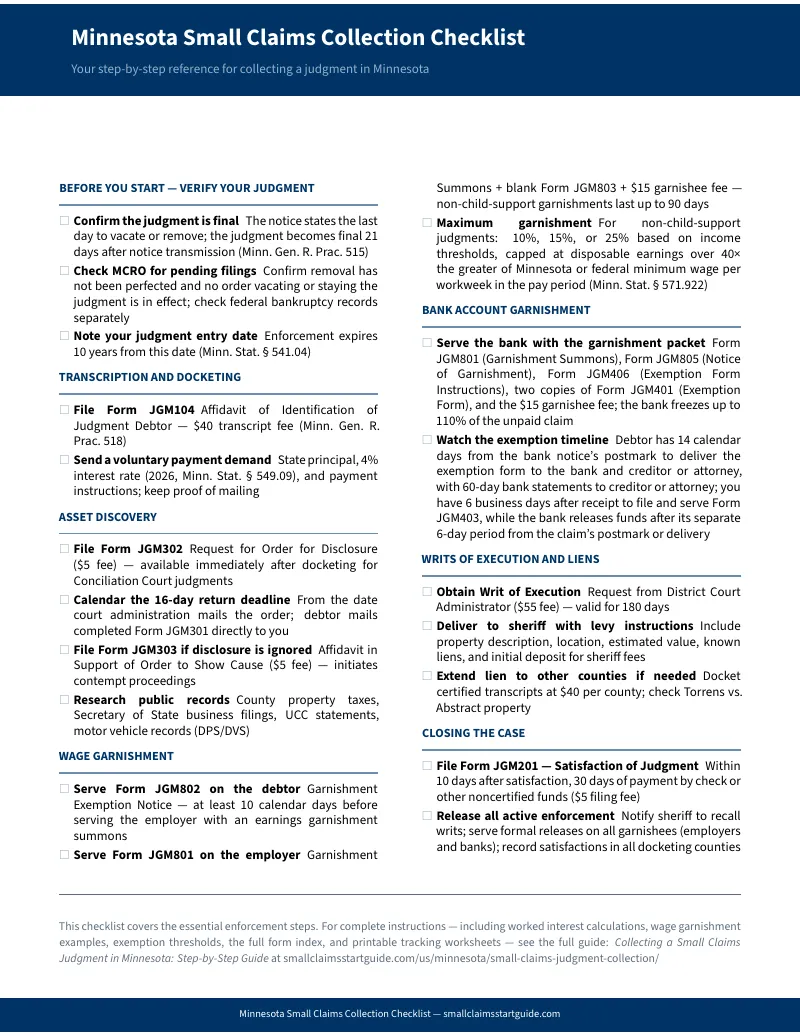
The guide also includes a 19-item checklist you can print and work through from start to finish — every step, every form number, every fee, in order.
Plus four standalone enforcement tools you can print and use alongside the guide: a Collection Balance Ledger for tracking principal, interest and payments; an Enforcement Deadline Tracker for every statutory deadline; an Enforcement Decision Flowchart that maps the debtor's assets to the right tool; and a Sheriff Instruction Worksheet to complete before visiting the civil process division.
Who It's For
- You won a money judgment in Minnesota Conciliation Court and the debtor has not paid
- You have a default judgment and need to know how to enforce it
- You're a landlord collecting an unpaid rent balance or unreturned security deposit
- You're a contractor or small business owner with an unpaid invoice up to $20,000
- You want to handle collection yourself instead of paying 33%–50% to a collection attorney
Why Not Just Use the Free Court Website?
The Minnesota Judicial Branch publishes its forms and legal definitions for free — and the guide links directly to every official form you'll need. What the court website doesn't provide is a system.
The free pages describe the 20-day stay in one place, docketing rules in another, garnishment forms in a third, and exemption statutes in a fourth. There's no workflow. No sequence. No tracker for the 16-day disclosure deadline. No guidance on which enforcement tool to use based on what the debtor actually owns. And court staff are legally prohibited from telling you which steps to take — they can confirm a form is filed, but they can't advise you on strategy.
The Judgment Collection Roadmap organizes all of it into one document you can follow from the day after your judgment is entered to the day you file the satisfaction and close your case.
What the Free Checklist Covers vs. the Full Guide
The free checklist gives you the overview: the waiting period, the key form numbers, the enforcement options, and the exemption warnings. It's enough to understand the process at a high level.
The full guide gives you the depth: worked examples of garnishment calculations, the exact sequence for each enforcement tool, fee schedules, deadline tracking, interest accounting, and step-by-step instructions for every form you'll file. If the checklist shows you the map, the guide walks you through every turn.
Satisfaction Guarantee
If the guide doesn't help you, email [email protected] for a full refund, no time limit. We read every message.
Start Collecting What You're Owed
Download the free Minnesota Small Claims Collection Checklist to see the process at a glance — or get the full Judgment Collection Roadmap for the complete step-by-step system with forms, fees, worked examples and deadline trackers.
The court gave you a judgment. This guide gives you a plan to collect it.
Frequently Asked Questions
What if the rules change after I buy?
We update the guide when the rules change. Email us any time, even years later, and we'll send you the current edition free.