You know the court exists. You don't know which form starts your case.
Your contractor took a $4,000 deposit and disappeared. Your landlord kept your security deposit past the 21-day window and never sent an itemized statement. A client owes you for work you finished months ago. You searched "how to file small claims in Minnesota" and found the Minnesota Judicial Branch help page, a LawHelpMN fact sheet, and a Nolo guide that covers all fifty states in four hundred pages — none of which told you, start to finish, what to do and in what order in Minnesota Conciliation Court.
You don't need fifty states. You need to know whether your claim fits under the $20,000 limit and the statute of limitations, how to send a proper demand, how to complete Form CCT102 through Guide & File or on paper, whether Court Administration serves the defendant for you or you have to arrange it yourself (the answer depends on one number: $2,500), and how to file your Affidavit of Service before the 60-day deadline kills your case. One missed form, one wrong defendant name, and your case never reaches the judge.
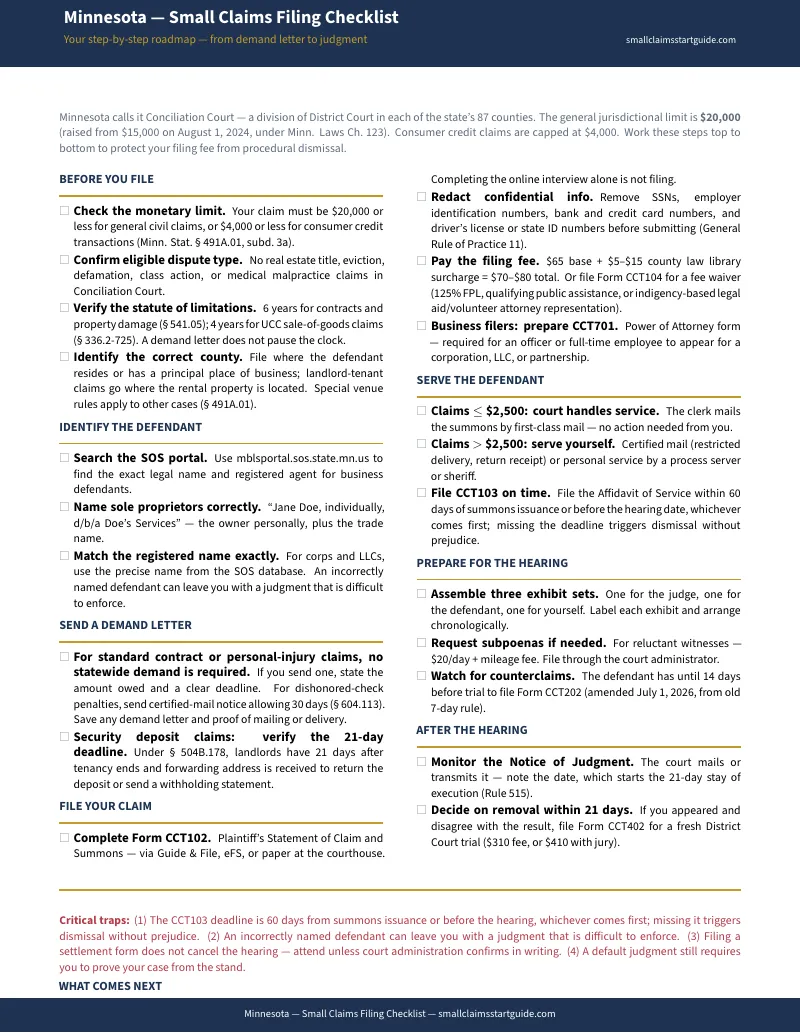
The Minnesota Conciliation Court Filing Workflow
The Minnesota Small Claims Filing Guide takes the entire process — from checking whether your claim fits the $20,000 cap through preparing evidence, presenting your case at the hearing, and understanding the judgment — and puts it in one printable sequence with checklists, worksheets, and a deadline calendar. Every step references the specific Minnesota form, the Minn. Stat. citation, and the timeline.
This is not a national overview that mentions Minnesota in a footnote. It is not a form-filling service that charges hundreds of dollars for software that generates the same PDFs the court hands out for free. It is not a debt-defence product for people who were sued — this guide is for people filing claims. And while the Minnesota Judicial Branch offers downloadable forms and Guide & File at mncourts.gov, those tools generate the initial claim form without explaining how to track service, file your Affidavit of Service on time, organize three copies of evidence for the hearing, or navigate the $2,500 pivot that determines who serves the papers.
What's Inside
Checking the Limit and the Clock
Minnesota Conciliation Court handles claims up to $20,000 under Minn. Stat. § 491A.01 — raised from $15,000 effective August 1, 2024. Consumer credit transaction claims have a separate $4,000 cap. The statute of limitations varies by claim type: six years for both written and oral contracts under Minn. Stat. § 541.05, six years for property damage, and six years for personal injury under Minn. Stat. § 541.05. The guide walks through each limit and shows you how to calculate your deadline from the date the breach or injury occurred.
The Demand Letter — Build a Paper Trail Before You File
Minnesota does not require a demand letter for most claims, but sending one is strongly advisable: it documents that you asked for payment and were refused, gives the other side a chance to settle without court, and strengthens your case at the hearing. For security deposit claims under Minn. Stat. § 504B.178, the 21-day statutory deadline does the work of a demand — the guide covers how the timeline, bad-faith penalties, and the forwarding-address requirement fit together. The guide includes a demand letter framework with certified mail tracking instructions.
Identifying the Defendant — Getting the Legal Name Right
Suing a trade name or a "doing business as" instead of the registered LLC or corporation renders any resulting judgment legally void. The guide walks through verifying the defendant's legal entity through the Minnesota Secretary of State Business Entity Search portal, determining whether to name a DBA, LLC, or individual, and finding a registered agent address for corporate defendants. Unprepared filers discover this mistake after the hearing, when they cannot collect on a judgment entered against a name that does not legally exist.
Venue Rules — Filing in the Right County
You file in the county where the defendant resides or where the cause of action arose. Cross-county disputes and out-of-state defendants add complications. The guide explains the venue options, the special rules for corporate defendants with multiple offices, and the practical difference between filing in Hennepin or Ramsey County (electronic filing, centralized self-help centers) versus a rural judicial district (paper filings, limited clerk hours, varied hearing schedules).
Filing Form CCT102 — Statement of Claim and Summons
The guide walks through the claim form field by field: naming the defendant correctly, writing a clear factual statement, and filing at your county's Court Administration office. It covers two filing paths — Minnesota Guide & File for electronic generation plus eFile and eServe (eFS), or the paper form submitted in person or by mail. It covers the fees: the $65 base under Minn. Stat. § 357.022 plus county law library surcharges, and the fee waiver application using Form CCT104 for those who qualify.
Service of Process — The $2,500 Pivot That Trips Everyone Up
Filing the claim is half the job. Getting the papers properly served on the other side is the other half, and failed service is the single most common reason self-represented claims get dismissed. For claims of $2,500 or less, Court Administration serves the defendant by first-class mail — no extra work from you. For claims above $2,500, you are responsible for arranging service yourself: certified mail, a professional process server, or in some cases a county sheriff. The guide covers each method, explains the 60-day deadline to file Form CCT103 (Affidavit of Service), and includes a service tracking log so you never miss the window.
Corporate Representation and Power of Attorney
If you are filing on behalf of a business entity — an LLC, corporation, or partnership — Minn. R. Gen. Prac. 512 requires that an officer or full-time employee appear on the entity's behalf and file Form CCT701 (Power of Attorney for Conciliation Court) before or at the hearing. The guide covers how to prepare the form and what happens if you arrive without it.
Evidence Assembly — What the Judge Needs to See
The hearing is informal but the judge still needs organized evidence. Showing up with a stack of loose papers in no particular order is the easiest way to lose a case you should have won. The guide covers how to build an evidence binder: contracts and agreements, invoices and receipts, photographs with dates, repair estimates, text messages and emails, and witness statements — organized into three identical sets for the judge, the defendant, and yourself. The evidence organizer worksheet keeps everything indexed and hearing-ready.
The Hearing — What Actually Happens
Conciliation Court hearings are informal proceedings, typically lasting 15 to 30 minutes. The guide covers what the hearing looks like, how the judge or referee runs the proceeding, how to present your evidence clearly, how to respond to the defendant's arguments, and what happens if the defendant does not show up and you request a default judgment. It also covers the defendant's right to file a counterclaim within 14 days of the hearing date and the procedure for removal to District Court for a de novo trial.
After the Decision — Judgments, Removal, and Collection Basics
If you win, the judgment means the court says the defendant owes you the money — plus post-judgment interest at the current statutory rate. It does not collect the money for you. Either party may request removal to District Court for a new trial within the statutory window. The guide covers the post-judgment timeline, the court administrator's mailed decision, and the handoff to the companion judgment collection guide for enforcement.
Printable Worksheets and Planning Tools
The kit includes printable worksheets plus the 22-item master checklist: a deadline calendar mapping every statutory window from demand letter through post-judgment, a cost calculator covering filing fees plus service costs, a service tracking log, an evidence organizer, a case eligibility worksheet, a defendant entity verification worksheet, and a fill-in demand letter template with mailing record. Print them, write on them, check off each step as you go.
Who This Is For
- Tenants owed a security deposit. Under Minn. Stat. § 504B.178, the landlord has 21 days after you move out and provide a forwarding address to return the deposit or deliver an itemized statement of deductions. If they miss the deadline, you may be entitled to the full deposit back plus bad-faith penalties of up to $500. The guide covers the statutory timeline, how to calculate your claim, and how to document the unit condition at move-out.
- Homeowners with a contractor dispute. The roofer, plumber, or remodeler took your deposit and abandoned the project or delivered substandard work. Contractors operating under trade names or DBAs can be difficult to serve correctly — the guide covers how to find the legal entity name through the Secretary of State and how to use a process server when certified mail fails.
- Small landlords owed rent or damage costs. A former tenant left owing rent or caused damage beyond the deposit. Money claims go through Conciliation Court — eviction and possession actions are a separate process in District Court or Housing Court under Minn. Stat. § 504B. The guide covers landlord money claims only.
- Sole traders and freelancers with unpaid invoices. A client stopped paying. The guide covers how sole proprietors and business entities file, including the Power of Attorney requirements under Minn. R. Gen. Prac. 512 for business claimants.
- Buyers refused a refund. You paid for something that never arrived, was defective, or did not match the description — a used car with undisclosed damage, an appliance that stopped working, a service that was never performed. The guide covers how to document your loss and locate the seller's legal name for service.
- Anyone owed money in Minnesota under $20,000. If you would rather spend an evening with a step-by-step guide than piece together scattered court pages, legal aid fact sheets, and statute PDFs — some of which still cite the outdated $15,000 limit — this is for you.
Why Not Just Use the Free Court Resources?
You should use them — and the guide tells you exactly when and where. The Minnesota Judicial Branch at mncourts.gov publishes forms CCT102, CCT103, CCT104, and CCT701, offers Guide & File for electronic claim generation, and runs self-help centers in Hennepin and Ramsey counties. LawHelpMN.org publishes Fact Sheet C-01 on Conciliation Court. HOME Line offers free help to tenants claiming security deposits.
What these resources do not do is put the information in the order you need it. Guide & File generates the initial CCT102 form but explicitly tells you not to attach evidence and provides no guidance on the $2,500 service pivot, the 60-day Affidavit of Service deadline, or evidence organization for the hearing. LawHelpMN's fact sheet is an educational overview without fillable worksheets or deadline tracking tools. HOME Line is limited to tenant disputes. And Court Administration staff can confirm filing fees and schedule hearing dates, but are legally prohibited from helping you review your claim, organize your evidence, or explain service strategy.
The guide does the organizational work: every form, every fee, every deadline, in the order you encounter them, with checklists and worksheets you can print and work through. It sits between the free information (which you still need) and a $150-to-$400-an-hour attorney (which makes no economic sense for most claims under $20,000).
What This Is Not
This guide explains the procedure. It does not give legal advice, predict outcomes, or tell you how to argue your case. It is not published by, affiliated with, or endorsed by the Minnesota Judicial Branch, Minnesota courts, or any government agency. If you need legal advice, contact a lawyer. If you need free help, the guide lists LawHelpMN, HOME Line, the Volunteer Lawyers Network, county law library clinics, and courthouse self-help resources.
Satisfaction Guarantee
Full refund, no time limit. If the guide is not what you expected, email [email protected] and we will refund you — no questions, no deadline.
Get Started
Download the free Minnesota Small Claims Filing Checklist — a one-page, 22-item summary of the limit, forms, fees, service steps, and deadlines. If you want the full guide with step-by-step instructions, printable worksheets, and the deadline calendar, get the complete Minnesota Small Claims Filing Guide for .
Frequently Asked Questions
What if the rules change after I buy?
We update the guide when the rules change. Email us any time, even years later, and we'll send you the current edition free.