You Just Got Served — and the Internet Is Giving You the Wrong Instructions
You opened an envelope and found Form DC 84, an Affidavit and Claim in the Small Claims Division of Michigan District Court. Someone is suing you for up to $7,000. You have a hearing date on the notice, and every search result is telling you to file a written answer within 21 days.
That advice is wrong for Michigan Small Claims. A written answer is the rule in General Civil court. In the Small Claims Division, no written answer is required or even accepted before the hearing date. If you spent the last hour looking for an answer form to file, you can stop — that is not how this court works.
But "you don't need to file an answer" is only the first of several decisions you need to make, and the court's blank PDF forms don't walk you through any of them.
The Michigan Defendant's Procedural Roadmap
This is the guide that puts the full Small Claims response process in front of you in order — from the moment you open the envelope to the options available after a decision.
It replaces hours of searching scattered court websites, decoding legal jargon on Michigan Legal Help articles, and worrying about deadlines you may not even have. Every chapter follows your actual timeline as a defendant, with the SCAO form numbers, the Michigan statutes, and the specific procedural steps for this court.
What you're looking at right now
- A 47-page step-by-step guide — 14 chapters covering every stage from reading your papers to post-judgment options
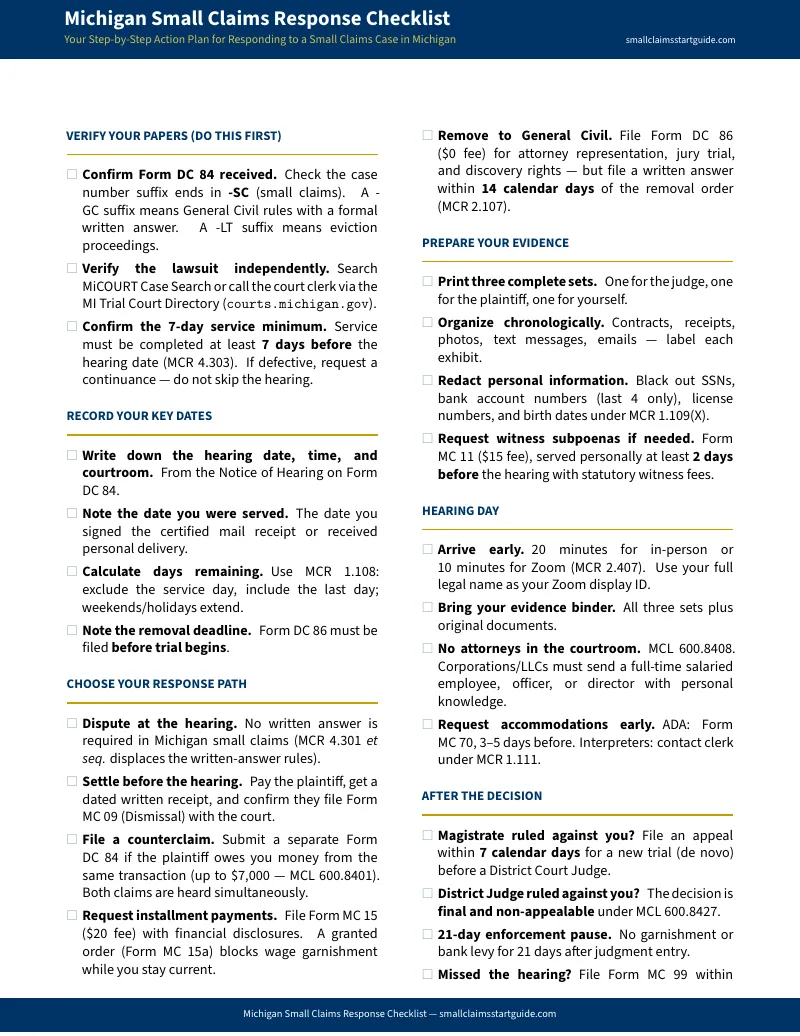
- A 25-item response checklist — the condensed version you can print and check off as you go
- Four standalone printable worksheets — Form DC 84 decoder, deadline and options tracker, evidence packaging index, and day-of-hearing logistics checklist
What's Inside the Guide
Decode the papers you were served
Form DC 84 is two pages of boxes and legal shorthand. The guide walks through every field — the plaintiff's claimed damages, the statutory basis, the incident date, the court address, the case number — and explains what each one means for your situation. The Notice of Hearing (Form DC 84n) tells you when and where to appear, or whether it's a Zoom hearing, and the guide shows you how to read it.
Understand the no-written-answer rule
Michigan's Small Claims Division is different from every other civil division and from most other states. No written response is required before the hearing. The guide explains exactly what your procedural obligations are, why national "lawsuit answer" templates do not apply here, and the one scenario where a written answer becomes mandatory — removal to General Civil under MCL 600.8408.
Evaluate your five response options
You have more options than showing up and arguing. The guide lays out each one side by side:
- Dispute the full claim at the hearing — present your evidence and let the magistrate or judge decide
- Settle before the hearing — reach an agreement and file a Dismissal (Form MC 09) or Consent Judgment (Form DC 85)
- File a written counterclaim — if the plaintiff owes you money from the same transaction, claim up to $7,000 back
- Request installment payments — use Form MC 15 to propose a structured monthly payment plan
- Remove the case to General Civil — file Form DC 86 to move to a division with attorney representation, jury trial rights, and formal discovery, at the cost of a mandatory written answer within 14 days
Prepare your evidence like a defendant, not a plaintiff
Free court resources focus on what plaintiffs need to prove their case. This guide is built for the other side of the courtroom. It shows you how to organize contracts, receipts, photos, text messages, and move-in/move-out checklists into three indexed evidence sets — one for the judge or magistrate, one for the plaintiff, one for you — with guidance on common dispute types: contractor work, security deposits, business refunds, and private vehicle sales.
Know what happens at the hearing
The guide covers hearing logistics — whether you're in front of an Attorney Magistrate or a District Court Judge, in person or on Zoom. It explains courtroom etiquette, how testimony works in the informal Small Claims format, how to handle live settlement discussions in the hallway or mediation room, and the critical difference between the two: a magistrate's decision can be appealed within 7 days, but a District Court Judge's decision in Small Claims is final under MCL 600.8427.
Understand post-judgment options
If a judgment is entered against you, the guide walks through the 21-day execution stay before garnishment or property seizure can begin, how to request installment payments using Form MC 15 and MC 15a, how to file for a rehearing before a District Court Judge after a magistrate's decision using the strict 7-day deadline under MCR 4.303, and how to file a motion to set aside a default judgment using Form MC 99a if you missed the hearing for good cause.
Who This Guide Is For
- Homeowners sued by a contractor who says you owe for work that wasn't finished, wasn't done right, or was never authorized
- Tenants or former tenants whose landlord filed a claim over rent, utilities, or alleged property damage
- Landlords whose former tenant is claiming double damages under the Security Deposit Act
- Small business owners sued by a customer, client, or vendor over a refund, service, or delivery
- Private sellers sued by a buyer over a vehicle, equipment, or goods
Not covered: If the plaintiff on your papers is a credit card company, debt buyer, or collection agency, this guide is not the right resource. Those lawsuits use different procedures and defenses. The guide directs you to Michigan Legal Help and free legal aid for debt-collection cases.
Why Not Just Use the Free Court Resources?
You should use them — and the guide tells you where to find every free form and free resource. SCAO forms are free to download. Michigan Legal Help articles are free to read.
But here's the problem. The free resources give you pieces: Form DC 84 as a blank PDF with no explanation of what the plaintiff's entries mean for you. Michigan Legal Help articles that explain the law but leave you to figure out evidence organization, hearing logistics, and the removal trade-off on your own. Court clerk pages that list filing fees but can't tell you whether to settle, counterclaim, or remove your case — clerks are legally prohibited from giving that kind of guidance.
This guide puts the pieces in order. One document. One timeline. Your timeline, not the plaintiff's.
Full Refund, No Time Limit
If the guide doesn't help, email [email protected] for a full refund. No time limit, no hoops.
Get Started
Download the free Michigan Small Claims Response Checklist to see the 25-item overview of deadlines, forms, and steps — or get the full guide with detailed instructions and four printable worksheets for .
Frequently Asked Questions
What if the rules change after I buy?
We update the guide when the rules change. Email us any time, even years later, and we'll send you the current edition free.