You Won. They Haven't Paid. Now What?
The judge ruled in your favor. You have a signed money judgment from Michigan small claims court. But weeks have gone by and the other side has not sent a check — and nobody at the courthouse is going to chase them down for you.
Michigan district courts are neutral referees. Once the gavel drops, collecting the money is entirely on you. The problem is that enforcement has its own maze of forms, fees, deadlines and court officers — none of which the judge explained when they handed down the ruling.
The Michigan Judgment Collection Roadmap puts the entire post-judgment process into a single sequential workflow: from the mandatory waiting period through asset discovery, garnishment, seizure, liens and final satisfaction. Every step is mapped to the specific SCAO form, the exact fee and the officer or agency that executes it.
What's Inside
- Post-Judgment Enforcement Timeline — the 21-day waiting period explained: when it starts, what resets it, and what happens if the debtor files a Motion for Installment Payments (Form MC 15) before the window closes
- Debtor Examination Walkthrough (Form MC 11) — how to subpoena the debtor to court and compel them to reveal every bank account, employer and piece of property they own, under oath. Includes what to do when the debtor does not show up
- Asset-to-Form Selection Matrix — a single reference table that matches what you found (wages, bank deposits, tax refunds, personal property, real estate) to the exact SCAO form you need to file. No more guessing whether you need MC 12, MC 13, MC 19 or MC 52
- Wage Garnishment Step-by-Step (Form MC 12) — periodic garnishment of the debtor's earnings, including the $35 statutory disclosure fee the employer must receive with the writ, the 25% disposable-earnings cap, and the garnishee's 7/14/28-day compliance clocks
- Bank Account Garnishment (Form MC 13) — nonperiodic garnishment that freezes the debtor's deposits, with the $35 statutory disclosure fee and the bank's response timeline
- Tax Refund Intercept (Form MC 52) — how to garnish the debtor's Michigan state income tax refund before they spend it, with the $6 state treasurer disclosure fee
- Property Seizure (Form MC 19) — when and how a court officer can seize and sell the debtor's non-exempt personal property, including how the process differs between urban courts with designated officers and rural courts where the County Sheriff handles it
- Real Estate Lien Recording (Form MC 94) — how to record a judgment lien with the Register of Deeds so the debtor cannot sell or refinance without paying you first
- Statutory Interest Calculator — post-judgment interest under MCL 600.6013(8) adjusts every six months based on the five-year U.S. Treasury Note rate plus one percent. The guide breaks the formula into plain steps so you can calculate exactly what the debtor owes today
- Debtor Exemption Checklist — which assets Michigan law protects from enforcement (homestead equity, trade tools, federal benefits), so you do not waste $15 filing fees pursuing property you cannot legally reach
- Satisfaction and Case Closure (Form MC 17) — how to release active garnishments, discharge recorded liens and file the Certificate of Satisfied Judgment once the debtor has paid in full
Who This Is For
You are a judgment creditor in Michigan — meaning a court already ruled that someone owes you money (up to $7,000 in small claims), and they have not paid. You might be:
- An individual owed a security deposit, a personal loan repayment or compensation for property damage
- A sole proprietor or landlord with an unpaid invoice or tenant balance
- Someone who won a default judgment and has no idea where the debtor works or banks
Attorneys are prohibited in Michigan's Small Claims Division. Every enforcement procedure in this guide is designed for people representing themselves.
Why Free Resources Leave You Stuck
The Michigan Judiciary publishes a two-page overview (Form DC 85info) that lists your enforcement options. The SCAO website hosts every form as a free PDF download. That is genuinely useful — and this guide links directly to those official resources.
But here is what the free resources do not give you:
- No sequence. The forms arrive as separate downloads with no indication of which one to file first, second or third. A creditor facing a debtor who earns wages, has a bank account and owns a car sees three different forms and no framework for deciding the order.
- No fee math. Free resources mention the $15 filing fee per writ but do not explain the statutory disclosure fees — $35 for wage garnishments, $35 for bank garnishments, $6 for tax refund intercepts — or show you how to roll those costs into the sworn balance on Item 2 of the writ so you can recover them from the debtor.
- No interest calculation. Post-judgment interest under MCL 600.6013(8) is not a simple annual rate. It resets every six months and requires you to look up the Treasury Note yield. No free resource walks you through the math.
- No compliance tracking. Once a writ is served, you need to monitor the garnishee's 14-day disclosure deadline, the 28-day fund release window and the 182-day service expiration — none of which appear on the forms themselves.
The Michigan Judgment Collection Roadmap fills every one of those gaps. It is not a replacement for the free forms — it is the instruction manual the court does not provide.
What You Get
Your download includes six PDFs:
- The Full Guide (49 pages) — fourteen chapters covering every enforcement tool in Michigan, with forms, fees, service requirements, compliance deadlines and exemptions
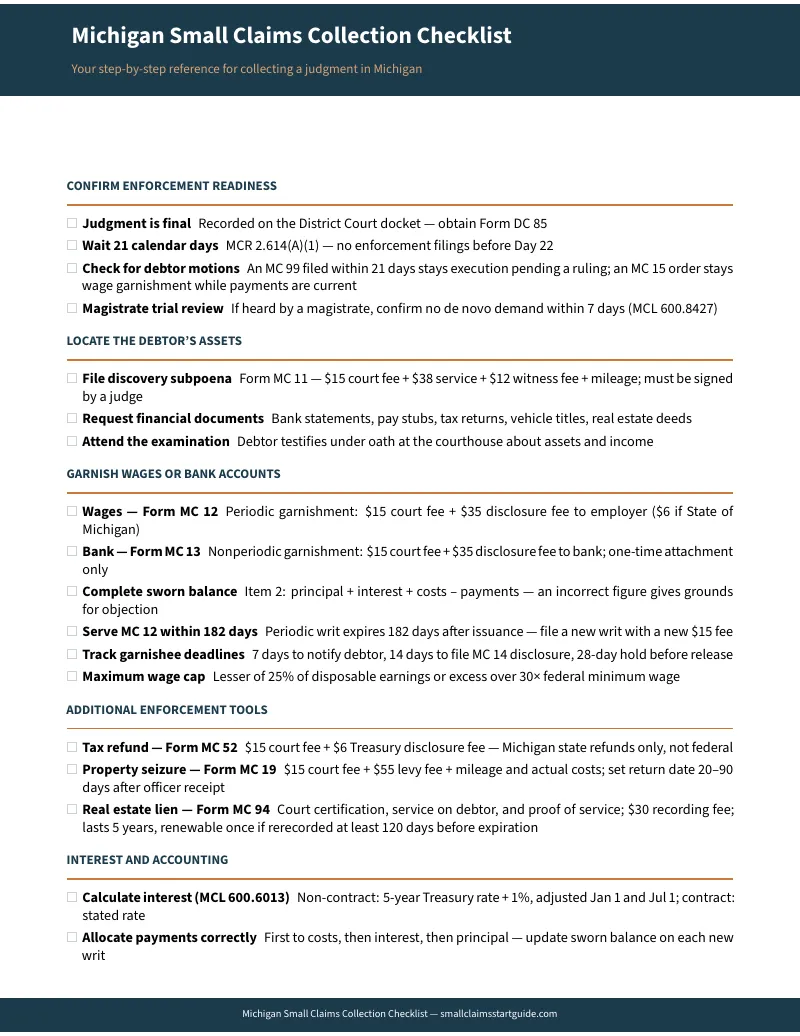
- The Collection Checklist (2 pages) — a condensed overview of the waiting period, enforcement options, key forms and exemption rules that you can print and keep beside you
- Collection Balance Ledger — a fill-in tracker for every cost you pay and every payment you receive, so the sworn balance on Item 2 of your next writ is always accurate
- Enforcement Timeline Tracker — a fill-in worksheet mapping every deadline from the 21-day waiting period through writ expirations, garnishee response clocks and judgment renewal
- Garnishee Compliance Log — tracks each garnishment from service through fund receipt, including disclosure deadlines and objection windows
- Satisfaction and Case Closure Checklist — the five steps to formally close your case once the debtor has paid in full, with forms, deadlines and a lien discharge tracker
All files are yours to keep permanently. Full refund, no time limit — email [email protected] if the guide is not what you expected.
Start With the Free Checklist
Not sure whether the full guide is right for your situation? Download the free Michigan Small Claims Collection Checklist first. It covers the 21-day waiting period, lists each enforcement tool with its form number and fee, outlines the major debtor exemptions and links to every SCAO form and legal aid resource.
If you need the step-by-step detail — the debtor examination script, the interest formula, the fee recovery instructions, the compliance tracking — the full guide picks up where the checklist leaves off.
Frequently Asked Questions
What if the rules change after I buy?
We update the guide when the rules change. Email us any time, even years later, and we'll send you the current edition free.