
You know the court exists. You don't know which form to file first.
Your contractor took your deposit and disappeared. Your landlord kept your security deposit and will not answer your calls. A client owes you for work you finished months ago. You have already searched "how to file small claims Michigan" and found the court website, Michigan Legal Help, a few Reddit threads, and a national book that covers fifty states in four hundred pages.
You do not need four hundred pages. You need to know which form to fill out, what it costs, how to get the papers to the other side without missing a deadline, and what to bring to a hearing that lasts fifteen minutes. One wrong name on the form, one failed service attempt you did not follow up on, and the magistrate dismisses your case before you say a word.
The Michigan Small Claims Filing Workflow
The Michigan Small Claims Filing Guide takes the entire process — from checking whether your claim fits the $7,000 limit through to what happens after the magistrate or judge rules — and puts it in one printable sequence with checklists, a service log, an exhibit index, and a deadline calendar. Every step references the exact SCAO form number, the fee, and the timeline.
This is not a 400-page legal reference and it is not a $100–$300 filing service that submits your paperwork but leaves you on your own at the hearing. It is a procedural workflow: what to do, in what order, by when.
What's Inside
Checking the Limit and the Clock
Michigan's Small Claims Division handles money-only claims up to $7,000. But the dollar limit is only half the question — if your statute of limitations has expired (six years for contracts, three years for property damage), the claim is dead before you file. The guide walks through every limit and shows you how to calculate your deadline from the date the dispute happened.
The Demand Letter — Because the Form Asks About It
Michigan does not require a formal demand letter, but Form DC 84 asks whether you demanded payment and when. Showing up without evidence of a demand looks like you skipped a step. The guide covers what the letter needs to say, how to send it by certified mail so you have a delivery receipt for court, and how long to wait before filing — you can file right after asking.
Filing Form DC 84 — Field by Field
Form DC 84 (Affidavit and Claim, Small Claims) starts your case. The part that trips people up is not the form itself — it is naming the defendant correctly. A person, a DBA, an LLC, and a corporation each require a different approach, and a wrong name can make your judgment unenforceable even if you win. The guide covers entity verification through the Michigan Department of Licensing and Regulatory Affairs, venue rules for selecting the right District Court, and calculating your claim amount. Filing fees are $30 (claims up to $600), $50 ($601–$1,750), or $70 ($1,751–$7,000). If you cannot afford the fee, the guide covers the fee waiver process using Form MC 20.
Serving the Defendant — Methods, Costs, and the Rules
After you file Form DC 84, the court clerk can serve the defendant by certified mail with return receipt requested for approximately $15. If certified mail fails — the defendant does not sign for it, or the letter comes back unclaimed — a court officer or process server can deliver the papers in person at approximately $26 plus statutory mileage. Either way, the defendant must be properly served before the hearing date. The guide covers both methods, their costs, what to do when service fails, and how to request alternate service using Form MC 303 if the defendant cannot be located.
The Service Log — Tracking What the Court Needs to See
Free resources explain the service rules but do not give you a way to track them. The guide includes a printable service log worksheet for recording certified mail tracking numbers, postmark dates, green card return receipts, and process server affidavits — the exact documentation the court needs before your hearing date.
Evidence Binder Assembly — Three Copies, Chronological Order
Small claims hearings run ten to fifteen minutes. You will not have time to dig through a folder looking for the right receipt. The guide shows you how to assemble three matching evidence sets — one for the magistrate or judge, one for the defendant, and one for you — with contracts, invoices, text messages, photographs, and repair estimates in chronological order, indexed and ready to reference when the magistrate asks a question.
The Hearing — What Actually Happens
What the courtroom looks like, how the magistrate or judge runs the proceeding, how to present your evidence clearly without rambling, and what happens if the other side does not show up. Attorneys are not allowed in the Small Claims Division, so both sides present their own case.
Security Deposit Claims — The Michigan-Specific Rules
Michigan's Landlord-Tenant Act sets rigid deadlines for security deposit disputes: 30 days for the landlord to return the deposit or send an itemised list of deductions, a 4-day window for the tenant to provide a forwarding address, a 7-day objection letter, and a 45-day deadline after which the tenant can sue for double the amount wrongfully withheld. The guide maps every deadline and shows you how to calculate a double-damages claim without exceeding the $7,000 jurisdictional limit.
After the Decision
A judgment in your favour does not mean the defendant writes you a cheque. If a magistrate decided the case, either party can appeal to the District Court judge within seven days. If a judge decided the case, the ruling is final. The guide covers the appeal rules and your post-judgment options, with a pointer to the companion judgment-collection guide for enforcement steps.
Printable Checklists and Deadline Calendar
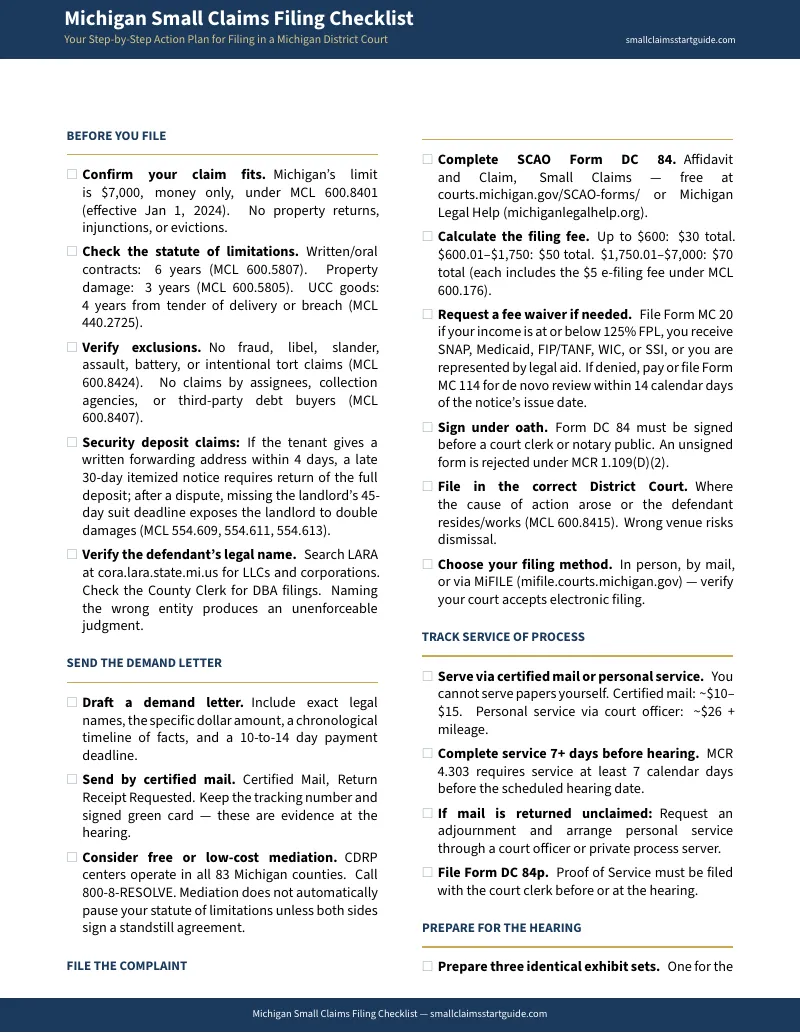
Every step on one page — from entity verification through the hearing — with the forms, fees, and deadlines filled in. Print it, check off each step as you go, and know exactly where you are in the process at any point.
Who This Is For
- Tenants owed a security deposit. Your landlord had 30 days to return your deposit or send an itemised statement of deductions. If they failed to act within 45 days, you may be entitled to double the amount wrongfully withheld. The guide covers the statutory timelines, the objection letter, and how to calculate your claim.
- Homeowners with a contractor dispute. The contractor took your deposit and disappeared, or the work is defective. The guide covers naming the correct entity, documenting incomplete work, and presenting repair estimates.
- Small landlords owed rent or damage costs. Your former tenant left owing rent or caused damage beyond normal wear. The guide covers locating a former tenant for service and documenting damage with inspection records and repair invoices.
- Sole traders and freelancers with unpaid invoices. A client stopped paying. The guide covers suing a business entity, presenting an invoice trail, and the five-case-per-week filing limit for businesses.
- Buyers refused a refund. You paid for something that never arrived or did not match the description. The guide covers identifying a business's registered agent and selecting the correct venue.
- Anyone owed money in Michigan who wants to handle it themselves. If your claim is $7,000 or less and you would rather spend an evening with a step-by-step guide than an afternoon on hold with the court clerk, this is for you.
Why Not Just Use the Free Court Resources?
You should use them — and the guide tells you exactly when and where. The Michigan Courts website publishes every SCAO form you need, and Michigan Legal Help offers guided interviews that fill out Form DC 84 and Form MC 20 for you. Community Dispute Resolution Program centres offer free mediation statewide.
What the free tools do not do is put the information in the order you need it. SCAO publishes forms as isolated templates with basic instruction sheets. Michigan Legal Help generates completed forms but does not supply a trial binder, exhibit index, service log, or deadline calendar. The court's information is organised by topic — one page for fees, another for service, another for the hearing — not by the sequence you actually work through.
The guide does the organisational work: every form, every fee, every deadline, in the order you encounter them, with printable worksheets you can take to court. It sits between the free information (which you still need) and a $100–$300 filing service (which submits your paperwork but does not prepare you for the hearing).
What This Is Not
This guide explains the procedure. It does not give legal advice, predict outcomes, or tell you how to argue your case. It is not published by, affiliated with, or endorsed by the Michigan Judiciary, the State Court Administrative Office, any District Court, or any government agency. If you need legal advice, contact a lawyer. If you need free help, the guide lists the resources available in your area, including Michigan Legal Help's self-help tools and legal aid organisations.
Satisfaction Guarantee
Full refund, no time limit. If the guide is not what you expected, email [email protected] and we will refund you — no questions, no deadline.
Get Started
Download the free Michigan Small Claims Filing Checklist — a one-page summary of the limit, forms, fees, service steps, and deadlines. If you want the full guide with step-by-step instructions, a service log, an exhibit index, and the deadline calendar, get the complete Michigan Small Claims Filing Guide for .
Frequently Asked Questions
What if the rules change after I buy?
We update the guide when the rules change. Email us any time, even years later, and we'll send you the current edition free.